Credit: (Edwin J. Torres/Governor's Office)
In addition to hundreds of millions of dollars in spending, the Democrats controlling New Jersey’s budget process added or changed 48 pages in the bill to divert money from dedicated funds, give a pass to poorly performing nursing homes and attempt to maximize federal Medicaid payments as Congress moves to cut Medicaid funding.
Late Monday night, Gov. Phil Murphy signed the nearly $59 billion budget he negotiated with Democratic leaders in the Legislature.
The details of the language changes are contained in a document prepared by the nonpartisan Office of Legislative Services. Many of the legislative language changes are technical in nature and others are relatively minor — one specifies at least $850,000 be allocated for a loan redemption program for reproductive health primary care practitioners. Others make a significant impact and have rankled some advocates and unions.
For instance, language was included that increased raids on the state’s Clean Energy Fund, by $125 million to $190 million. Utility customers pay a surcharge on monthly energy bills into the fund and the money is supposed to help New Jersey achieve its climate policy goals and transition to renewable energy. But governors and legislators have been taking money from the fund to help plug fiscal holes for more than a decade, with more than $2 billion in ratepayer money used for other than its legally dedicated purposes over time. The additional diversion includes $50 million to go to the general fund and another $70 million to New Jersey Transit.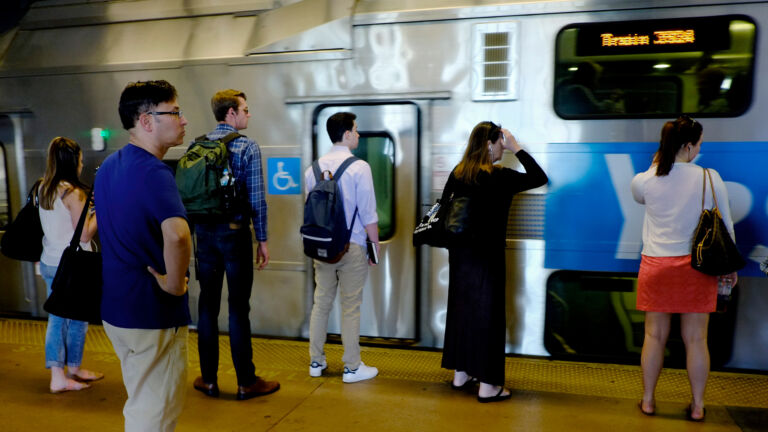
Fund diversions
Ed Potosnak, executive director of the New Jersey League of Conservation Voters, said this year’s raid reaches “levels not seen since the Christie administration” and that “may delay projects that will lower energy costs for working families while also ensuring that New Jerseyans can breathe cleaner aid — especially at a time when Washington, DC is stepping back.”
Other fund diversions written into the budget by Democratic lawmakers include $100 million from the Affordable Housing Trust Fund that is supposed to be used for housing construction for other housing-related programs and $45 million from the opioid settlement fund dedicated to new evidenced-based drug interventions to four hospitals. The opioid fund diversion was done in language added to the budget at the last minute.
A benefit for poorly performing nursing homes
In a post on the social platform X, acting State Comptroller Kevin Walsh criticized another last-minute change in budget language that will allow the “worst nursing homes” to continue to receive Medicaid funds and new patients. That overrides a policy adopted by the state Department of Human Services that allows managed-care organizations to stop funding new admissions to these nursing homes until their quality improves. Walsh wrote that his office found the state spends $100 million every year on the worst-performing nursing homes, which he said provide “inadequate care to New Jersey’s most vulnerable population.”
Like the resolutions that added hundreds of millions of dollars in spending for lawmakers’ preferred projects, known as Christmas tree items in New Jersey, language resolutions can be sponsored by legislators, as well as the governor’s office and its administration. None of the specific resolutions that are supposed to include justifications for the additional spending and language changes, as well as who sponsored them, are available for scrutiny even though the budget has been passed and signed into law. If last year is any indication, that information won’t be made public for another month.
Public-worker health care
One resolution added that has drawn the ire of 10 public sector unions spells out the process for determining $100 million in savings from the state health benefits plan. It allows for the state and union officials to submit proposals and for the State Health Benefits Plan Design Committee to vote on one by Sept. 30. Barring that, there are provisions for mediation, for representatives of the governor and unions, potentially with a tiebreaker, to hammer out a savings plan by Dec. 15 at the latest.
“This is a targeted attack on the healthcare of state and public higher education employees,” said Rebecca Givan, president of Rutgers AAUP-AFT union. “Increasing our healthcare costs means our members and families will delay or decline care. This is an unnecessary and vicious attack on our health and our collective bargaining agreements.”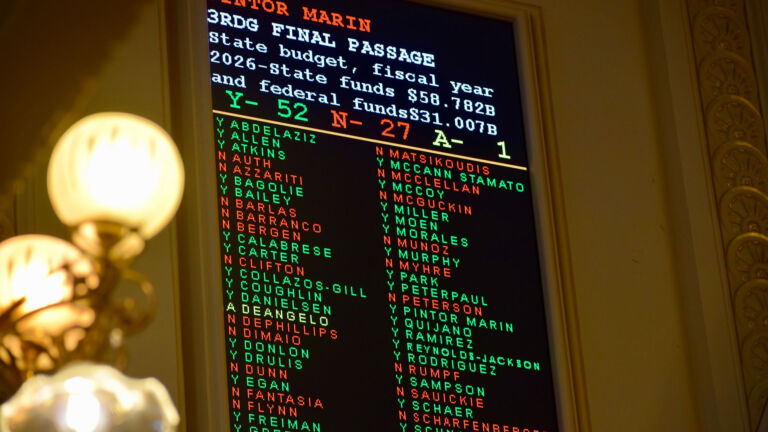
But the elaborate process outlined in the budget language might not be used. In a statement released after the Assembly passed the budget, Majority Leader Lou Greenwald (D-Camden) said lawmakers learned last week that the state had gotten $200 million in unanticipated revenue and that “it’s clear that there is no immediate need to require state workers to pay more for their health benefits.” Speaker Craig Coughlin (D-Middlesex) called for public hearings this month on public worker health benefits, potential premium increases and options to identify savings.
Other written resolutions
Other noteworthy resolutions written into the budget include:
- Several permit fund transfers involving programs at seven hospitals — five of which got a total of $24 million in state budget addons this year — to “maximize federal Medicaid payments” to physicians and other professionals. Among the programs are a modernization and expansion at The Children’s Hospital at St. Peter’s University Hospital, a palliative care pilot at Holy Name in Teaneck and a shelter and health program at RWJBarnabas Health involving Hudson, Union and Ocean counties.
- One permits the issuance of $250 million in higher education bonds, with New Jersey City University eligible for $50 million for deferred maintenance and other capital needs.
- Another allows candidates for governor to use state matching funds for security costs for themselves, their family and staff.
- There is a change in the allocation of more than $110 million from cannabis fees, including $8 million for anti-violence summer youth programs in four cities that in the past have been funded through general revenues as legislative add-ons and $35 million in transitional aid to municipalities.
- Up to $8.2 million in funding in the Department of Human Services’ budget would be used for legal services and related costs for people at risk of detention or deportation, in addition to $5.4 million for the Kids in Need of Defense (KIND) program to provide legal representation to unaccompanied children in the state.