Credit: (AP Photo/Seth Perlman, File)
 Six months ago, Gov. Phil Murphy called for a broad reform of parole to reduce the frequency of people who make small mistakes winding up back in prison in New Jersey. A month later, as part of his budget plan, he announced East Jersey State Prison would be closed and $30 million in savings would result from the reform.
Neither of those things happened, at least not yet.
Misconceptions about the impact of the proposal, pushback by parole officials and a lack of time to gather consensus have delayed the plan. Whether those issues can be ironed out before Murphy leaves office in mid-January is unclear.
During his State of the State message in January, Murphy touted recent pardons he issued and said the state needs to give more people a second chance.
“Roughly 10 percent of our state’s entire prison population consists of people who are being held behind bars for committing a technical parole violation, like missing a scheduled meeting or forgetting to report a move to a new town,” Murphy said. “Nobody should lose their freedom because of a technicality.”
Technical violations
Technical parole violations include missing a check-in with a parole officer, not asking permission before changing an address, not alerting an officer of a residence change, and substance use. Murphy called on lawmakers to pass a reform that would impose sanctions smaller than parole revocation for technical violations, perhaps spending a weekend in jail, with the severity of sanctions increasing with each additional violation. Revoking parole could still happen when criminal parole violations occur. Other provisions of the reform would allow parolees who follow all the rules to shorten their supervision more quickly and raise the standard needed to keep a parolee in prison from whether he might commit another violation to whether he might reoffend.
According to state officials, there were more than 1,000 people in state prison after their parole was revoked for technical violations regarding the terms of their parole supervision, rather than a new criminal offense. The Department of Corrections said, in budget documents, that reducing the prison population by between 800 and 900 over a sustained period would allow it to close East Jersey State Prison, which is almost 125 years old and has a population of roughly 1,100. Murphy’s budget proposal put the savings in this fiscal year, which started July 1, at $30 million. In the 2027 fiscal year, the savings would jump to $50 million, according to answers corrections officials provided to legislators. Closing the prison, which is in Woodbridge, would avoid an estimated $350 million in needed capital improvements.
Last year, 87% of people represented by the public defender’s office at parole hearings were there for technical violations.
Since the 2020 fiscal year, the state has closed four prisons, saving $97.9 million, although it reopened a portion of one of those to house roughly half of the women who had been incarcerated at the Edna Mahan Women’s Correctional Facility.
Support — and resistance
Social justice advocates and organizations praised Murphy’s proposal. Among them was the state Office of the Public Defender, which issued a report last year pointing out what it considered problems with the state’s “broken” parole system.
But while summaries and bill drafts were shared among the governor’s office, legislators and staff, a final, comprehensive parole reform bill, including changes in sanctions for technical violations, was never introduced.
“There was a lot of kind of back and forth between all of the parties, and I think a lot of information that was getting out there about what the bill did and what it didn’t do, some of which was accurate, some of which was not, and it just seemed like everybody wanted to take a step back and make sure that we get it right,” said Jennifer Sellitti, the state public defender. “It just felt like everything was in a little bit of a rush. And I think that we’re at a point where people want to make sure that the bill does what it’s intended to do, no more, no less, and then all of the parties who are at the table are going to be comfortable with a new scheme of parole moving forward.”
It seemed clear from the statement by Samuel Plumeri, chairman of the New Jersey State Parole Board, at budget hearings during the spring that his office was not fully on board with what was being discussed at that point.
Early in his statement to the Assembly Budget Committee on April 28, Plumeri referenced a report on the state’s parole system that recommended the board develop a “structured remedial action tool for parole officers to ensure consistent, equitable, and effective responses to parole violations.”
That report was written by Alexandra Walker of the Alliance for Criminal Justice Innovation and paid for by the National Institute of Corrections.
Plumeri also said the parole board was taking other steps to reduce technical violations, including the institution of parole assessment centers that have diverted 440 parolees from the revocation process. And he said the state’s parole revocation rate had been below 7% over the last five years, while the national average is close to 11%.
That the state revocation rate is lower than the nation’s is “a clear reflection of the agency’s long-standing commitment to effective, well-maintained policies over the past two decades,” Plumeri said.
By the numbers
Data in budget documents shows that in cases where parole violations result in a revocation hearing, more than three-quarters of parolees wind up having their parole revoked, although that percentage has been declining over the last decade.
Sellitti said that while revocations have been declining, the number is still high: Last year, 87% of people represented by the public defender’s office at parole hearings were there for technical violations.
“Worse still is that 99% of the people we represent were held pending the outcome of their revocation hearing,” Sellitti said. “So 87% of that 99% are not there because they committed a crime.”
Even the potential of revocation can be devastating, she said. It can take several months for a hearing to be held and in that time, a person may have lost a job, lost housing and lost more time with family.
‘It just seemed like there was a lot of difficulty in separating fact from fiction when it comes to what’s in this bill, what it’s going to do and, quite frankly, areas of negotiation…’ — Jennifer Sellitti, state public defender
“Whether it’s four weeks or four months, we are really doing a disservice to people who are committing non-violent technical violations, and perhaps now setting them back,” Sellitti said. “They’re walking out of county jail all over again and starting over.”
And violating parole conditions can be easy to do, she said. If someone doesn’t have an apartment, they may be couch-surfing and sleeping with different friends at different addresses on different nights. If they don’t have a job, they may not have the money to travel to the parole office.
‘Much more complex’
Plumeri told lawmakers in the budget hearings that parole officers need to know where a parolee is living and need to have regular communication with them as a matter of public safety; he said parolees are told the importance of following all the rules and that their parole can be revoked if they do not comply with all the conditions of their release.
“The simplification of technical parole violations is much more complex, in my view,” Plumeri said. “We take public safety very, very seriously, and we don’t just cavalierly violate people … What we do in terms of those violations are meaningful, and they’re not without steps that we haven’t taken.”
During the Senate Budget Committee hearing on May 13, Sen. Doug Steinhardt (R-Warren) called Murphy’s State of the State message that people were being sent back to prison solely for technical violations a “fraud.” When he asked Plumeri if anyone during his quarter century with the parole board had had parole revoked solely because he was not living where he was supposed to be, had failed to get permission to move, had missed a meeting with an officer or had used drugs or alcohol, Plumeri answered, “No, sir.”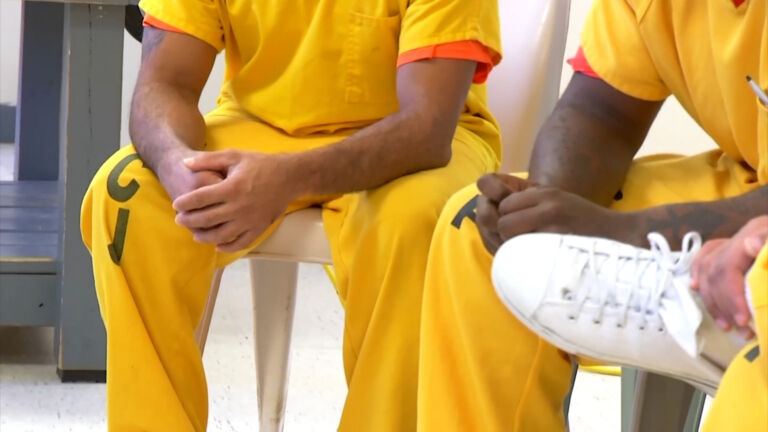
After about 15 minutes of Steinhardt’s questions and criticism of the proposal, Sen. Paul Sarlo (D-Bergen), who chairs the committee, said that while it would be better to have a bill to debate, there appeared to be opposition to the proposal.
“Clearly, it’s something that I would not support, and I’m sure many members of this committee would not support, and I think I heard it from the chairman that he has significant issues as well,” Sarlo said.
A case of misconceptions?
Sellitti said discussions of the concept without having an introduced bill only fed misconceptions about the reform.
“It just seemed like there was a lot of difficulty in separating fact from fiction when it comes to what’s in this bill, what it’s going to do and, quite frankly, areas of negotiation, because there were some things that we could work through — we have worked through,” she said.
Among the misconceptions were that violating a domestic violence restraining order or that a sex offender’s change of residence without notification would be considered technical violations. Both are serious violations and would be treated as such, Sellitti added.
‘We hope to see the bill passed by the end of the year.’ — Tyler Jones, spokesman for Gov. Phil Murphy
The inaction left social justice advocates who had been supporting the reform disappointed.
“This leaves New Jersey behind even more conservative states,” said Marleina Ubel, senior policy analyst with New Jersey Policy Perspective, a progressive think tank.
In announcing the proposal, Murphy had said that such “deep red” states as Louisiana and South Carolina had already enacted a similar parole reform.
Murphy is ‘more committed than ever’
It’s unclear whether the proposal will get introduced once lawmakers go back into session, potentially not until after the election in November.
Sellitti said her office is continuing to work with the parole board, governor’s office, lawmakers and other stakeholders on a proposal all sides can agree on to improve the system while still ensuring that parolees who commit more serious infractions face parole revocation.
“It’s something that we really believe in, something we would like to see happen, and are doing everything that we can to work with our partners to put together something that both helps people not be re-incarcerated over technical violations and helps them rebuild their lives and, at the same time, protects public safety,” she said.
A spokesperson for Murphy said the governor is “more committed than ever” to getting this reform done.
“The Governor’s Office has been working collaboratively with legislators and policy experts to draft legislation reforming penalties for technical parole violations,” said Tyler Jones. “We hope to see the bill passed by the end of the year.”
— Charts by Colleen O’Dea
This story is made possible in part by the Corporation for Public Broadcasting, a private corporation funded by the American people.