Editor’s note: This story was last updated at 11 p.m., June 10.
Democrats and Republicans on Tuesday finished voting in what became a historic primary race in New Jersey: the first partisan election with no party line ballots and the most expensive race for governor on record.
Polls closed at 8 p.m. Tuesday after weeks of early voting that saw nearly 12% of registered Democrats and Republicans vote.
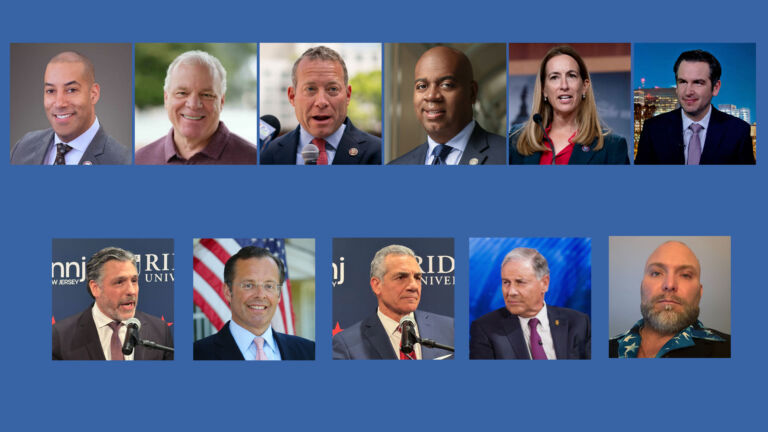
The open governor’s seat — Democrat Phil Murphy cannot serve more than two four-year terms — drew the most crowded New Jersey gubernatorial field in decades, with most of the candidates well-funded. At least two candidates, Democrats Steve Fulop, mayor of Jersey City, and Steve Sweeney, union leader and former president of the state Senate, had planned to run in 2017 but did not once it was clear Murphy would get county Democratic endorsements and largely self-finance his campaign. On the Republican side, Jack Ciattarelli made his third attempt at the governor’s office.
What the victors said
Shortly after polls closed Tuesday, The Associated Press called the Republican primary for Ciattarelli, with 17% of GOP votes counted.
The AP called Sherrill the winner of the Democratic primary at 8:39 p.m., with 32% of Democratic votes counted.
“In New Jersey we know how to make history,” Sherrill told supporters, recalling George Washington’s famous crossing of the Delaware River. “And here we are nearly 250 years later and once again New Jersey stands at the front lines. We are in an American crisis — but not a fight for independence, but for our future.”
Sherrill promised to fight for affordability — claiming Ciattarelli raised taxes as a local and state politician — abortion and community. “I am going to protect your kids online and create a better future for them,” she said. “I’m going to protect our rights, including a right to an abortion. Jack has pledged to implement an abortion ban and defund Planned Parenthood.”
And Sherrill worked to tie Ciattarelli to President Donald Trump: “A state like this is not going to be led by a Trump lackey like Jack Ciattarelli,” she said.
“I am ready to shake up the status quo. And Jack is the status quo,” she said. “He’s a ghost of elections past,” she said, adding later, “If Jack Ciattarelli is the ghost of elections past, then tonight we write the future.”
Ciattarelli promised to reach out to communities of color, unaffiliated and independent voters and Democrats who are frustrated with their party. “I will go places other Republicans won’t,” he said.
“Tonight, because of you we won all 21 New Jersey counties,” Ciattarelli said in his victory speech. “We won because our campaign is about people, not politics. Our campaign is about vision, not division.”
Ciattarelli pledged to end protections for immigrants, stop suburban sprawl, overhaul the public school curriculum and reduce the size of state government. “New Jersey, I truly believe the future of our state hangs in the balance,” he said, promising a campaign that will be “all gas, no breaks.”
“Guys I’ve had it. It’s time for a change,” Ciattarelli said. “It’s time for a Jersey guy who understands what people are up against every day,” he said, describing himself as a “common-sense problem solver” and a “hands-on CEO” for the state.
Record spending
This is also the first year for a governor’s race under a 2023 campaign finance law that appears to have opened the door to this year’s record spending by independent groups backing candidates. Together, candidate campaigns and the state, federal and nonprofit committees backing them have spent more than $151 million since 2022, according to an NJ Spotlight News analysis.
The 11 major-party candidates spent close to $55 million, including $37 million in public matching funds. Independent committees, which by law are prohibited from coordinating with candidates, spent another $96 million. Nearly half that, or $46 million, was money given by the New Jersey Education Association through its political committee to two other groups backing its president Sean Spiller since 2022.
In the Democratic race, each of the major candidates tried to carve out a lane to victory: Fulop and Newark Mayor Ras Baraka were the progressives, U.S. Rep. Mikie Sherrill (D-11th) presented herself as a moderate with significant party support in north and central Jersey. Sweeney was the South Jersey candidate with state government experience and labor support. U.S. Rep. Josh Gottheimer (D-5th) was laser focused on affordability and pledged to cut property taxes and Spiller was the teachers’ candidate, backed by an extraordinary amount of money for a single candidate in New Jersey.
Affordability was top of mind among voters, followed by housing and democracy issues, according to the latest independent poll taken in early May by Emerson College Polling.
On the Republican side, state Sen. Jon Bramnick (R-Union) sought to appeal to the moderate wing of the party, which once dominated in New Jersey elections. Ciattarelli led in most polls and was considered the favorite after Trump endorsed him. Former talk radio host Bill Spadea billed himself as the most MAGA candidate. Mario Kranjac, the former Englewood Cliffs mayor, and Justin Barbera, who owns a construction firm, spent little money and factored little in the race.
Bramnick, Ciattarelli and Spadea received public matching funds and appeared in two state-mandated debates, as did all the Democrats except Spiller, whose campaign did not raise enough money individually to qualify. But all the candidates participated in other forums, some with a mix of Democrats and Republicans, since the beginning of the year.
Spadea ‘not going anywhere’
Spadea said the conservative ideals his campaign endorsed were the concepts that motivated Republican voters, including the ones who chose Ciattarelli. Spadea, who said he would continue to advocate on issues like gun access and opposition to people who are transgender, urged his supporters to not let doubters on social media get them down.
“The career politicians have failed. They have failed our state,” said Spadea, a former radio host. “I gotta tell you this, I’m not going anywhere.”
“We did not lose this race because of what we did,” Spadea said, noting his campaign was outspent and accusing others of telling lies and launching “vicious attacks” against him. “And it didn’t help that the president of the United States came in here and supported a Never-Trumper,” he said, referring to Ciattarelli. “The other guy ran on our policies. Our issues won this election.”
Concession speeches
Baraka, who was running second behind Sherrill with 87% of Democratic votes counted, urged Sherrill’s campaign to include progressive priorities. “The majority of people want change,” he said. “I hope [party leaders] start paying attention to some of the marginalized voters in the party and bring the party together.”
Urging party unity, Baraka said, “We can’t let Ciattarelli win.” Later, he said, “we need to bring the party together from all the nooks and crannies of the state.”
But, Baraka cautioned, “We’re going to have to have some talks in the Democratic Party about what this party should be,” adding there’s a need for more input from working-class families. “We need to lift the party up and get people involved.”
Spiller was backed by an extraordinary amount of money for a candidate who did not resonate with a statewide audience.
“We always knew what we were up against when we started this. When you take on machine politics, when you take on the big money, the special interests, it’s not going to be easy. It’s never going to be handed to you,” Spiller told a crowd of about 85 supporters in Montclair while conceding the race. “But we launched this because we knew that it’s a vision that should matter, that it’s fighting for what our working families here in New Jersey need, that should matter.”
Supporters said the campaign helped raise issues that are important to educators even though Spiller lost the nomination.
“There’s a lot to process in these results, a lot to think about,” Fulop told supporters at a beer garden in Jersey City, his voice hoarse. “I do feel we were right on the message, we were right on our intentions,” he said, adding that he “wouldn’t change anything” about his two-year push to be governor.
“The state is at a crossroads. Although tonight wasn’t what we wanted,” Fulop said, “we have to work hard to make sure a Democrat gets elected in November.”
Gottheimer said Democrats need to campaign on “a commonsense approach” to win.
“From day one, our campaign dared to strive and achieve greatly — to think big and take risks. We thought outside the box of today’s conventional Democrats,” he said in a statement. “We developed new ideas and pushed them relentlessly — ideas that would make our great state even greater, that would grow it, and help those struggling to get by — and we took on Trump and anyone who messed with Jersey families.”
Voters’ issues and interest
Affordability was top of mind among voters, followed by housing and democracy issues, according to the latest independent poll taken in early May by Emerson College Polling. While different positions by candidates in the GOP field gave voters some clear reasons to support or oppose an individual based on issues, that was tougher on the Democratic side. Most of the Democratic candidates agreed in principle on many key questions, with the differences in the details. That led to some voters being undecided late in the campaign.
Campaign financial activity was robust in Assembly races as well. Candidates raised more than $26 million, with almost $4 of every $5 taken in by incumbents, according to the state Election Law Enforcement Commission.
These primary elections got the attention of New Jersey voters, most of whom tend to ignore nonfederal election years, and primaries in particular. Fewer than a quarter of registered Democrats and Republicans vote in a typical year. But more than 12% of registered partisans — close to 481,000 people — had voted early, either in person or by mail as of end of day Monday.
Mail-in ballots postmarked or placed in drop boxes by 8 p.m. on Election Day can still be counted for another six days, so final turnout numbers won’t be known for at least a week, but the total could easily exceed the 786,000 high for a gubernatorial primary this century.
Assembly primaries
There are an unusually large number of contested Assembly primary elections this year — in 23 districts for Democrats and six for Republicans — and these may have drawn higher early in-person turnouts, in Hudson and Bergen counties in particular.
Those Assembly results, and the gubernatorial results, could give an indication of the impact of the new ballot design being used statewide by both parties this year. There was no county line, but those county party endorsements appeared under candidates’ names on ballots. Offices are arranged in a block style on the redesigned ballot, with the candidates for each office listed within the same block.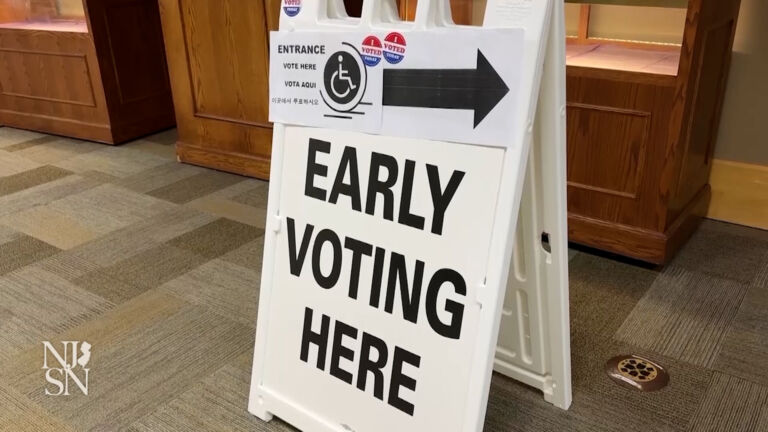
Among the Assembly races considered the most competitive were the three districts representing Hudson County — the 31st, 32nd and 33rd — where slates of candidates running with Fulop as “Democrats for Change” faced off against county-endorsed candidates and, in the 32nd, a third slate of Hoboken Mayor Ravi Bhalla and Katie Brennan. The 37th and 38th districts in Bergen County also were contentious.
Campaign financial activity was robust in Assembly races as well. Candidates raised more than $26 million, with almost $4 of every $5 taken in by incumbents, according to the state Election Law Enforcement Commission. They spent $15.3 million as of May 30, with incumbents spending about three times more than challengers. That only includes spending by the candidates and not by independent committees.
— Lilo H. Stainton contributed reporting.