Credit: (Hannah Gross/NJ Spotlight News)
Despite spending more than $40 million in teachers’ dues, the president of the New Jersey Education Association landed a fifth-place finish in the race to become the Democratic nominee for governor.
Supporters at Sean Spiller’s election night watch party at Montclair Brewery said that record-high spending was worth it since Spiller’s campaign helped elevate issues important to teachers and working-class people. The union’s spending on behalf of its president contributed to making Tuesday’s election the most expensive race for governor on record in New Jersey.
Spiller’s campaign raised the least amount of money of the six Democrats running to replace Gov. Phil Murphy, raising $438,817 through May 27. But an independent committee funded by the NJEA had $40 million to spend on promoting Spiller’s campaign, making him the highest-funded candidate in the race by about $20 million. That’s based on a review by New Jersey campaign finance officials of state-based independent campaign committees.
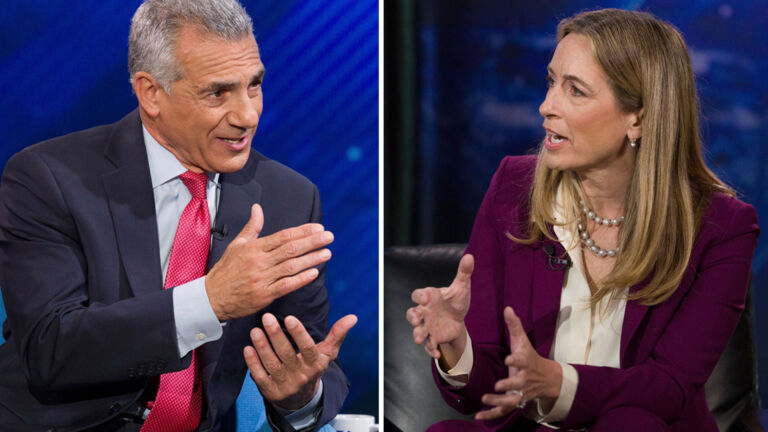
In the end, the spending wasn’t enough to defeat Rep. Mikie Sherrill (D-11th) who will face former Assemblyman Jack Ciattarelli, the Republican nominee. Spiller congratulated Sherrill and in his concession speech Tuesday night said he will continue raising issues important to educators and working-class people.
“We’ve got to center the issues of working-class people too, and we’re going to make sure that’s front and center in everything that she’s fighting for as she takes on Jack Ciattarelli,” Spiller told NJ Spotlight News.
NJEA’s political track record
The NJEA, long considered one of the state’s most powerful and politically active unions, has a history of getting involved in state political races, but not to the tune of $40 million or in support of one of its own leaders.
It spent more than any other interest group in 2021 to help reelect Gov. Phil Murphy, contributing more than $15 million over three years.
And it targeted Democrat Steve Sweeney during one of his reelection campaigns for state Senate. As Senate president, Sweeney engineered pension and benefit reforms in collaboration with Republican Gov. Chris Christie. The union’s political arm spent $5.4 million in 2017 against Sweeney, at the time a record for spending in a legislative race, and $6.7 million in total on elections that year.
Sweeney won that election. He lost Tuesday in his bid to run as a Democrat for governor, coming in sixth place with roughly 28,000 fewer votes than Spiller, in unofficial returns as of Wednesday.
Spiller’s argument
“When it’s one of our own, when it’s an educator, when it’s us, all of a sudden it’s a big story,” Spiller said about questions on the NJEA spending. “Why do we always have to hand it to someone else for it to be OK? We decided we don’t have to do that.”
About one month after the decision was made to spend $40 million on supporting NJEA’s endorsed candidate, Spiller announced his candidacy.
Spiller, the former mayor of Montclair, said his campaign showed that working-class people can pool their money to get working-class people elected. The electorate has been conditioned to be OK with big money from Wall Street or developers, but not from teachers, he said.
 Credit: (Hannah Gross/NJ Spotlight News)
As president of the union, Spiller works to strengthen public education in New Jersey and help members become more involved in their communities, according to the group’s website. Spiller was paid about $370,000 plus an additional $70,000 in other compensation in fiscal year 2023, according to the union’s tax filings.
The road to $40 million
NJEA decided to commit to spending $40 million to elect a governor who “prioritizes public schools and employees” in May 2024, about one month before Spiller officially entered the race, according to NJEA spokesperson Steve Baker. The NJEA-aligned super PAC Garden State Forward was spending money to raise Spiller’s profile and gain name recognition since 2022 through a nonprofit called Protecting Our Democracy.
NJEA’s Delegate Assembly, a body of about 150 elected union members, approved spending $20 million in assets from fiscal years 2023-24 and 2024-25 on independent expenditures related to the gubernatorial election. Garden State Forward contributed the $40 million to the independent expenditure group Working New Jersey, which supported Spiller’s candidacy.
“New Jersey needs and NJEA members deserve a governor who shows a willingness to work with the NJEA to keep the public schools in New Jersey #1, who believes in improved educator salaries and benefits, and who will continue our progress toward a just and secure retirement,” reads the spending authorization voted on by the union’s Delegate Assembly.
The Delegate Assembly is made up of about 150 union members elected by rank-and-file members in each of the counties and in specific groups, such as higher education, aspiring educators and retired educators. Delegate Assembly meetings are advertised and open to all members, Baker said.
Spiller’s candidacy
About one month after the decision was made to spend $40 million on supporting NJEA’s endorsed candidate, Spiller announced his candidacy. He then earned the endorsement of NJEA’s 150-member PAC Operating Committee. That committee mainly includes members who are elected to other positions, such as the executive committee, Delegate Assembly or local or county office, according to Baker.
“Unions are allowed under Citizens United to fund independent expenditures through the use of union dues,” Baker said. “NJEA does that.”
‘It’s hard to find the value for teachers in this $40 million-plus investment.’ — Micah Rasmussen, director, Rebovich Institute for New Jersey Politics
The independent expenditure group Working New Jersey spent about $37.5 million as of May 27. This includes $19.1 million on media, $8.7 million on political consulting, $5.6 million on direct mail and $2 million on billboards and signs.
Some NJEA members also contributed directly to NJEA’s PAC, which can be used to support campaigns directly. Members participated in get-out-the-vote efforts, such as canvassing and phone banking. Any NJEA staff who worked for the campaign did so on a voluntary basis after work hours, Baker said.
Supporters undaunted
Dan Siegel, an elementary Spanish teacher in the West Windsor-Plainsboro Regional School District, said he voted for Spiller because he wanted a strong supporter of public schools as the next governor. Even though he didn’t win, Siegel said Spiller served as a vehicle for highlighting issues important to educators, such as the teacher shortage, mental health and affordability.
“We’re putting our issues out in the forefront, and I think that forced the other candidates to say, ‘Oh, jeez, these educator issues are important,’” Siegel said moments before Spiller conceded the race. “I’m hoping that Mikie Sherrill can see that.”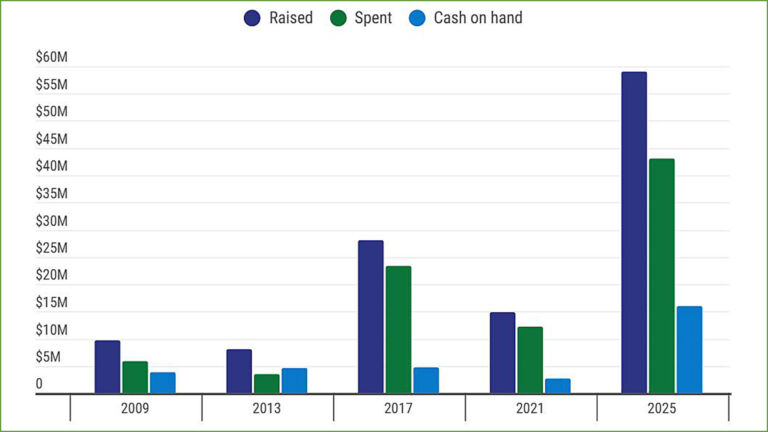
To critics, the high price tag for awareness raising may not have been worth it.
“It’s hard to find the value for teachers in this $40 million-plus investment,” said Micah Rasmussen, director of the Rebovich Institute for New Jersey Politics. “I don’t think there is any evidence I can find that it led to a bigger discussion on the plight of teachers. It didn’t lead to, I think, an improved climate for teachers.”
Rather, the high spending may have created more backlash than benefits, Rasmussen said. He estimates the union spent around $500 per vote, the highest of any candidate, although both votes cast and the money spent in this election are still being counted.
Mike Lilley, president and founder of the Sunlight Policy Center, a group critical of how NJEA leadership spends its money, called the record spending on Spiller’s campaign wasteful. His group estimates Spiller spent $545 per vote. Spiller received 85,475 votes, or about 10.7% of the total number cast, with 94% of votes counted.
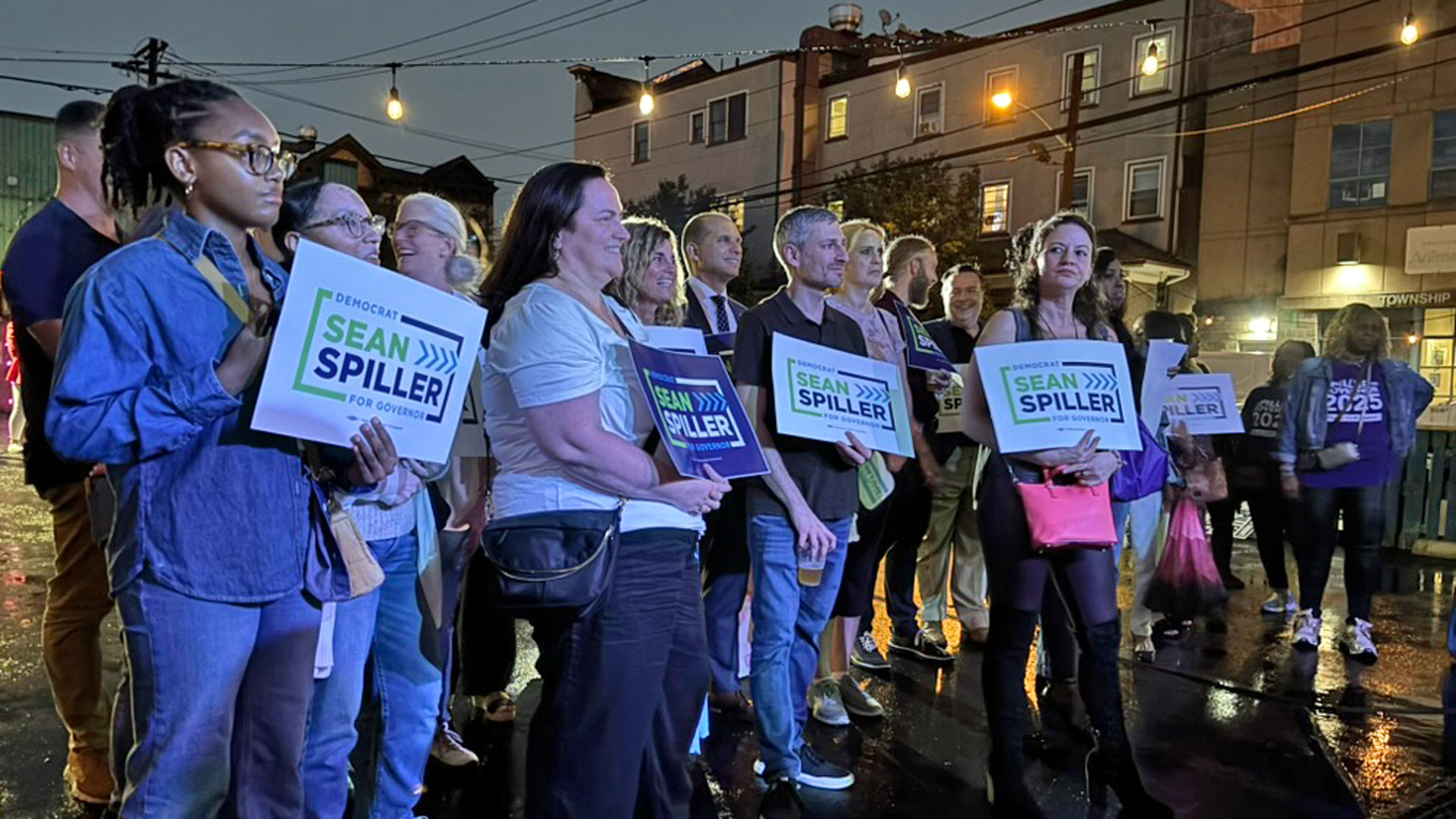
At Spiller’s election night party, the crowd of about 85 people was a mix of NJEA staff and union members, plus Spiller’s friends and family.
Tyeisha Jefferies, a third grade English Language Arts teacher in Camden County, said Spiller was the candidate she could trust to look out for her interests as an educator, including pension benefits and rising health care costs. She said the union’s spending on his campaign was “absolutely” worthwhile.
“I’d do it all over again,” Jefferies said, referring to the high campaign spending.
— Colleen O’Dea contributed reporting.