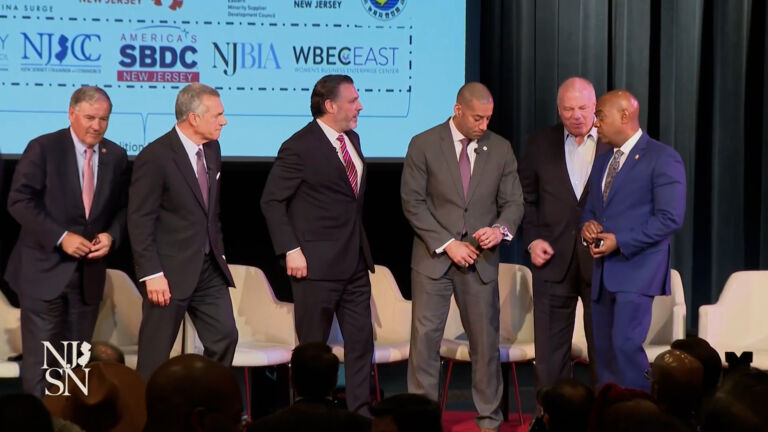
Credit: (Spiller campaign; Sweeney campaign; AP Photo/John Minchillo; Newark Mayor's Office; AP Photo/Andrew Harnik; NJSN; AP Photo/Mike Catalini; Kranjac campaign; AP Photo/Mike Catalini; Steve Hockstein/NJ Advance Media via AP, Pool; Barbera campaign)
Registered voters in a recent poll on the New Jersey governor’s race cited democracy as one of their top issues. The topic covers a lot of ground and not every one of the 11 major-party candidates has addressed it, though the candidates offer noteworthy differences on voter registration and elections.
Democrats are more likely to support same-day voter registration, while Republicans are more likely to require voters to show identification when going to the polls. But there are nuances among the candidates’ positions.
Various candidates mentioned a number of other issues related to democracy as an issue and the related topic of transparency in government, including controversial changes made last year to the state’s Open Public Records Act (OPRA) and campaign finance laws.
All the Democrats running for governor also pledged to fight President Donald Trump’s policies. One of the five Republicans running in their primary said he would oppose Trump when he disagrees with him or when his policies hurt New Jersey.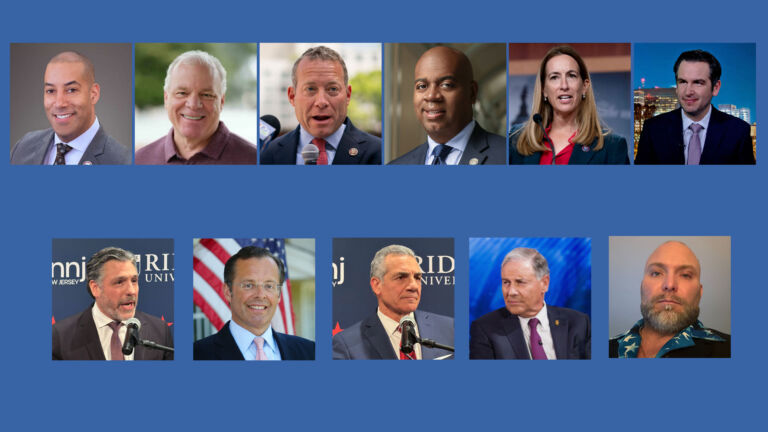
NJ Spotlight News pulled together candidates’ positions ahead of the June 10 primary election. In-person early voting starts Tuesday at 10 a.m. and continues through Sunday, with polls closing at 8 p.m. Tuesday through Saturday and at 6 p.m. on Sunday.
The candidates
Democrats: Ras Baraka, mayor of Newark; Steve Fulop, mayor of Jersey City; Rep. Josh Gottheimer (D-5th); Rep. Mikie Sherrill (D-11th); Sean Spiller, president of the New Jersey Education Association; Steve Sweeney, union leader and former president of the state Senate.
Republicans: Justin Barbera, owner of a construction firm; Sen. Jon Bramnick (R-Union); Jack Ciattarelli, former state Assembly member; Mario Kranjac, a lawyer and former mayor of Englewood Cliffs; Bill Spadea, former talk radio host.
Positions on democracy
DEMOCRATIC CANDIDATES
Sweeney
 Credit: (Sweeney campaign)
Sweeney does not list any democracy-related positions on his website. In a nod to transparency, he releases his state and federal income tax returns, something not required by state law. As president of the Senate, Sweeney said a bill to bring same-day voter registration would not pass in the Senate because many members of the Democratic majority did not support it.
On the campaign trail, Sweeney said he is “not afraid of anybody” and would stand up to Trump and all the actions he is taking that are impacting New Jersey.
In an interview on NJ Spotlight News program “Chat Box” about how to limit the influence of money in politics, Sweeney said that because of U.S. Supreme Court rulings, “You can’t stop it.”
Spiller
 Credit: (NJEA)
On his campaign website, Spiller devotes a page to “Protecting Democracy,” where he talks about defending the state against actions by Trump that show “reckless disregard for our constitution, separation of powers and established law.” Spiller said he would appoint an attorney general who would “use every legal means to defend our residents from Trump’s intimidation and fight attempts to take away funding critical to our state.” Spiller would bring back the Office of the Public Advocate, created in 1974, abolished in 1994, reinstated in 2005 and last abolished by former Republican Gov. Chris Christie, to lead the response to threats from the federal government.
Spiller said he would increase governmental transparency by strengthening the state’s public records law while protecting individuals’ privacy and data. He would establish rules for the use of artificial intelligence in election campaigns. He also said he would support same-day voter registration and expand programs to increase voter registration and engagement, especially in communities with low voter turnout. He would protect the Freedom to Read law that prevents book bans in New Jersey public schools and public libraries, and create a task force under the secretary of higher education to establish best practices to address freedom of speech and safety on campuses.
Sherrill
 Credit: (AP Photo/Andrew Harnik, File)
Sherrill does not list democracy-related issues on her website. Answering questions on a number of issues during an Action Together New Jersey forum, Sherrill said she supports same-day voter registration and a system that would automatically send a mail-in ballot to all registered voters for all elections.
In completing NJ Spotlight’s voter guide, Sherrill said she would appoint an “aggressive” attorney general to take Trump to court to defend the state and against federal funding cuts.
Gottheimer
 Credit: (AP Photo/John Minchillo, File)
On his website, Gottheimer pledged to make it “easier for New Jersey residents to register, vote and have their voice heard.” He added he would “fight any extremist attempts to damage our democracy.” Gottheimer’s campaign has been running ads showing an AI-generated boxing match between himself and Trump.
In his plan, Gottheimer said he supports five changes related to voting. He would implement same-day voter registration. He would extend in-person early voting to a system similar to what Vermont uses, in which people can begin voting in person 45 days before Election Day up to 5 p.m. the day before.
Gottheimer said he would enact universal mail-in voting and send a ballot to all registered voters, but still have polls open for those who want to vote in person. He said he would expand automatic registration, which currently occurs when a person gets or renews a driver’s license, to other programs, including Medicaid, SNAP and unemployment benefits. And he would start a pilot program to allow those deployed overseas in the military and their family members to vote online.
Fulop
 Credit: (NJ Spotlight News)
Fulop released a position paper on government reform where he said he would push for stronger conflict-of-interest and ethics policies. He would also prohibit fundraising by the governor and Legislature while the Legislature is in session, although that could prove problematic as New Jersey’s legislative session technically lasts for two years. Fulop opposed the 2023 Elections Transparency Act and said he would amend it to reinstate strong pay-to-pay laws and allow for the state elections watchdog to again pursue campaign finance violations that are as old as 10 years.
He would also give the Election Law Enforcement Commission the additional funding that lawmakers promised but did not deliver so it can “protect New Jersey’s election integrity.” Fulop said he would revamp financial disclosure forms to provide greater detail about assets and require full disclosure for all those who operate as lobbyists, including unelected party leaders.
Fulop would provide incentives to localities to move all elections to November. He would centralize election management statewide, saying that allowing each county to operate its own election no longer makes sense. Fulop would use randomization software in drawings for candidate ballot position. He supports same-day voter registration and the use of ranked choice voting.
Fulop also pledged to improve public access to government documents. He would work to make the Legislature subject to the Open Public Records Act. Fulop supports the fee shifting provision, allowing the attorney who wins a suit against a governmental body to receive payment, that Democrats removed from OPRA last year. He would also require mediation before a lawsuit could be filed against a municipality or county to “allow simple miscommunications to be rectified.” And he would fund a statewide system for commercial requests for information to free up clerks to deal with other requests and their other duties.
Baraka
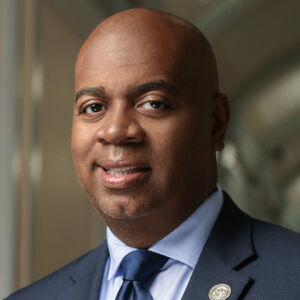 Credit: (Newark Mayor's Office)
In a position paper, Baraka proposed a task force to study aligning “all elections with the national cycle,” meaning even-numbered years when Congress and, every four years, the presidency are on the ballot to increase turnout in governor, legislative and local races. He said he supports automatic voter registration at age 18, allowing 16-year-olds to register and vote in school elections, and same-day voter registration. He also would give the right to vote back to all those incarcerated. And he would centralize election information, including candidate statements and multilingual sample ballots, on the state website.
“To build a strong democracy, New Jersey has a lot we can do to make every vote count, make voting as easy as possible, and ensure that the government remains transparent and accountable to the people,” he said.
Baraka also proposed changes to campaign finance laws, including by expanding public financing of elections to legislative, county and local election. He would seek to impose limits on the amounts super PACs could raise and the amounts party committees could contribute to candidates. And he pledged to expand transparency on super PACs and eliminate dark money, although the latter may be impossible because of U.S. Supreme Court rulings.
Additionally, Baraka said he would roll back the limits put on OPRA last year and improve the state’s public records law.
REPUBLICAN CANDIDATES
Spadea
 Credit: (AP Photo/Mike Catalini)
On his website, Spadea proposes a number of sweeping changes regarding elections and voting that he said he would accomplish in his first year in office. He would require a “re-registration of all voters” — there are more than 6 million in New Jersey — to “clean up the voter rolls,” which all counties currently do at least every two years following federal elections. Spadea said he wants to require people to show identification before they can vote. He also wants to roll back the state’s popular mail-in voting to an absentee ballot, requiring voters to be given one only if they have a valid reason for not being able to go to the polls. So far, more than 220,000 New Jerseyans, including 56,000 Republicans, have voted by mail in the gubernatorial primary.
Spadea also said that, given he would be facing Democrats in control of at least one house of the Legislature, he would take a page from Trump’s playbook and govern by executive order starting “on day one.” Until the Republicans could take control of the Legislature, Spade said he “can declare a state of emergency and start fixing things with executive orders.” For example, he said he could declare a public safety emergency to reverse the state’s eight-year-old bail reform system that allows people charged with a crime to be released on certain conditions that could include an ankle monitor or holds them in jail without bail pending trial.
Kranjac
 Credit: (Kranjac campaign)
Kranjac’s website does not have detailed policies, and he did not raise enough money to qualify for public matching funds and the state-mandated debates. He says on his website that he would “pass term limits for politicians” and increase transparency for state and local government, but without any specifics.
In answering NJ Spotlight’s voter guide, Kranjac expressed his full support for Trump and said he would eliminate from the state budget money earmarked for the attorney general to oppose Trump policies impacting state residents.
Ciattarelli
 Credit: (AP Photo/Mike Catalini, File)
On his website, Ciattarelli lists a number of proposals regarding government. He said he wants an eight-year term limit for all state legislators “to promote fresh ideas and new leadership in state government.” He also would break from the tradition of keeping a partisan balance on the state Supreme Court and would nominate “the best and most qualified” candidates, regardless of party affiliation, although he would likely run into opposition from a Senate that must confirm judicial nominees as long as it is controlled by Democrats.
Ciattarelli proposes a number of election-related changes. He said he would require voter ID at the polls and require all people using mail-in ballots to prove their identity and citizenship before getting a ballot. Ciattarelli would end the process of counting ballots postmarked by Election Day but received after close of polls. He would expand the number of early in-person voting sites and the number of early in-person voting days before primaries.
Ciattarelli would expand voter registration opportunities beyond motor vehicles transactions to those getting hunting, fishing or trapping licenses, gun permits, business licenses and construction permits. He would allow for the counting of mail-in ballots 25 days before an election, with the results posted within 30 minutes of close of polls. And he would create a voter fraud task force within the attorney general’s office.
Ciattarelli received Trump’s endorsement.
Bramnick
 Credit: (Steve Hockstein/NJ Advance Media via AP, Pool)
Bramnick doesn’t address democracy-related issues on his website. During the Spotlight debate, Bramnick argued for greater civility in politics and said he wouldn’t govern by “sound bite,” but would use a “mature approach” and carefully review policy. He also said he doesn’t think diversity and inclusion in hiring decisions should be mandated, but he does think it’s “important to discuss inclusion, discuss diversity.”
Bramnick also said he would keep the partisan balance on the Supreme Court, saying that not doing so would mean the next Democratic governor could stack the court in a way that Republicans would not like.
The only Republican to say he would oppose Trump when he disagrees with him, Bramnick said in an interview on the NJ Spotlight News program “Chat Box,” “You’re going to help New Jersey? I’m going to be with you on those issues. But I think the people of New Jersey want a governor who is going to put New Jersey first. And then if you see something coming out of Washington that you don’t like, you stand up and say it.”
Asked what can be done to limit independent spending on campaigns, Bramnick cited U.S. Supreme Court rulings, saying, “It doesn’t look, legally, that anyone is going to stop it.”
Barbera
 Credit: (Barbera campaign)
Barbera does not have a website detailing his policies and he did not raise enough money to qualify for public matching funds and the state-mandated debates.