
 Credit: Bobby Brier
Althea Gifth of Newark said she relies on the NJ Transit train service to get to and from her job everyday as a home health aide on Long Island, where she is a caretaker for a 90-year-old woman.
But the strike by union rail engineers forced her to stay at her client’s house in New York on Friday night, she said. Gifth then took a 9:47 a.m. train from Long Island on Saturday, but around 2 p.m. she was still in Newark Penn Station trying to get home.
Complications like that caused by the strike are a “horror story” and that traveling during the strike is “mentally draining,” Gifth, 44, told NJ Spotlight News during an interview at the train station.
Gifth’s struggles to get home Saturday afternoon is one of many such stories for workers who depend on NJ Transit rail service for travel on off peak hours including employees in health care and service jobs. The stress of the strike is being felt by all commuters, but most especially by those who work on weekends and in jobs with unpredictable schedules. For many of those workers, the lack of transportation is more than an inconvenience, but a direct threat to their job stability and livelihoods.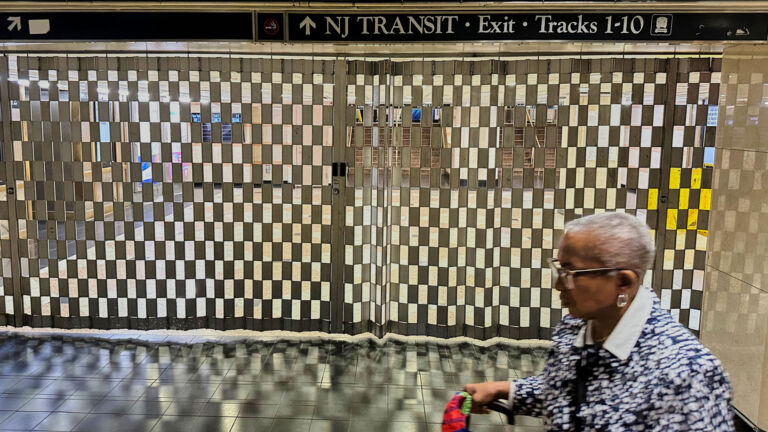
As the strike continues, the lack of train services is likely to cause greater strain in getting to work, delaying school pick-ups and cancelling needed medical appointments.
NJ Transit rail service shut down early Friday after more than 350 train engineers went on strike. The train engineers, members of the Brotherhood of Locomotive Engineers and Trainmen labor union, argue they are underpaid relative to their regional peers at other major mass transit agencies.
Kris Kolluri, the chief executive officer of NJ Transit, said in a Saturday morning news conference that he and Gov. Phil Murphy want a “fair deal that will not break the bank.”
Salary fight
“That is our principle. We are not moving from that, and I hope the union understands that that is where we are and that is where we will be,” said Kolluri. “Ultimately, fair wages is their position, which I respect. Not breaking the bank is our position that they should respect.”
“We need to make sure we live within our means,” said Kolluri. “The governor and I have said we will not make a decision on a labor contract that will leave the next governor a mess to clean up.”
Late Saturday, Kolluir said in a statement that the Saturday talks were “constructive” and both sides planned to meet again Sunday.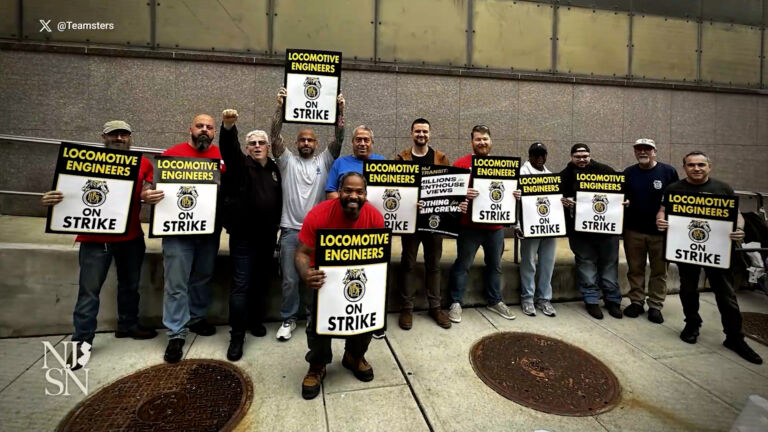
The union claims its members earn an average of $113,000 a year and says an agreement could be reached if that went to $170,000. NJ Transit leadership disputes the union’s data, saying engineers have average total earnings of $135,000 annually.
As the country’s third-largest transit system, NJ Transit provides nearly 1 million weekday trips, including into New York City. More NJ Transit buses are being added, but supplemental service can only accommodate about 20% of the people who could be accommodated if the trains were running.
NJ Transit, based in Newark, employs 12,000 workers operating bus and light-rail services throughout the state. Transit officials have warned that giving into the union’s demands would bring on fare increases or other fiscal measures that could ultimately lead to the end of the agency, which serves more than 350,000 daily customers.
Negotiations continue
Kolluri said Saturday that he and Gov. Phil Murphy agreed to meet with the labor union that afternoon to continue negotiations. Both sides late last week had agreed to negotiations with the National Mediation Board on Sunday.
‘I’m hungry, so I just don’t want to go anymore.’ — Daiane Santos.
While they wait for rail service to resume, commuters like Daiane Santos of Elizabeth are continuing to feel the strain caused by the strike.
Santos was supposed to meet a friend in New York on Saturday afternoon for lunch, but decided to cancel her plans and return to Elizabeth after feeling “super stressed” from having to travel into the city without the use of NJ Transit.
“I talked to my friend and she was already having lunch and I couldn’t arrive in New York City,” said Santos, 31. “I’m hungry, so I just don’t want to go anymore.”
“I’m so tired,” said Santos.
