Credit: (AP Photo/Seth Wenig)
WASHINGTON — Telecommunications equipment, software systems and safety measures would be overhauled, hundreds of radar systems would be replaced and six new air traffic control centers would be built under a new national aviation strategy.
Announced after a wake of delayed passengers, safety worries and traumatized air traffic controllers at Newark Liberty International Airport, the plan would take three years, according to the Transportation Department.
“Decades of neglect have left us with an outdated system that is showing its age,” Transportation Secretary Sean Duffy said Thursday, requesting funding up-front from Congress in order to complete the plan within three or four years.
It’s unclear how much the plan unveiled Thursday would cost or how it would be funded.
The effort announced Thursday is largely a continuation of what has been planned by the agency and would require buy-in from Congress to fund.
Duffy announced the plan at a time when federal workers, including those at the Federation Aviation Administration, are resigning or being pushed out of their jobs in droves by Trump administration cuts that have jettisoned hundreds of thousands of federal workers from their posts.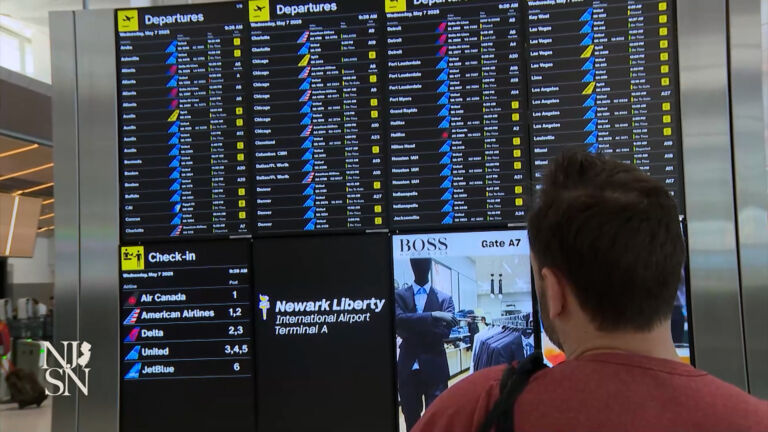
The plan also landed on the heels of a string of airborne events that have run from dangerous to deadly, including a January collision in Washington, D.C., between an Army Black Hawk helicopter and a commercial jetliner that killed 67 people.
Rough weather and a shortage of air traffic controllers led to delays at Newark in recent days, and air traffic controllers there lost radar and radio contact on April 28 of planes they were monitoring for “30 seconds,” according to Duffy.
“The primary communication line went down, the backup line didn’t fire, and so for 30 seconds we lost contact with air traffic,” Duffy told Fox News. “Now, were planes going to crash? No. They have communication devices.”
He called that incident “a sign that we have a frail system in place” that requires attention. Some air traffic controllers took medical leave due to the stress of that outage.
In a separate incident last month, a tour helicopter broke apart in midair over the Hudson River, killing its passengers and igniting calls, including one from Rep. Rob Menendez (D-8th), to more stringently regulate the tour helicopter industry.
The plan calls for the replacement of new telecommunications equipment at more than 4,600 sites, plus 25,000 new radios and 475 voice switches, the department said.
It would also replace 618 radar systems that have “gone past their life cycle,” build six new air traffic control centers and replace towers.
Last week, Duffy said the U.S. is short about 3,000 air traffic controllers.
In a letter Thursday, Menendez and Rep. LaMonica McIver (D-10th) pressed Duffy and the acting FAA to “immediately ground all non-essential helicopter traffic within a 20 mile radius of the Statue of Liberty to alleviate congestion in the airspace and ease this unnecessary burden on air traffic control.”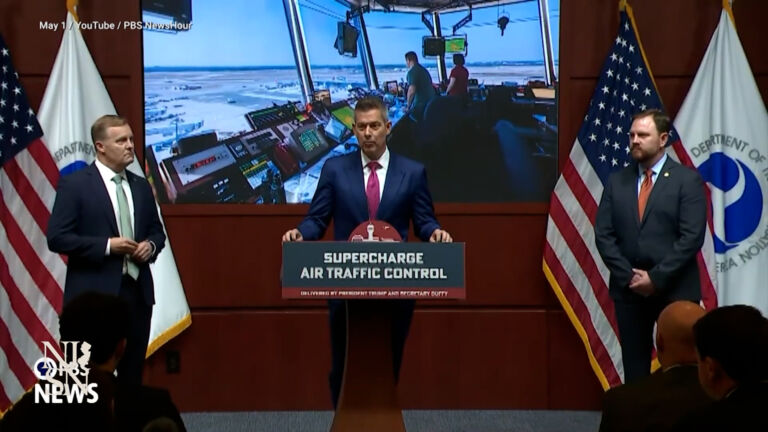
Helicopters are an unrelenting nuisance, the lawmakers said.
“Residents of Hudson County, including Hoboken, Jersey City, and Bayonne, are already subjected to the persistent hovering of low-flying helicopters, day in and day out,” their letter reads. “These helicopters shake apartment buildings, wake babies, and are causing deep safety 2 concerns amongst the community especially considering recent tragedies such as the crashes in Jersey City and at Reagan Airport.”
The Trump administration issued a broad budget proposal last week that includes $359 million for the Federal Aviation Administration, part of the Transportation Department, and $824 million for the FAA to upgrade radar systems.
In its budget request, issued last week with few details, the Trump administration called for deep spending cuts for domestic programs across most of the federal bureaucracy.
Transportation, along with immigration programs, the military and the Department of Veterans Affairs, was one of the few departments slated for a funding increase.