Credit: (AP Photo/Rod Lamkey Jr.)
WASHINGTON — To pay for their signature legislation this Congress — tax cuts — Republicans are eyeing cuts and changes to a wide variety of federal programs largely meant to help vulnerable citizens, in particular seniors and the poor.
President Donald Trump and Republican allies in Congress are writing sweeping tax legislation expected to also include funding for national security and immigration programs.
Central to the legislation would be an extension of the 2017 federal tax law — the law that put a $10,000 cap on the state and local tax, or SALT, deduction, a priority for New Jersey members of both parties.
Republicans writing the bill have options to pay for the legislation, including five choices about the SALT deduction, choices that include repealing it altogether which would save $1 trillion over a decade, according to a 50-page list of cuts Republicans wrote that is circulating around Capitol Hill.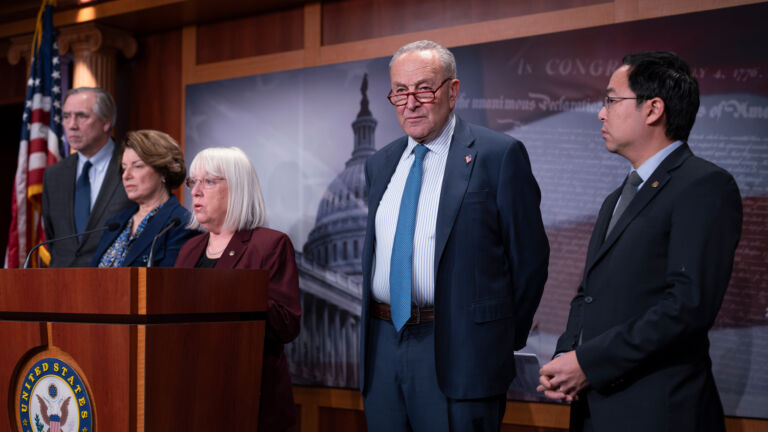
Other items Republicans could include to fund their tax cuts and increased spending, according to the list, are a 10% “across the board tariff on all imports” and repealing parts of a 2021 federal infrastructure law.
Challenges on Capitol Hill
The Republicans are not considering any significant federal corporate or income tax increases to pay for their legislation.
To shepherd the bill into law, Republicans must navigate a paper-thin majority in the House, where they can afford to lose one member’s vote, before returning to their home states and districts to face the public.
Extending the portions of the 2017 tax law that expire at the end of the year unless Congress acts, will cost more than $4 trillion over a decade, according to the nonpartisan Congressional Budget Office.
To get their bill into law, they also must work around the filibuster — the Senate rule that requires 60 votes of support on a given bill — and will likely do so by invoking a procedural maneuver called budget reconciliation that allows bills that relate to revenue to pass on simple majority votes.
“You’ve got a honeymoon, we’re going to be going into it. It doesn’t last for long,” Rep. Jeff Van Drew (R-2nd) said in a recent interview with NJ Spotlight News. “This is going to be a real bumpy ride for the next two years.”
Congress must also soon lift what is known as the debt ceiling, the self-imposed procedural point at which the U.S. can no longer borrow money to pay back debt it already owes.
Some of the proposed cuts
Extending the portions of the 2017 tax law that expire at the end of the year unless Congress acts, will cost more than $4 trillion over a decade, according to the nonpartisan Congressional Budget Office.
Two of the most significant cuts on the Republican list are about $800 billion worth of clean-energy tax credits from a 2021 law Democrats passed and roughly $405 billion in tax credits for zero-emission electricity.
Another proposal is to add work requirements to Medicaid, the health coverage system for the poor, for an estimated $100 billion in savings.
The list also includes a suite of potential cuts to federal health programs, including tens of billions of dollars’ worth of subsidies to the health insurance marketplaces under the Affordable Care Act, popularly known as Obamacare.
The Republican plan also floats the idea of eliminating the nonprofit status of hospitals that currently hold that designation, cutting the deduction available for charitable contributions to health organizations and zeroing out the federal credit for child and dependent care — for estimated savings over a decade of $260 billion, $83 billion and $55 billion, respectively.
Medicaid and food programs at risk
Another proposal is to add work requirements to Medicaid, the health coverage system for the poor, for an estimated $100 billion in savings.
Food programs are not safe from proposed cuts, either.
The authors of the memo consider lowering funding for the Temporary Assistance for Needy Families block grant program, which flows to every state and U.S. territory, by 10% to save $15 billion.
Smaller-ticket items on the list include eliminating federal subsidies to operate the National Flood Insurance Program, a move projected to save about $11 billion over a decade, and implementing “income verification” for national school breakfast and lunch programs.