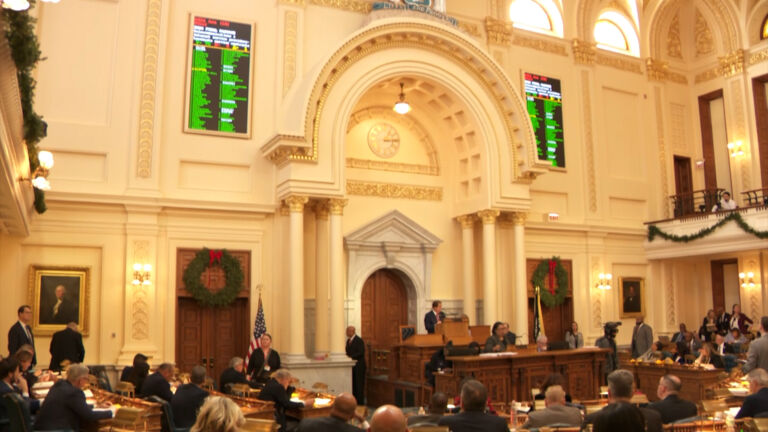
Credit: (Rich Hundley III/ NJ Governors Office)
Candidates trying to get on the ballot for most public offices in New Jersey would have to get more voters to back them if the governor signs a bill lawmakers sent to him on Thursday. In many cases, the number of signatures required for nominating petitions would double under the bill.
The measure (A-5117) was introduced and initially passed the Assembly in December along with the bill to change the design of ballots from the party line to an office block.
At the statewide level, the number of signatures required from registered voters would increase this year from 100 in a given legislative district to 250 for the 80 Assembly seats on the ballot and from 1,000 registered voters to 2,500 for candidates in the governor’s race.
Both the Senate and Assembly passed the bill, sponsored by Assembly Majority Leader Lou Greenwald (D-Camden) Thursday, along party lines. Democrats, who control both houses and the governor’s office, said the increase in signature requirements would ensure that only serious candidates get on the ballot. Republicans who spoke against it said it is an attempt to prevent challenges to incumbents.
“While candidates across New Jersey are already circulating petitions for the upcoming primary election, this body is moving the goalposts mid-game, making it harder for people to run for office,” said Assemblywoman Dawn Fantasia (R-Sussex). “This is about protecting incumbents and keeping challengers off the ballot.”
Why now?
“Folks who want to run for office should be able to get out there and meet their constituents, knock on doors and get the necessary signatures,” said Sen. Paul Sarlo (D-Bergen), a prime sponsor of the bill in the upper house. “I don’t believe we’re taking away any opportunity from anybody. If they want to be a meaningful candidate, they need to go out there and get the necessary signatures, simple as that.”
‘This is a blatant attempt to replace ‘the line’ with new barriers that make it harder for challengers to run. New Jersey voters deserve better.’ — Assembly candidate Katie Brennan
While the League of Women Voters of New Jersey did not take a position on the bill, its president Jesse Burns said, “While modest signature increases might not create a significant hurdle for candidates, Trenton’s anti-transparency culture makes the public skeptical of the intention of legislation like this.”
This year’s Assembly elections have the potential to shake up the power of the Democratic machine. The increase in signature requirements, which did not get a hearing in the Senate but went straight to a floor vote, is seen as a way of trying to blunt that.
Although the Senate has yet to consider the bill requiring primary ballots to use an office-block style, county clerks across the state already have agreed not use the state’s unique party line ballot. That move follows the federal court ruling barring the use of that ballot in last spring’s Democratic primaries. Ending the party line ballot could diminish the parties’ abilities to steer voters toward their preferred candidates.
Incumbents vs. challengers
Assembly Democratic incumbents are facing challengers in a raft of districts across the state. Jersey City Mayor Steve Fulop, who is running for the Democratic gubernatorial nomination, has assembled a slate of candidates in more than half the legislative districts. Other challengers are likely, as well.
 Credit: (AP Photo/Matt Rourke)
“Instead of lowering costs for families, funding schools, or fixing New Jersey’s crumbling public transit, establishment politicians waste time and resources rigging the system in their favor,” the group wrote. “And they did this in an election year when, for the first time, many will compete without the protection of the county line. That’ s not leadership — it’ s cowardice. It’ s a desperate attempt to cling to power and avoid accountability. With an election already underway, now is not the time to change the rules. Doing so disrupts campaigns, gives an unfair advantage to well-funded, establishment-backed candidates, and makes it harder for grassroots challengers to compete.”
“There’s certainly room for a good-faith debate on ballot access requirements, but that’s not what this is,” said Katie Brennan, a candidate in Hudson County’s 32nd Assembly District. Brennan gained wide attention after she accused a man given a high-ranking job in the Murphy administration of sexually assaulting her during Murphy’s first gubernatorial campaign.
“Changing the rules just weeks before the filing deadline shows that this is really about protecting those in power, even if it’s at the expense of voters having a real choice. This is a blatant attempt to replace ‘the line’ with new barriers that make it harder for challengers to run. New Jersey voters deserve better.”
‘This is about protecting incumbents and keeping challengers off the ballot.’ — Assemblywoman Dawn Fantasia (R-Sussex)
If Murphy signs the bill to increase the number of ballot signatures, it could cause confusion among prospective candidates, given the Secretary of State’s office has already released nominating petition forms that list the current signature requirements.
While the bill states that Pennsylvania, New York and California have signature requirements higher than New Jersey’s current numbers, the National Council of State Legislators’ website shows that there are a number of states with lower requirements for legislative candidates than New Jersey. Many states, including Alabama, Delaware and Illinois, have signature requirements only for independent or unaffiliated candidates. Other states require lower numbers for major-party candidates — for example, 15 registered voters in a district in Hawaii or 50 registered party voters in Ohio.
By the numbers
Under the bill, the number of signatures required to get on the Democratic or Republican primary ballot would increase for all offices in the state. In addition to the increases for governor and Legislature, these signature requirements also would change:
- Statewide office (U.S. Senate), from 1,000 to 2,500;
- U.S. House of Representatives, from 200 to 500;
- Countywide office (commissioner, clerk, sheriff, surrogate), from 100 to a minimum of 150 and a maximum of 300;
- School board, from 10 to 25.
The number of signatures required for municipal offices would be based on the size of the town. The requirement would rise from 50 to 100 in the largest communities. Municipalities of fewer than 14,000 residents would see the number of signatures remain at 50 or drop to 25.
Independent candidates do not appear on the primary ballot, but the number of signatures they would need to appear on the general election ballot also would increase, from 800 to 2,000 for governor and from 100 to 250 for the Assembly.