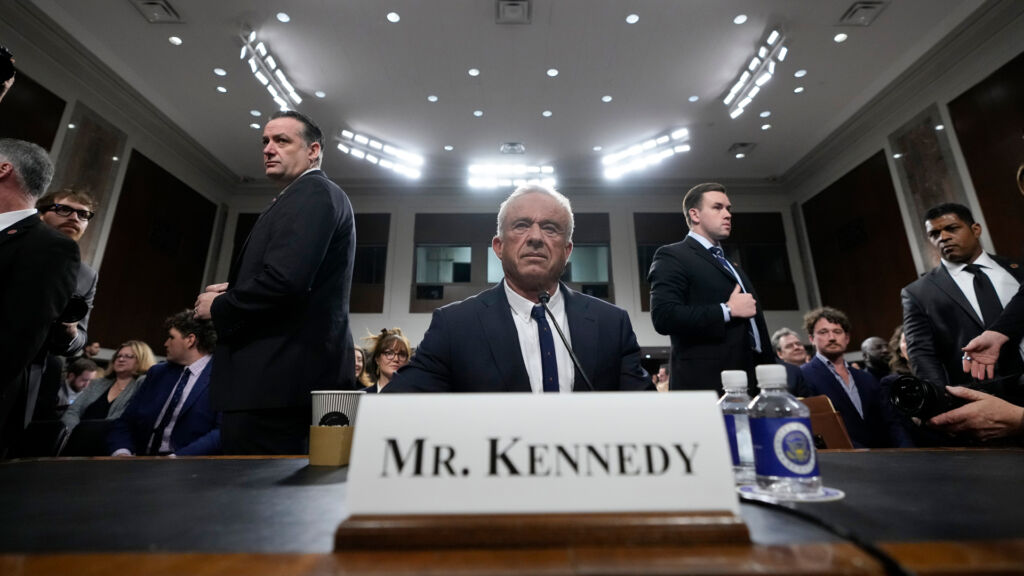
Robert F. Kennedy Jr. insisted he would follow the science if confirmed to oversee the federal government’s sprawling cluster of health care agencies during a contentious U.S. Senate hearing Wednesday, but Democrats remained unconvinced he had the knowledge, experience and integrity to protect Americans’ health and well-being.
Republicans on the Senate Finance Committee welcomed President Trump’s pick for secretary of the U.S. Department of Health and Human Services and Kennedy’s pledge to “make American healthy again” by reducing chronic disease and promoting healthier foods. Kennedy — who ran for president himself last year first as a Democrat and then as an Independent — must be approved by the committee before the full Senate could vote to confirm him in the job.
Democrats interrogated Kennedy about his stance on vaccines — proven preventive medicine he built a lucrative legal career questioning — and abortion, a procedure he once said should be a woman’s decision with her doctor. On Wednesday Kennedy echoed the president repeatedly, insisting “every abortion is a tragedy,” and said he would follow through on Trump’s request to study the safety of mifepristone, a medication used to terminate pregnancies.
More on Kennedy confirmation hearings
Kim ready for Thursday hearing
Sen. Andy Kim (D-NJ) said in an interview with NJ Spotlight News on Wednesday evening that he wants to know if Kennedy grasps the scope of the job he’s pursuing. Kim is not a member of the Senate Finance Committee, but serves on a separate panel that will question Kennedy on Thursday.
“How much of the breadth of HHS does he understand?” Kim said. “So much of the conversation’s been about vaccines. But what else he is interested in besides vaccines and nutrition?” he asked. “People in Jersey have a wide range of concerns on health care, and frankly HHS does a lot more than just health care.”
 Credit: (AP Photo/Jose Luis Magana)
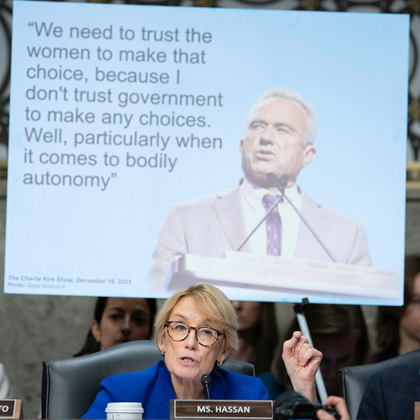
Sen. Maggie Hassan (D-NH) was one of many that questioned Kennedy’s evolving stance on a woman’s abortion rights. “When did you sell out your life’s work and values to get this position?” she asked, before hoisting a bundle of papers she said included nearly 40 studies on mifepristone, access to which some Republicans are seeking to restrict. “The studies are there. The safety is proved. The science is there,” she said.
“Regardless of what you believe, regardless of what values you have, if President Trump tells you to do something, you’re going to do it,” Hassan added. “That to me is unacceptable in a secretary of Health and Human Services.”
Questioning Kennedy’s track record
Kennedy is the son of former Attorney General Robert Kennedy and nephew of former President John F. Kennedy. He established himself as an attorney fighting environmental battles, including over mercury levels in the Hudson River, and went on to found Children’s Health Defense, a national nonprofit that litigates cases involving vaccines, pollution and chronic diseases. The organization’s website currently features links to a film called “Vaxxed: Authorized to Kill,” a book called “The Medical-Pharmaceutical Killing Machine,” and to the Senate website that broadcast Kennedy’s confirmation hearing Wednesday, although the nominee insists he has severed ties with the organization.
Sen. Bernie Sanders (I-Vt.) shared images from Kennedy’s presidential campaign website of infant’s onesies with anti-vaccine messages like “unvaxed and unafraid,” available for $26 each. The site claims it is raising money to pay off campaign expenses, like security for Kennedy.
‘And there’s no one who will fix it the way I do, because I’m not scared of vested interests.’ — Robert F. Kennedy Jr.
“Now you’re coming before this committee and saying you are pro-vaccine, you just want to ask some questions, yet your organization is making money selling a children’s product to parents which costs $26 that casts fundamental doubt on the usefulness of vaccines,” Sanders said.
 Credit: (AP Photo/Jose Luis Magana)
Kennedy said he did not have control over the website and, in responding to other senators, insisted he did not oppose vaccinations outright. “I believe vaccines play a critical role in health care. All my kids are vaccinated,” he said.
There’s nobody better, Kennedy said
Kennedy said his experience working with hunters, farmers and families and his work suing vaccine manufacturers and government agencies that oversee them makes him uniquely qualified for the role at HHS, which oversees more than 100 programs through its many divisions. In addition to operating Medicare and Medicaid, the agency oversees public health and disaster response, medical research and food and pharmaceutical safety, through the Food and Drug Administration.
“I don’t think anybody is going to be able to do this like I am — because of my peculiar experience, because I’ve litigated against these agencies. I’ve written six books about these agencies. I know a lot about them, and I know how to fix it,” Kennedy told senators. “And there’s no one who will fix it the way I do, because I’m not scared of vested interests.”
Kennedy’s battles with drug companies, and the millions he has earned through this litigation, raised spirited questions from Sen. Elizabeth Warren (D-MA). Warren pressed Kennedy to not accept any proceeds from these lawsuits while in office and for four additional years, which he refused to do, and then listed the many ways he could use his government position to advance these cases and boost his income.
“As Secretary of Health and Human Services, Robert Kennedy will have the power to undercut vaccines and vaccine manufacturing across our country. And for all of his talk about ‘follow the science’ and his promise that he won’t interfere with those of us who want to vaccinate our kids, the bottom line is the same. Kennedy can kill off access to vaccines and make millions of dollars while he does it,” Warren said. “Kids might die, but Robert Kennedy can keep cashing in.”
Before Kennedy could respond, committee chairman Sen. Mike Crapo (R-Idaho), said Kennedy had disclosed his finances and potential conflicts and was cleared by ethics officials to proceed through the nomination process.
Food agenda, addictions
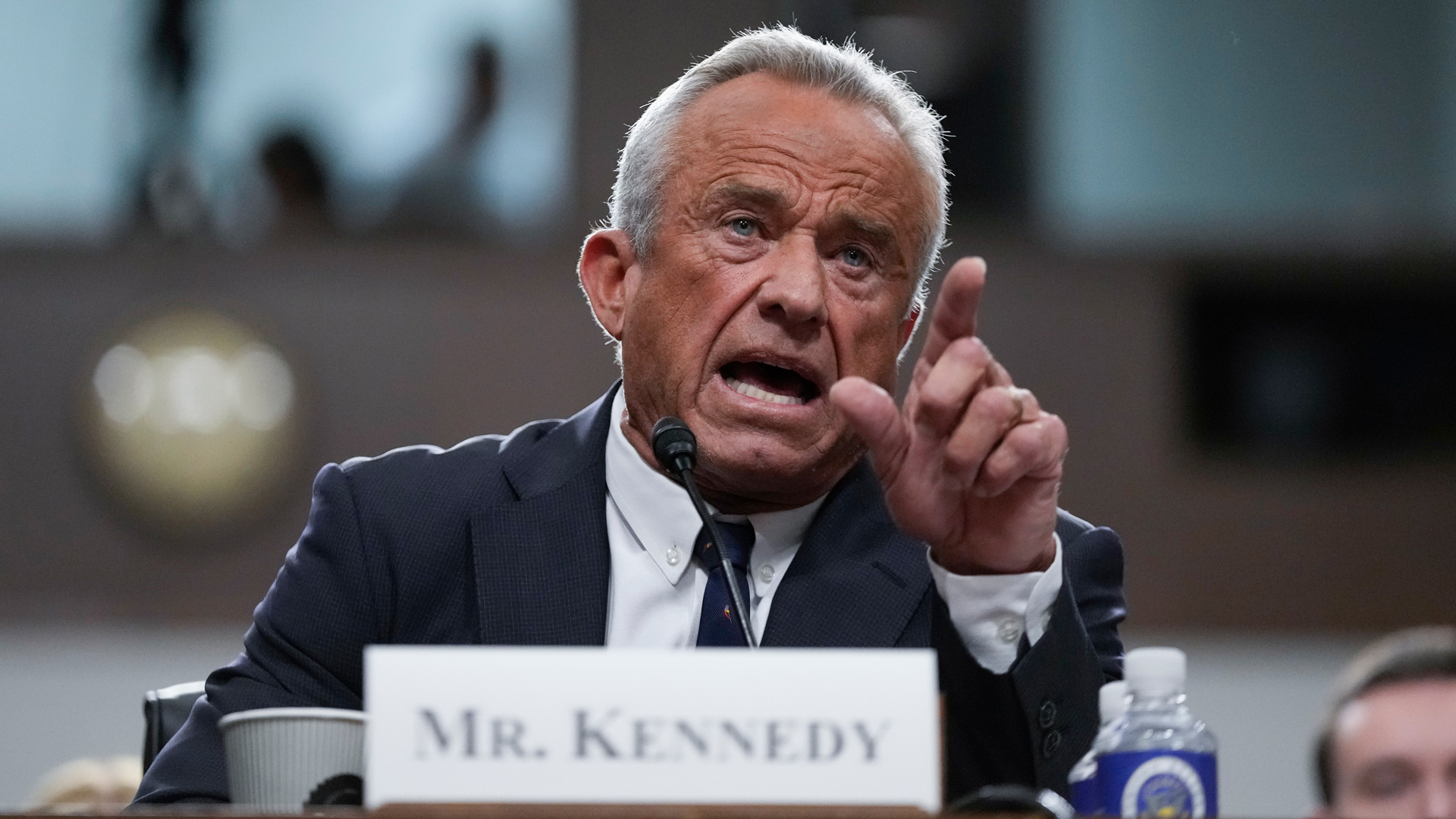
During the hearing — which also touched on rural health care, programs to counter AIDS abroad and efforts to cut the cost of prescription drugs — Kennedy said food additives and pollution, an issue not under HHS purview, are the root cause of most chronic diseases in the United States. He said chronic health conditions like diabetes and obesity now impact a majority of adults and are hobbling the nation. “This is an existential threat economically, to our military, to our health and sense of well-being. And it’s a priority to President Trump,” he said, pledging to bring “radical transparency” to the federal health department, if approved.
 Credit: (AP Photo/Ben Curtis)
Pushed for specifics on his plans, like how to improve Medicaid — which insures 72 million Americans, including more than 2 million in New Jersey — Kennedy gave few details. He insisted he would not dismantle the “critical program,” which has been a popular target for Republican budget cuts, but would make it work better, in line with Trump’s demand. But he also appeared several times to confuse Medicaid with Medicare, the public insurance program for older Americans, and incorrectly suggested that federal government covers the full cost of Medicaid when the tab is split with states.
When it comes to food choice, Kennedy pledged he would not ban access to fast food, acknowledging his ‘boss’ Trump has a preference for McDonald’s cheeseburgers and Diet Cokes.
Kennedy, who highlighted his own 42-year recovery after a decade-plus of heroin use, also stressed the need for additional personal accountability. In response to a question from Sanders, he suggested that a long-time smoker might not have the right to the same access to benefits as someone who chose not to use tobacco. Kennedy also advocated for tools like health savings accounts, which give people greater control over parts of their health care coverage and advocated focusing food-security programs on healthier options.
When it comes to food choice, Kennedy pledged he would not ban access to fast food, acknowledging his “boss” Trump has a preference for McDonald’s cheeseburgers and Diet Cokes. “I don’t want to take food away from anyone,” Kennedy said. “If you want to eat a Hostess Twinkie, you should be able to do that. But you should know the impact on your health.”
A target for Democrats — and some Republicans?
If cleared by the Senate Finance Committee, Kennedy will face a full Senate floor vote by the chamber’s 100 members. A simple majority of 51 votes is needed to confirm federal nominees, but it is likely to be close for Kennedy.
Senate Minority Leader Chuck Schumer, a Democrat from New York, said Wednesday Kennedy was one of three Trump nominees he thinks may draw Republican opposition. “There are certain nominees that we’re particularly focusing on,” Schumer said.
Beyond Kennedy, he mentioned Trump acolyte Kash Patel, picked to be director of the FBI, and Tulsi Gabbard, a former congresswoman from Hawaii who has parroted Russian propaganda, who is Trump’s choice to be the director of national intelligence. “We’re focused on some particular people who we think we might get some Republican support on,” Schumer said.
Former Senate Majority Leader Mitch McConnell, who still holds sway with many of his Republican colleagues, made a cryptic reference in December all but certainly about vaccines and Kennedy, who had been nominated then.
“Efforts to undermine public confidence in proven cures are not just uninformed — they’re dangerous,” McConnell said. “Anyone seeking the Senate’s consent to serve in the incoming administration would do well to steer clear of even the appearance of association with such efforts.”
As a child growing up in rural Alabama, McConnell was struck with polio and still walks with a limp as a result.