Credit: (kconwaymakeup via TikTok)
[Update: On Wednesday and into Thursday morning, the FAA issued temporary flight restrictions across a series of New Jersey cities and towns, citing “special security reasons.” Full list. Look for further NJ Spotlight News coverage today.]
WASHINGTON — Apparent drone sightings in New Jersey and other states have thrown a spotlight on the difficulty of tracking drones, formally called unmanned aircraft systems, across U.S. airspace and efforts to regulate the growing industry.
As the use of drones for commercial and recreational purposes ballooned in recent years, the Federal Aviation Administration issued rules for drone pilots to follow.
“Drones have blown up very quickly,” Greg Reverdiau, co-founder and lead instructor at the Pilot Institute, a drone-training organization headquartered in Prescott, Ariz., said in a phone interview with NJ Spotlight News. “The FAA’s trying to come up with how to handle these regulations.”
Like other drone experts, Reverdiau said what people in recent weeks have taken for drones, perhaps flying where they are not permitted, are likely safely functioning aircraft. “I do believe the majority if not all of it is aircraft flying safely and legally,” he said. “People go outside and they pay attention,” he added. “There’s just a lot of traffic flying legally in the United States.”
Limitations on monitoring
While law-enforcement agencies, elected officials and drone experts have largely said the recent perceived drone sightings are likely nothing out of the ordinary, the episode has highlighted authorities’ limitations in monitoring drones nationwide.
Lawmakers in Washington and New Jersey have called for federal officials to release more information to the public about drones. Without proof, some have accused foreign nations of deploying drones in U.S. airspace.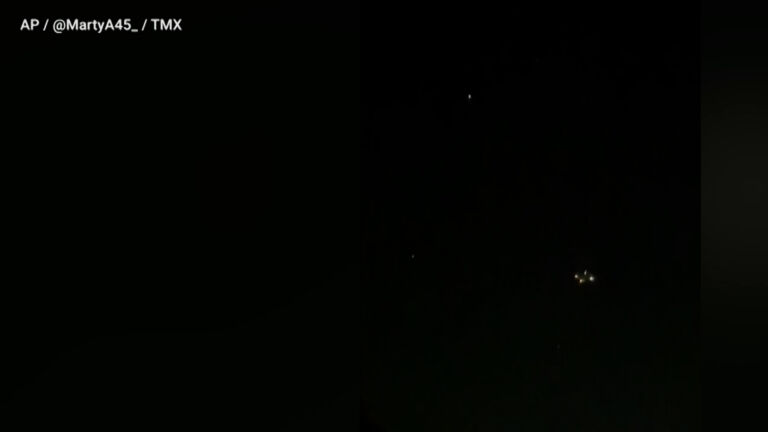
In a joint statement Tuesday, federal officials said the FBI has received more than 5,000 “reported drone sightings in the last few weeks,” generating about 100 leads.
“We have not identified anything anomalous and do not assess the activity to date to present a national security or public safety risk over the civilian airspace in New Jersey or other states in the northeast,” the agencies said, adding that there have been a “limited number” of drone sightings over military bases in New Jersey and other states.
“Such sightings near or over DoD installations are not new,” the statement said. “Local commanders are actively engaged to ensure there are appropriate detection and mitigation measures in place.”
 Credit: (AP Photo/Ted Shaffrey)
Speaking to reporters Tuesday on the White House’s South Lawn, President Joe Biden said there is “no sense of danger.”
“Nothing nefarious,” Biden said. “There’s a lot of drones authorized to be up there.”
Gottheimer: No imminent threat
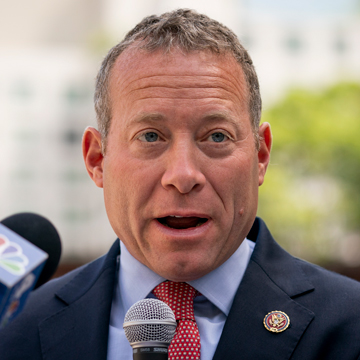
Rep. Josh Gottheimer (D-5th), a member of the House Intelligence Committee who attended a closed-door briefing on drone activity this week, said there is no safety risk.
 Credit: (AP Photo/John Minchillo, File)
“I don’t believe these recent drone sightings pose an imminent threat to public safety,” Gottheimer said in a statement Wednesday.
Two primary regulations govern drone use in the U.S. One, put in place in 2016, sets rules for drone use and requires pilots to take a test before being allowed to operate. It was later updated to allow drones to be flown at night.
“That’s what governs the majority of drone flights in the United States,” Reverdiau said.
The other regulation is for recreational purposes — “the kid at the park,” as Reverdiau put it. That regulation has 10 rules for users to follow, he said. “Very commonsense type rules.”
People who filmed what they think was a drone likely were viewing an airplane coming in to land, he said.
A few thousand feet up, “they just look like a big car,” he said, adding that New Jersey also has busy airspace. “You have a lot of traffic coming from Europe, the United States.”
The number of drone pilots being harassed by fellow citizens has increased in recent weeks, as has the number of incidents of airplane pilots being targeted with lasers, he said. “That can be very dangerous for pilots.”
The FBI’s Newark office issued a warning Monday against pointing lasers at pilots.
NJ Spotlight News Washington, D.C. Correspondent Benjamin J. Hulac has been following the ongoing drone issue and has more on New Jersey lawmakers’ responses.
Rules of operation
To operate a drone legally in the U.S., a pilot must register it with the FAA if it weighs more than about half a pound.
There are about 1 million commercial and recreational drones registered with the FAA, according to agency figures. But Reverdiau estimated the number of commercial and recreational drones used in the country is about 2 million. “A lot of people don’t know that you have to register,” he said.
Lisa Ellman, executive director of the Commercial Drone Alliance, in an interview with NJ Spotlight News, said the drones to worry about are those that are unregistered.
“The careless, the clueless, the criminal,” Ellman said. “That’s where you worry.”
‘We have a window to address those vulnerabilities before a hostile actor could take advantage of that.’ — Clayton Swope, Center for Strategic and International Studies
When someone registers their drone, they create a digital form of identification, and there are publicly available smartphone applications that let users scan the sky to gather information on drones they see.
“You can download an app, like Drone Scanner, and you can hold up your phone,” Ellman said, referencing a popular app. “Just like cars on the road, you’ll be able to see a digital license plate,” she said. “If it has a legitimate license plate, it’s probably somebody following the rules.”
More authority soon?
Bipartisan legislation (S. 1631) pending in both the Senate and House would give the departments of Homeland Security and Justice more authority over unmanned aircraft.
The commercial and military systems in the U.S. created to detect danger were erected in the mid-20th century to look for airplanes, missiles or bomber threats, not small, low-flying drones, said Clayton Swope, deputy director of the aerospace security project at the Center for Strategic and International Studies, a think tank.
“That’s one reason why we feel like there’s a gap in knowledge from a military standpoint. Our systems just weren’t designed to look for drones,” Swope said in an interview with NJ Spotlight News.
Early-warning systems that monitor U.S. airspace were designed “effectively to not look for those things, because they were distracting from the main goal of looking for aircraft and helping aircraft controllers manage aircraft operating over the U.S. safely.”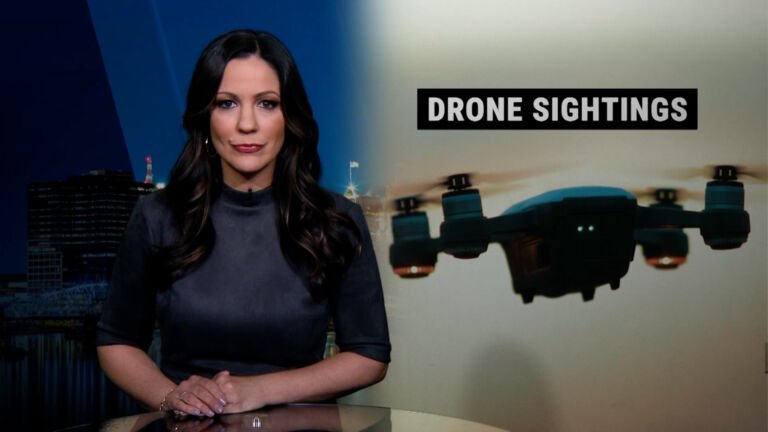
Tracking drones is a new challenge, and solutions, including the use of radio signals or special cameras, can address it, Swope said. “It’s not that the technology doesn’t exist. It’s just that we don’t have that at the nationwide level, over the whole homeland.”
Swope likened the federal response to drone activity to the Chinese-government spy balloon that floated into U.S. airspace early last year. This spate of drone sightings is a chance for U.S. authorities to regulate drones domestically, he said. “In some ways this is good that the public and the government are seeing this together, probably before there’s a real threat, no indication from anybody that any of these drones are actually doing anything nefarious on the East Coast,” Swope said. “We have a window to address those vulnerabilities before a hostile actor could take advantage of that.”