Credit: (AP Photo/Ted Shaffrey)
The leaders of a special state Assembly committee considering a new ballot design for New Jersey say they are keeping an open mind, but after the first two hearings, it appears some members want any new ballot to include features that critics say could give some candidates an edge. This is not surprising when the committee members themselves will likely be running for election next year, making them among the first statewide candidates running on the new ballot.
But as the hearings have exhibited, the prospect of a different ballot design set off new debate among advocates who want the state to do away with any preferential treatment of candidates.
“We want to be clear that the starting point for the fairness of ballot design has to really be about ensuring that there’s no extra weight on the scale, one way or the other,” said Peter Chen, senior policy analyst with New Jersey Policy Perspective, a progressive think tank.
The bipartisan committee created by Assembly Speaker Craig Coughlin (D-Middlesex) has scheduled a third hearing tonight at 6 p.m. at New Jersey Institute of Technology in Newark.
A federal court ruling last spring barred the use of the county-line layout for this year’s Democratic primary ballot.
The Kim case
In a case filed by Democratic Rep. Andy Kim (D-3rd), then running in the U.S. Senate primary and since elected to the seat, U.S. District County Judge Zahid N. Quraishi agreed with Kim’s argument that the county line gives an advantage to candidates who have party backing.
 Credit: (Tom Williams/Pool via AP)
While that decision only applied to the Democratic ballot in this year’s primary, an earlier case still pending in federal courts is likely to end in a similar result. Eleven county clerks have agreed not to use the county-line design moving forward and most county parties have withdrawn from the original case.
Coughlin and Assembly Republican leaders announced the creation of the 12-member committee last month to review the kinds of ballots used elsewhere in the country and devise a proposal for New Jersey. The Senate, whose members are not on the ballot next year, does not have a similar committee.
‘Do you want a horrible ballot, or do you just want a terrible ballot, I guess is what you’re asking me. I would say, let’s go for a fair ballot.’ — Julia Sass Rubin, Bloustein School of Planning and Public Policy, in response to a committee member’s question
To their first hearing — held during the week of early in-person voting — the committee invited county election officials at the center of the process and Wendy Underhill, director of elections and redistricting with the National Conference of State Legislatures.
Underhill confirmed what good-government advocates have been saying for years: No other state has a primary ballot design like New Jersey’s. Essentially all other states use what’s known as the office-block ballot for primaries, she said, although a handful of others in the Northeast use rows or columns arranged by party for the general election.
Horrible, terrible or fair
Assemblyman Al Barlas (R-40th), co-chair of the select committee, asked several speakers their thoughts on Connecticut’s ballot, which for the general election uses rows and columns and lists party-endorsed candidates first.
Julia Sass Rubin, an associate professor at Rutgers University’s Bloustein School of Planning and Public Policy who has written about the advantages the county-line ballot provides to party-endorsed candidates, called Connecticut’s ballot “very unfair” and argued for using an office-block ballot with only candidates’ names in a primary, and the addition of party labels in a general election.
“Do you want a horrible ballot, or do you just want a terrible ballot, I guess is what you’re asking me,” Rubin replied to Barlas. “I would say, let’s go for a fair ballot.”
 Credit: (Screengrab from Zoom)
Other advocates who spoke last week at the second hearing — held two days after the general election — said that the office-block ballot is the one that is fairest to all candidates.
They said the order in which candidates appear on the ballot should be randomized, so all have an equal chance to be in the top slot, which studies have shown to consistently garner the most votes. Several suggested there should be no other identification of candidates for the primary than their name.
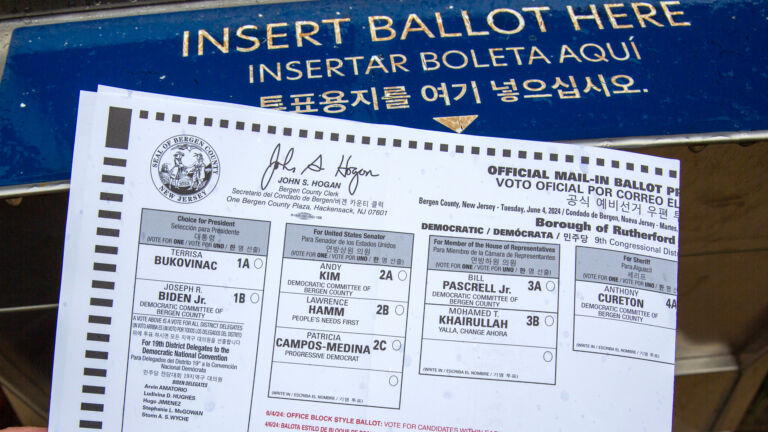
The ballot used for the Democratic primary in June under court order is a possible example of a layout that could be used. Arranged in office-block format, the ballot included not just candidates’ names, but also their “slogan,” including party endorsement.
Committee members’ concerns
Several committee members at the two previous hearings raised concerns that there would otherwise be no way to distinguish candidates on the ballot and help voters know who was running. Several states denote whether a candidate is an incumbent. New Jersey currently does not.
Lawmakers also asked how to show candidates who are running together, such as two Assembly running mates.
‘Voters are not confused by anything other than your system. We are not stupid.’ — Ben Dziobek, Climate Revolution Action Network
“People’s lives are so busy they don’t have time to research and dig through this sort of thing so there has to be some sort of way to guide them and give them information that would help them make an informed decision,” said Assemblyman Gerard Scharfenberger (R-Monmouth).
“I think it would be best to have it reflected somehow on the ballot itself,” he said. “The average guy or gal just sees names and has no way beyond that to determine what they stand for or who they are aligned with.”
How about neutral?
But advocates pushed back. “New Jersey’s new primary ballot design should aim to be neutral, which includes not grouping any candidates together,” said Nuzhat Chowdhury, an attorney with the New Jersey Institute for Social Justice, adding that bracketing candidates together is problematic and has a “negative impact” on voter choice.
Most advocates who testified last week said it’s up to voters to educate themselves about the candidates, and several suggested the creation of a state voter guide similar to that in a few other states.
Assemblywoman Ellen Park (D-Bergen) was clearly concerned with her future. At both hearings, Park said she will be facing a primary challenge next year from another candidate with the last name Park. Jersey City Mayor Steve Fulop announced that Tenafly Councilman Daniel Park will be running on his ticket next spring.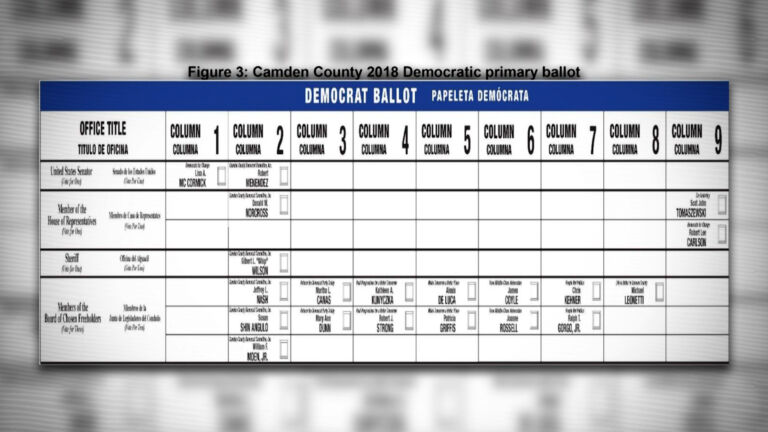
Assemblywoman Park asked how she can distinguish herself on the ballot from someone not likely to get the endorsement of the Bergen County Democratic Party.
“How could I make it clear to the voter I am who I am?” she asked. “What can you recommend or suggest that we can put on the ballot to make some sort of distinction between ourselves?”
Ben Dziobek, executive director of Climate Revolution Action Network, an environmental advocacy group, was blunt in his criticism of those who would support a ballot design at all similar to the county line.
“Voters are not confused by anything other than your system,” he said. “We are not stupid. Please stop implying that if you cannot win an election with just your name — you do have a first and last name — you did not campaign hard enough, and you should not win.”
Underhill said there are several other options that could help county parties maintain some level of control over the process, piquing the interest of at least some members.
For instance, Underhill said, some states allow a person to vote for all Democrats or all Republicans on a ballot by pushing just one button in a general election, though she said she didn’t know how or if that might work in a primary.
She also noted that political parties in a few states have replaced primary elections with party conventions to choose their candidates for the general election.
Whatever the recommendation of the committee there may also need to be some changes to current state law. County election officials testified that current regulations allow for the grouping of candidates running together and for the use of slogans, including those party endorsements, on the ballot — f names only were included on the ballot and not slogans, which are allowed , that would seem to violate the law.
While Coughlin did not set a deadline, state and county officials have said the Legislature will need to act by early March for the changes to be ready for next year’s elections.