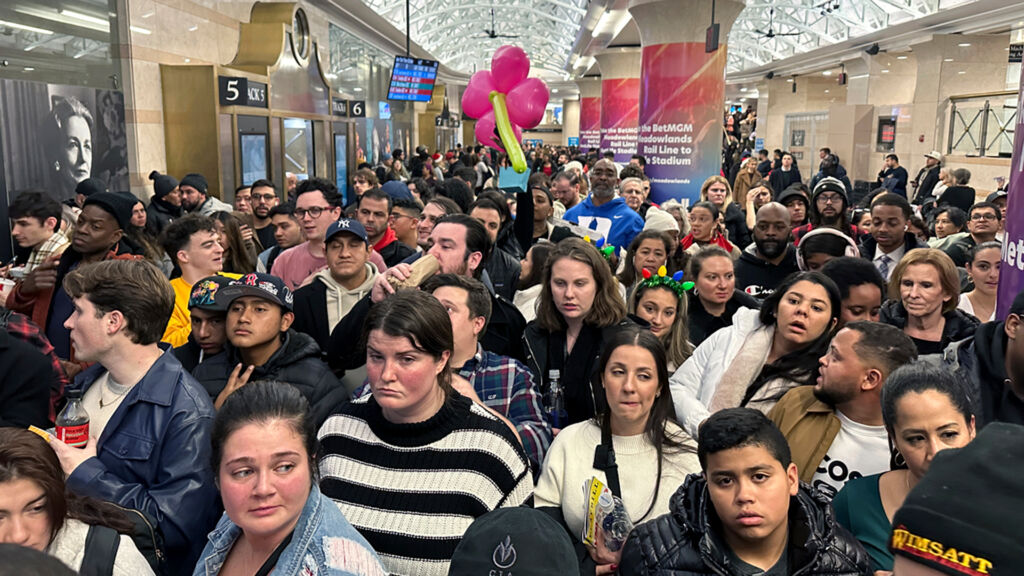
WASHINGTON — A clash likely to affect the future of passenger rail in the American Northeast for decades, in particular for New Jersey riders in the north of the state, is now playing out.
The contours of the dispute came starkly into view after rail agencies that use New York’s Pennsylvania Station, the busiest rail hub in the country, last week said they have no option but to physically expand the footprint of the station to meet passenger demand.
The expected target of that expansion? A city block directly south of the station, across West 31st Street.
Broadly, those opposed want to protect that block and propose Penn Station handle ridership increases by implementing “through-running” — trains would not terminate there but carry on with passengers to the next stop — and create an integrated regional rail network that allows riders to move smoothly.
Terminal stations are the final stop to a line, where trains unload their passengers, then depart empty. By contrast, stations with through-running services allow trains to pick up and drop off riders before continuing on, with riders, to another stop.
“The decisions that are going to be made around Penn station are going to have implications” across the Northeast, Tom Wright, president and CEO of the Regional Plan Association, an independent nonprofit group, said in an interview.
“New Jersey readers have a lot at stake in this debate,” he said. “The opportunity here is enormous.”
The big Penn questions
Central to the debate are questions over how Penn Station, a transportation nexus in the greater New York metropolitan area, should be run, how it should grow and whether to pursue a broader integrated rail network that links Manhattan with its surroundings and allows riders to move smoothly between rail systems.
The agencies that use Penn Station — Amtrak, New Jersey Transit and the MTA, which operates the city subway plus the Metro North and Long Island Rail Road systems — last week buttressed their argument with a study.
Pointing to the likely increase in ridership due to the Gateway Program, a $16-billion public works project to add two new tunnels under the Hudson River, in turn doubling the train volume between New Jersey and New York, the agencies said expansion had to happen.
Gateway work has begun and is expected to finish in 2034.
“This study demonstrates that to meet the needs of the region, we must expand the station beyond its existing footprint to deliver the passenger capacity promised by the Gateway Program,” said Stephen Gardner, CEO of Amtrak.
Arguing for expansion
Kevin Corbett, president and CEO of NJ Transit, agreed. “The findings of this study highlight the critical need for a comprehensive approach to increase capacity at New York Penn Station.”
The study examined the potential of digging deeper to build new tracks beneath existing ones at the station. Its authors also considered “through-running.” They found that while it would boost the station’s capacity to 40 trains per hour — short of Amtrak’s 48-trains-per-hour goal — it would also require the station’s existing platforms to be widened.
Once Gateway is done, train operators will go from two tunnels, completed more than a century ago, to four beneath the Hudson, doubling their capacity.
‘We’re furious. It’s not the right time to be throwing people out of their homes.’ — Sam Turvey, ReThink Penn Station
Entering Penn Station from New Jersey can be particularly slow, as trains need to let one another pass in the tunnels.
More tunnels connecting Newark’s train station and New York Penn Station, a notorious bottleneck, would likely mean better service in and out of the New York station and the elimination of transfers for some NJ Transit riders.
In 2020, former New York Gov. Andrew Cuomo revealed plans for a new station, to be called “Penn South,” that would require the demolition of a full block south of the current station.
Arguing against expansion
Sam Turvey, who leads a group called ReThink Penn Station, is a vocal opponent of that plan. Instead, the station should be used more efficiently with through-running, Turvey said, citing support from Andy Byford, a former MTA executive who has endorsed the concept at Penn Station.
“We believe you can accommodate all the needed capacity,” Turvey said in an interview with NJ Spotlight News, “without demolishing the neighborhood to the south.”
“We’re furious,” he said of the report issued last week. “It’s not the right time to be throwing people out of their homes.”
To complement more through-running, something Amtrak does on its line that runs from Boston to Washington, D.C., which includes a stop at Penn Station, the New York region and its overlapping rail systems should be folded into one integrated system that works together, Turvey said.
What has worked elsewhere
“New York is very ripe for that,” Turvey said, forecasting a new rail system with hubs in New Jersey and New York City boroughs beyond Manhattan, in particular Queens and the Bronx. The rail systems of the wider London and Paris areas, among other cities, work in a similar manner.
A multi-hub rail approach could transform American cities for the better on a New Deal-era scale, Turvey said. “It’s not the same as rural electrification in the Depression, but it has some similarities,” he said. “This has been wildly successful in Europe and the United States and in Canada and Australia.”
Wright, of the Regional Plan Association, is warm to the concept of through-running. But it’s not a panacea, he said.
“It would be nice to expand through-running” to NJ Transit and the Long Island Rail Road trains, he said.
‘The underlying problem is that the platforms and tracks have a very inefficient layout.’ — Rick Harnish, High Speed Rail Alliance
NJ Transit trains that emerge on the east side of Penn Station go to a rail yard in Queens, while LIRR trains that pop out of the station’s west side linger in a Manhattan rail yard before they’re ushered back to action.
A broader use of through-running would likely require new rail yards and construction, Wright said.
“The trains would have to turn around somewhere else,” he said. “There’s no free lunch here.”
By the numbers
About 340 NJ Transit trains, on average, use Penn Station on weekdays, according to Jim Smith, an NJ Transit spokesman. On the weekends, that number drops to 150.
Average daily ridership volume at Penn Station, including Amtrak, NJ Transit, the LIRR and the subway, is 600,000, said Jason Abrams, an Amtrak spokesman.
Volume at the station jumped in recent years, climbing from about 5.4 million riders in the 2020 budget year — when the COVID-19 pandemic squashed transit ridership figures worldwide — to more than 10.2 million in the 2023 fiscal year.
For comparison: The tally for fiscal year 2022 was 8,008,700, Abrams said.
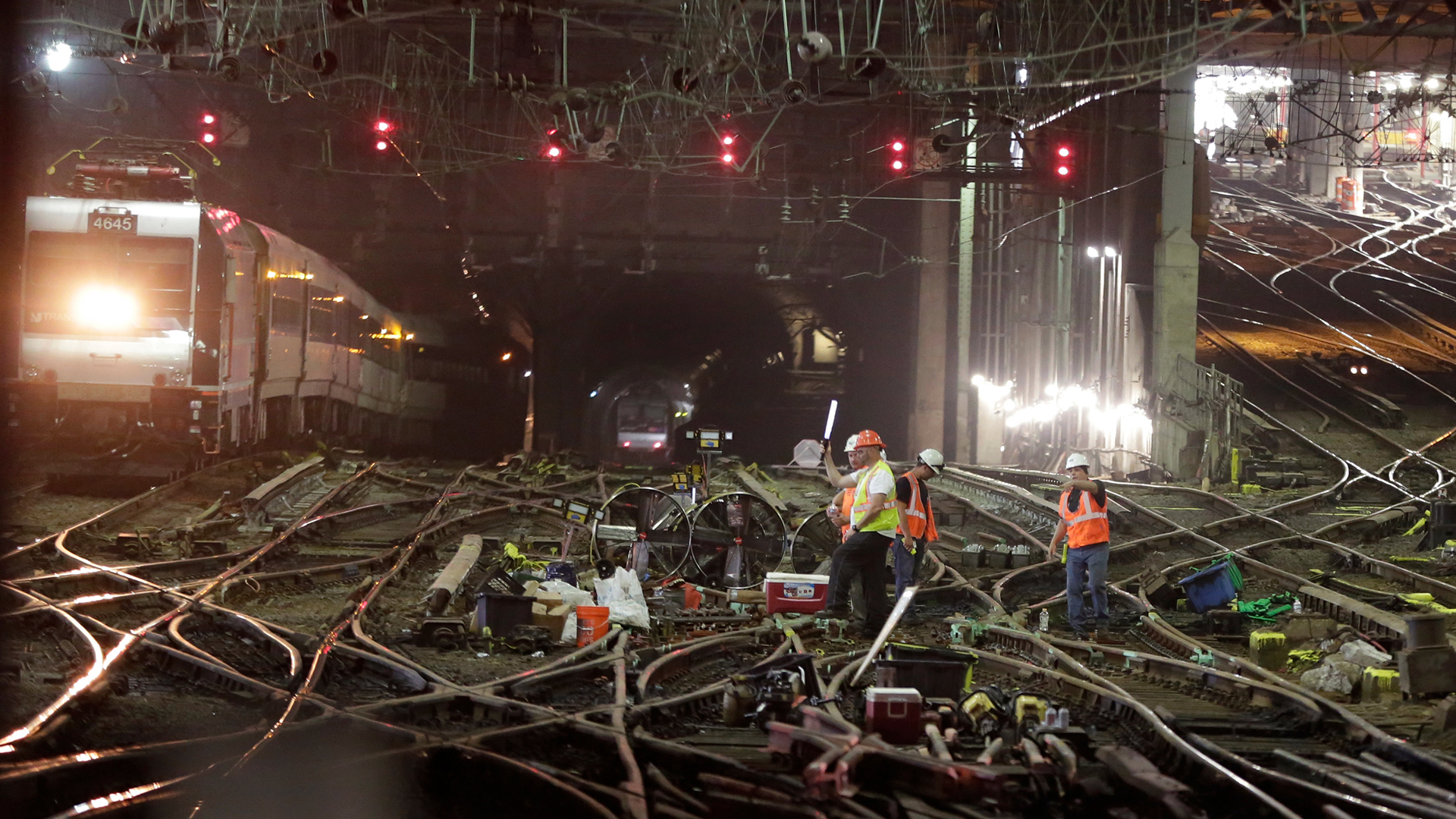
“The underlying problem is that the platforms and tracks have a very inefficient layout,” Rick Harnish, executive director of the High Speed Rail Alliance, a nonprofit rail advocacy group headquartered in Chicago, said in an interview.
“If you were to build it today, all of the tracks would be aligned, straight,” Harnish said. “You’d build the thing so trains could easily run through.”
 Credit: (AP Photo/Richard Drew)
Aging infrastructure, surging train volume and the fact the rail agencies use different electrical equipment muddies the picture at Penn Station, Harnish said.
More support for ‘through-running’
He, too, thinks through-running is a good idea. “If we were in a minor European city, they would have figured out how to create one unified system,” he said. “It would have happened a couple of decades ago.”
He underscored another issue — the absence of a heavy-hitting agency with an ambitious plan.
“What it comes down to is we really need a much bigger federal railway program to fix this and other things,” Harnish said. “That is a core problem. There’s no big picture.”
‘New York’s a big city, there are a lot of transit priorities, and sometimes it feels like Penn sucks up not necessarily all of the money, but all of the oxygen.’ — Danny Pearlstein, Riders Alliance
Service a few blocks east, at Grand Central Madison, a train station layered below Grand Central Terminal that connects with the LIRR, opened last year. It cost more than $11 billion.
People who decide the future of Penn Station must learn from that “unforgivable” project, said Danny Pearlstein, policy and communications director for Riders Alliance, an advocacy group for subway and bus riders.
The high price for one rail stop while other rail and bus stops struggle for funding is galling, Pearlstein said.
“For us the cautionary tale is actually not Penn, it’s Grand Central,” he said in an interview.
Flash and cash
Such high-profile transit projects draw politicians’ eyes and distract from the needs of rail and bus service at less flashy stops, he said.
“It’s a jobs program, it’s an opportunity to cut a ribbon, to prove you can get things done, to celebrate an infrastructure week,” Pearlstein said. “But for millions of people, in particular in the New York area, it’s a lifeline.”
Pearlstein said he was not necessarily opposed to expanding Penn Station, but that the public should be wary, in particular when equipment problems this year, for NJ Transit and Amtrak, have gummed up service for riders.
In late August, both agencies said they were not sure about the “root causes” of those delays.
“New York’s a big city, there are a lot of transit priorities, and sometimes it feels like Penn sucks up not necessarily all of the money, but all of the oxygen,” Pearlstein said.