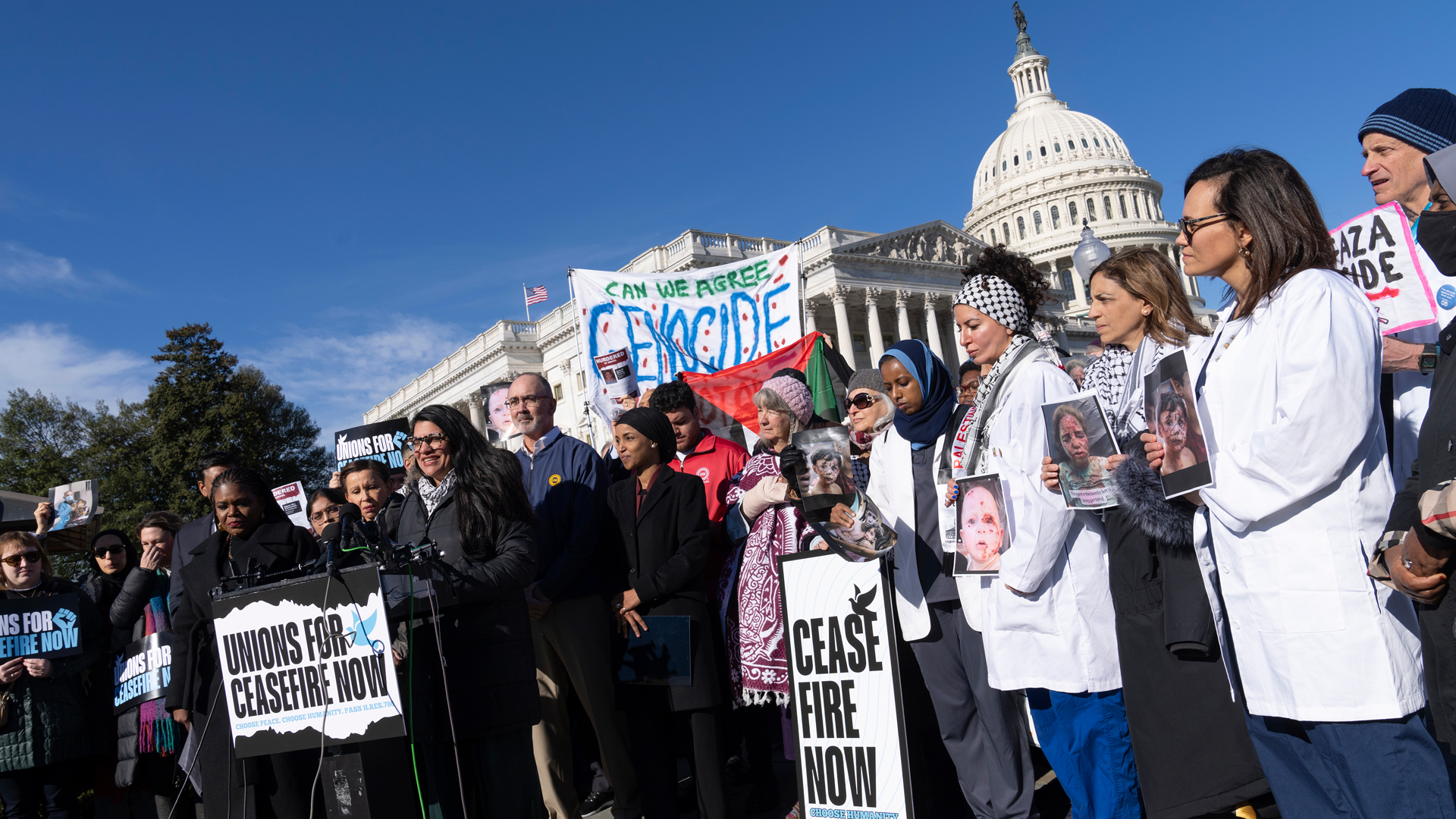
 Credit: (AP Photo/J. Scott Applewhite)
More and more left-leaning voters say they’re voting for a third-party presidential candidate, or not voting at all, in this election because of the Democratic Party’s support of Israel and the war in Gaza.
The movement is growing among left-leaning voters in New Jersey, who say they are disappointed by the party’s “failed promises” of social change and for not doing more to end the war.
Ali Aljarrah of CAIR Action New Jersey, which promotes civic engagement for American Muslims, called it a “movement to stop the bleeding and start the healing.”
“American tax dollars [are being used], American weaponry, and nothing’s being done about it. So of course they’re going to decide to vote third party. Of course [voters] are going to be disengaged. Of course they’re going to be very vocal and outspoken about this,” said Aljarrah.
An October Gallup poll said support among Democrats for third parties increased from 46% last year to 53% this year. And a recent GenForward survey said that 36% of Black, 57% of Asian American and Pacific Islander, 44% of Latino, and 53% of white Gen Z voters were “dissatisfied” with only having two major parties.
What happened in 2000, 2016
It’s a stance that’s controversial among the left: some Democratic Party officials are worried that third-party voters could cost Vice President Kamala Harris the election in a race that appears it may come down to just a few thousand votes in key states.
Those officials also say these voters are the reason former presidential candidate Hillary Clinton lost important swing states in 2016. In that election, 6% of voters nationwide chose third-party candidates.
And in the 2000 election, some Democratic Party officials also blamed the Green Party’s Ralph Nader for taking votes away from former presidential candidate Al Gore, who ultimately lost the electoral votes of Florida and the presidential race. Nader said in a recent interview the party used him as a “scapegoat” and signaled there were greater party issues to blame.
“What I regret is 330,000 Democrats who voted for Bush in Florida. What I regret is, you know, the shenanigans with the ballot design, and the hanging chads, which deceived people,” Nader said, when asked in the interview about his regrets following the 2000 presidential campaign.
Giving voice to frustration
Several third-party presidential candidates will appear on ballots in New Jersey, including the Green Party’s Jill Stein, and the Party for Socialism and Liberation’s Claudia De La Cruz, who are attracting the votes of disenchanted left-leaning voters.
New Jersey voters have given the state’s electoral votes to Democratic candidates since the 1992 presidential election and are expected to do the same this year. New Jersey left-leaning political organizers say voting third party, or not voting for a presidential candidate, is about signaling objections to the Democratic Party’s support of Israel.
“New Jersey is a blue state … so we’re not going to make a difference [electorally],” said Aljarrah of CAIR Action New Jersey. “But people do want to be able to express their voice.”
CAIR Action New Jersey put together a state voting guide, Aljarrah said, after Muslim community members asked the group which candidates they should consider voting for. The guide notes whether federal, state and local candidates support a ceasefire in Gaza, support an arms embargo on Israel or are allies of the Muslim community.
In the presidential candidate section of the guide, CAIR Action New Jersey recommends that Muslim voters select “candidates who support ceasefire, arms embargo, and other just policies, such as Dr. Jill Stein, Claudia De La Cruz, Joesph Kishore, and write in candidate Dr. Cornel West.”
Looking for ceasefire, arms embargo
Aljarrah said the Muslim community doesn’t always see politicians who listen to or understand their perspective.
“The Muslim community is looking for representatives that are at least on the federal level, [calling] for a ceasefire and [calling] for an arms embargo,” Aljarrah said.
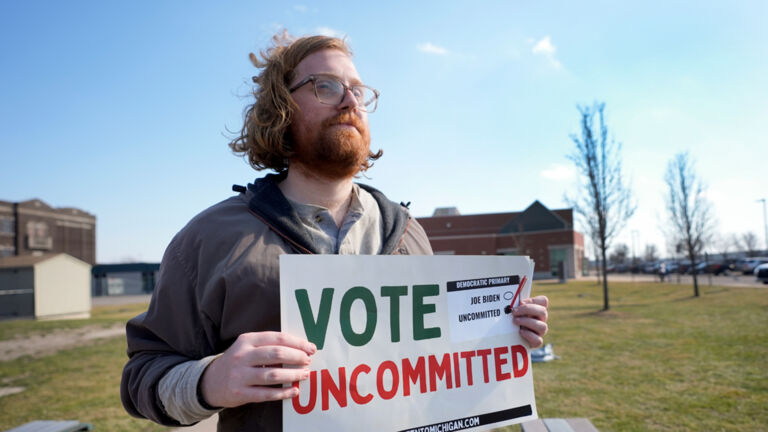
“It seems like there might be the case that the people who are choosing to take an anti-war, anti-genocide stance could potentially swing this election. And so we were trying to make the best use of the time leading up to Nov. 5 to leverage that electoral power,” she said.
While the group is not making endorsements, it’s encouraging voters to choose “anti-genocide candidates,” said Manicastri. The campaign has put together a petition for voters who are withholding their vote from Harris and Democratic congressional candidates.
“Our petition says we will vote for you if you deliver in arms embargo and a ceasefire prior to the election. And so we’ve given the Democratic Party the opportunity to earn our votes. They have chosen not to take policy positions that are favorable among the majority of their voter base,” said Manicastri.
Feeling unrepresented
Caroline Habib, an Egyptian American voter in Middlesex County, said she is worried about her friends and family if Israel expands the war across the region. She is unsure whether she will write in a presidential candidate or leave that line blank.
Habib said she supported Sen. Bernie Sanders (I-VT) in 2016, and since then, doesn’t feel represented by the Democratic nor the Republican Party.
“I also keep going back and forth with it, because what does another Trump presidency look like, and how much does my vote really matter when I’m the one living just in New Jersey, and we’re more than likely just going to end up being a blue state regardless?” she said.
Democratic Party officials have attempted to reach third-party voters through a targeted ad in swing states, saying in a video that “a vote for Stein is really a vote for Trump.”
Third-party voters or campaigners who spoke to NJ Spotlight News acknowledged fears of a Trump presidency but pushed back on the argument. Manicastri said the nation is “always weaponized against the left and marginalized workers who refuse to accept crumbs from Democrats, when it’s really a question Harris voters should be asking themselves.
“If their concern is that Harris may lose this election, why not place their energy into pushing her towards a policy position [arms embargo] that would almost guarantee her victory rather than continue to scold voters who reject the premise of genocide as an acceptable condition?” Manicastri told NJ Spotlight News.