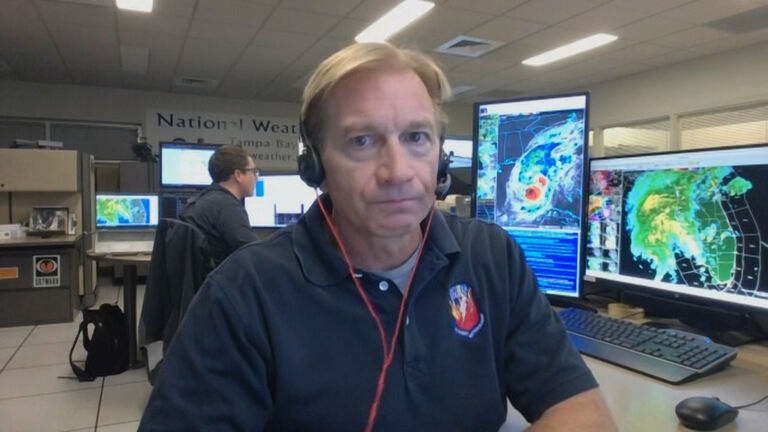
Credit: (NOAA via AP)
WASHINGTON — David Robinson, New Jersey’s state climatologist, has seen timely weather data save lives.
During Hurricane Ida in 2021, two months’ worth of rain fell in six hours across “a populated swath of New Jersey,” prompting a flash flood emergency, Robinson said.
“Thirty lives were lost that night due to drowning in New Jersey,” he said, adding that the flash flooding caught people off guard. “But there was also the strongest tornado in New Jersey since 1990 earlier that evening, down in Gloucester County, and there wasn’t even a serious injury, because warnings were issued and people knew what to do.”
In an interview with NJ Spotlight News about what has been a brutal hurricane season, Robinson spoke about the role of emergency services to prepare for and respond to storms.
“Just look at the number of fatalities from tornadoes in this country compared to what it was decades ago,” Robinson said last week, after Hurricane Helene had died out and the morning after Hurricane Milton made landfall in Florida. “You would see death tolls explode, frankly, without proper warnings.”
Project 25 assault
Such warning services have been in the crosshairs of some conservative efforts to privatize or even abolish them. One proposal in the now-infamous Project 2025 policy blueprint would break up the National Oceanic and Atmospheric Administration, or NOAA, a hub of weather and climate data that also houses the National Weather Service and the National Hurricane Center.
NOAA owns or operates 18 satellites along with thousands of ocean buoys, mobile observation platforms and coastal stations.
 Credit: (AP Photo/Julio Cortez)
That web of equipment produces timely weather data used worldwide, including during extreme events.
Private-sector forecasters and meteorologists lean heavily on the data that comes through NOAA and could not do their jobs without information from the agency, Robinson said.
“To this very day, hurricane warnings, severe thunderstorm and tornado warnings, are issued by NOAA through the National Weather Service, the National Severe Storm Center, through the National Hurricane Center,” Robinson said.
“The private sector does not try to jump them and issue their own warnings,” he said.
The push to privatize
Project 2025, a sweeping 922-page document calling for wholesale changes to the federal government, has called that notion into debate.
“Each day, Americans rely on weather forecasts and warnings provided by local radio stations and colleges that are produced not by the [National Weather Service], but by private companies such as AccuWeather,” reads a section of the document, published by the Heritage Foundation, a right-leaning political advocacy group.
“The NWS provides data the private companies use and should focus on its data-gathering services,” the document continues, using the abbreviation for National Weather Service. “Because private companies rely on these data, the NWS should fully commercialize its forecasting operations.”
 Credit: (AP Photo/Mike Carlson)
Project 2025 authors also state that there is a “climate debate” — that there are two legitimate cases to make about the fact that humans are heating the planet — and call for the “break up” of NOAA.
“It should be broken up and downsized,” the report continues.
The authors claim NOAA is “one of the main drivers of the climate change alarm industry” and call for the elimination of the agency’s wing dedicated to oceanic and atmospheric research. “The preponderance of its climate-change research should be disbanded,” they wrote.
Private versus public
Robinson didn’t discuss climate politics but did question how a private operation could match what NOAA does.
“They couldn’t possibly do it and operate the satellites and operate all the weather models and gather and archive all the surface data,” he said. “And we’re just talking forecasting, let alone archiving the nation’s climate history so we understand what climate has been in the past.”
Robinson added: “Someone could spend billions on doing this, but they have to charge an arm and a leg for a forecast every time you want to get on your computer and log in to get a forecast.”
Depending on the National Weather Service
If government weather data were privatized, people like Princella Talley, a Louisianan who has made it through three hurricanes, might have to subscribe to a weather service to get forecasts during a storm.
Before Hurricane Laura hit Louisiana in 2020,Talley relied on the National Weather Service to prepare.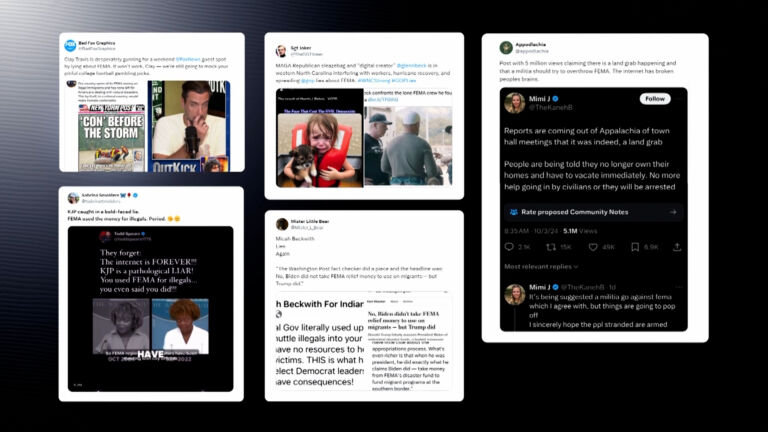
“I estimate that about 90% of my information came from the NWS and the other 10% was word of mouth from friends and family who were also relying on both local news alerts and the NWS,” Talley, 37, a writer and editor who lives in Richmond, Va., said by email.
Based on National Weather Service alerts, Talley managed to get some sandbags in place before Laura arrived. “My house still flooded, but the flooding would have been much worse had the sandbags not been in place.”
Political allegiance doesn’t come up in an emergency, she said. “Storms do not discriminate based on our backgrounds or political views.”
Still, she said, the “divisive rhetoric in our current political climate trickles down into a general distrust of all news media reporting, including weather reports.”
The politics of climate change
According to a Pew Research Center poll published in July, 72% of Americans had experienced extreme weather in the previous year.
The survey found 57% of Democrats had experienced unusually hot weather, versus 34% of Republicans.
It also found 65% of Democrats said climate change “contributed a lot” to severe weather events, like floods or storms. Among Republicans, that figure was 23%.
By warming the world’s oceans, climate change increases surface water temperatures, fueling stronger hurricanes. It also causes sea levels to rise, making storm surge worse.