Credit: (AP Photo/Matt Rourke)
WASHINGTON – In the face of a historic warming streak, Republicans this Congress and their candidate for president, Donald Trump, are pushing to expand the use of planet-heating fossil fuels.
Last month was the hottest July ever recorded, scientists at the National Oceanic and Atmospheric Administration said last week.
“We are at or near record warmth for the globe,” Karin Gleason, monitoring section chief for NOAA’s National Centers for Environmental Information, told reporters Thursday.
July was the 14th month in a row of global record-high temperatures, and NOAA estimated a 77% chance that 2024 will be the warmest year on record, dating back to 1850, when recordkeeping began.
This year is almost certainly going to be among the top five warmest, NOAA said.
As humans warm Earth, the U.S. remains the top producer among nations of oil and gas, fossil fuels that warm the atmosphere when burned, and Republicans have supported steps to produce more energy from fossil fuels and cut federal climate programs.
The Republican approach
Trump for years has questioned the basic fact of established climate science — that humans are warming their only home to a dangerous degree by burning fossil fuels — and promised to roll back climate regulations if reelected.
In February, on a largely party-line vote, the House voted 224-200 to increase the export of liquefied natural gas, or LNG, by removing trade restrictions.
New Jersey’s House Republicans, Reps. Jeff Van Drew, Chris Smith and Tom Kean, voted for the bill (H.R. 7176), while every Democrat from the state voted against it.
On a separate bill (H.R. 1023) to eliminate an Environmental Protection Agency program which provides billions of dollars’ worth of aid for states to cut their greenhouse gas emissions, New Jersey members’ votes broke down along the same lines.
Neither bill will become law this Congress because they would have to get through the Senate, where Democrats, who broadly oppose increasing fossil fuel production, hold a majority.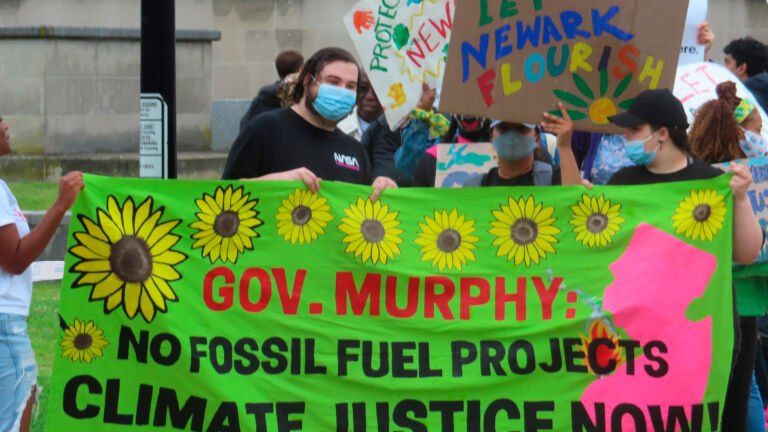
Representatives for Van Drew, Smith and Kean did not respond to questions about why they voted for the bills or their plans to lower emissions.
In February, the European Union’s Copernicus Climate Change Service, said the planet had warmed 1.5 degrees Celsius since the Industrial Revolution of the 1800s, when humans began burning fossil fuels, the primary driving force behind climate change.
While 1.5 Celsius, or about 2.7 degrees Fahrenheit, may not sound like much, that is an average temperature, meaning warming can be significantly higher in different parts of the planet, such as the sensitive polar regions.
Avoiding the worst
Scientists say society must thwart warming from exceeding 1.5 degrees to avoid a point at which warming accelerates through a series of cascading events like melting ice caps, thawing permafrost and spiking emissions of methane, a highly potent greenhouse gas.
The EPA program the House bill would have cut is a $27 billion program created under a climate, health and tax law Congress passed.
Drought conditions can fuel wildfires, prevalent in the western American states and Canadian provinces, that then fling smoke eastward to states like New Jersey.
While experts say that law is one of the most significant climate laws in U.S. history, and the Biden administration and congressional Democrats have touted it, the U.S. is an oil-producing powerhouse.
That has only expanded under the Biden administration. From 2018 through 2023, the “United States produced more crude oil than any nation at any time,” the Energy Information Administration said in March. The country is also the top global producer of gas.
Effects in NJ
Global warming has regional and local effects, as New Jersey residents learned last summer, when smoke from Canadian wildfires blanketed the state in an orangey haze and state officials issued public health warnings.
“Drought has recently worsened in the western United States,” Andy Hoell, research meteorologist at NOAA’s physical sciences laboratory, said Thursday.
Drought conditions can fuel wildfires, prevalent in the western American states and Canadian provinces, that then fling smoke eastward to states like New Jersey.
Rising heat also leads to health risks like heatstroke, as a Union County physician recently told NJ Spotlight News. “Every summer is the hottest of them all, it seems,” said Nicole Henry-Dindial, a clinical professor at Rutgers New Jersey Medical School.
Climate models like the EU’s Copernicus or the models NOAA uses have small differences, but they are all showing the same basic results, Gleason said.
“In general, they’re all saying essentially the same thing,” Gleason said. “The globe still remains incredibly warm.”
— Chart by Genesis Obando