
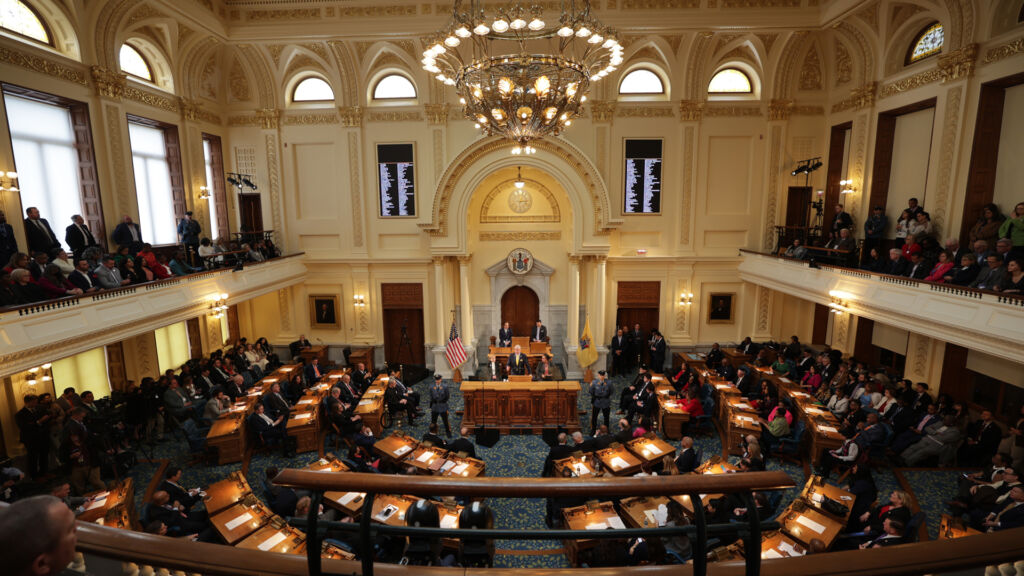
The full details of lawmakers’ last-minute budget requests remain hidden from the public more than a month after those additions helped produce New Jersey’s largest-ever annual budget.
In all, more than $600 million in new spending was added to Gov. Phil Murphy’s final draft of the state budget in late June by Democrats who control the Legislature.
Those additions, which came just days before the July 1 start of a new fiscal year — leaving little to no time at all for public scrutiny — pushed the size of the latest annual budget to a record-high $56.7 billion.
As of last week, written budget resolutions that are supposed to officially document each last-minute add-on, including by disclosing their sponsors, as well as any close ties sponsors may have to funding recipients, have yet to be made available to the public.
The rules for both the Assembly and Senate generally require members to submit the written budget resolutions a full two weeks before the final votes on the annual spending bill, which occurred this year on June 28.
The same rules also require lawmakers seeking the new appropriations, or key changes in budget language, to provide a written statement “explaining the proposed changes and the reasons therefor.”
Those same rules require the disclosure of any business, personal or family ties to “the intended recipient of any increased funding.”
Some of the add-ons
The last-minute add-ons to the budget for the 2025 fiscal year included new funding for food banks and soup kitchens, such as $500,000 for the Trenton Area Soup Kitchen, according to budget documents.
Lawmakers also added more funding for higher education, including $20 million in additional aid to community colleges, budget documents show. And there was also an additional $2 million in funding for the Latino Action Network Hispanic Women’s Resource Center, which is a widely praised organization that provides job-related services as part of its mission.
Some state lawmakers have already begun to take credit for securing added funding in the fiscal year 2025 budget for their preferred projects.
However, there were also more parochial items among this year’s add-ons, such as funding for park projects in Hightstown, Pennsville, Rutherford and South Brunswick, among others. Lawmakers also set aside $4.2 million for “ShoreTown Ballpark Improvements” and $1.5 million for “Trenton Thunder Ballpark Improvements,” according to budget documents.
While these and hundreds of other added line items have already been incorporated into the final spending bill enacted by Murphy, a second-term Democrat, what’s still undisclosed are the names of each individual sponsor.
Other key details associated with each request, such as the disclosures and the justifications for the added spending item, are also still being kept under wraps.
Longtime NJ tradition
To be sure, adding such spending items to a governor’s proposed budget in the final days before it wins the approval of the full Legislature is a time-honored tradition in Trenton.
Moreover, since the state Constitution gives lawmakers the authority to draft the annual spending bill, it provides a direct way for lawmakers to ensure their priorities receive attention — and not just the governor’s. And it also provides lawmakers with a way to secure state funding for high-priority local projects, much like the recently revived federal “earmark” process, all while easing the tax burden on their constituents by using the state budget as a funding source.
More on the late flurry of spending
Some state lawmakers have already begun to take credit for securing added funding in the fiscal year 2025 budget for their preferred projects. This includes $500,000 inserted into the final draft of the budget for “Police Department Capital Improvements” in Jamesburg.
“This investment will make their headquarters more resilient in the face of weather-related disasters, and more able to respond to local emergencies when those events do occur,” said Sen. Linda Greenstein (D-Middlesex) in a news release issued last week.
Pet projects
However, an ongoing analysis by NJ Spotlight News has found that much of the last-minute spending in recent years has paid for pet projects located primarily in legislative districts represented by majority Democratic lawmakers, even though the Legislature itself has more balanced representation, and the revenue used to fund such projects comes from taxpayers of all political backgrounds.
Meanwhile, this year’s decision to allocate funding for items including the local parks and municipal police facility renovations came as some proposals that could have had broader impacts in New Jersey, such as a reversal of a 15% New Jersey Transit fare hike or the continuation of a statewide back-to-school sales-tax holiday, went unfunded.
Last year, the fiscal year 2024 budget resolutions were made public by lawmakers in early September, on the eve of the Labor Day holiday weekend.
Moreover, it’s unclear if any competitive process or merit-based system was used to determine which items were chosen by majority Democrats for the last-minute budget add-ons. Funding for projects is generally distributed through grant programs administered by the executive branch, often with an application process.
Also unclear is exactly how many budget resolutions were submitted by lawmakers and how many of those submissions made it into the final spending bill, all in a year in which the budget itself is carrying a more than $2 billion “structural gap” between planned annual expenditures and revenues.
To close the gap, Murphy and lawmakers are planning to spend down budget surplus, according to budget documents.
Republican criticism
Under legislative rules, the written budget resolutions are required to be made public through the nonpartisan Office of Legislative Services. But when that occurs remains a subject of debate because legislative leaders maintain the rules don’t spell out a clear timeline.
In 2007, more than 400 requested budget changes were published online in mid-June, according to reporting at the time. The resolutions that year were disclosed well before the final budget was adopted — and just months after the former chair of the Senate’s budget committee was indicted on corruption charges related to the annual budget process.
In more recent years, there has been a tradition of not releasing budget resolutions until long after the start of the new fiscal year. Last year, the fiscal year 2024 budget resolutions were made public by lawmakers in early September, on the eve of the Labor Day holiday weekend.
In response to this trend, Republicans have suggested the current practice of delaying the release of the written documentation until well after the annual budget has been signed into law is inviting the same types of abuse that led to infamous corruption scandals of the mid-2000s.
The majority Democrats have defended their handling of the resolutions, in part, by arguing that all the added appropriations and key language changes themselves are made public in the final spending bill before it goes through both full houses, even if the sponsors of each addition and the other details are not made public at that time.
When asked by NJ Spotlight News about the status of this year’s written budget resolutions, and why they have yet to be made available to the public, spokespeople for the Assembly and Senate majority offices declined comment.
