Credit: (AP Photo/Ahn Young-joon)
WASHINGTON — Korean Americans who want to contact relatives living in North Korea could soon have a federal database at their disposal.
Legislation to establish a national repository of information through the State Department about Korean American families in the U.S. as well as separated family members in North Korea sailed through the House on Tuesday.
Under the bill (H.R. 7152), the repository would include information about living and deceased family members in North Korea, an internationally isolated nation of about 26 million.
Countries including South Korea have created similar lists after fighting in the Korean War stopped in 1953.
Since an armistice was reached to end the violence seven decades ago, more than 100,000 Korean Americans have been unable to communicate with family members in North Korea.
In New Jersey, about 98,000 residents are of Korean descent, according to U.S. Census Bureau data.
What other countries have done
Though some countries, like South Korea, have brokered family meetings over video calls, with letters or in face-to-face gatherings, the U.S. has no official method to match Korean Americans with relatives in North Korea.
“There is no formal U.S. government process to help them reunite with their relatives in North Korea,” said Rep. Greg Stanton, an Arizona Democrat. The House-passed bill “aims to fill this gap,” he said.
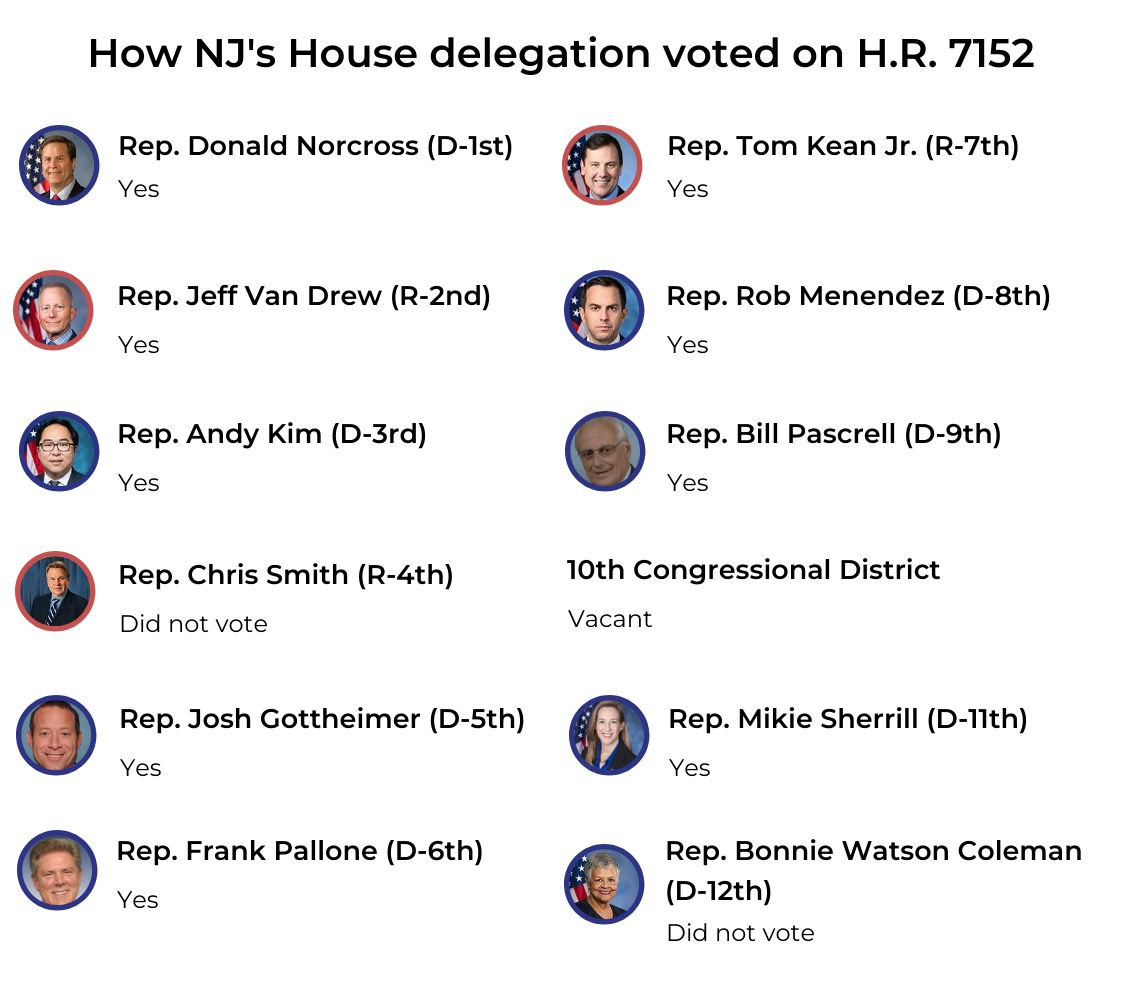
The bill, which has Democratic and Republican sponsors, passed 375 to 8. All votes against were from ultra-right Republicans.
Rep. Chris Smith (R-4th) spoke in favor of the bill on the House floor, calling it “very tender-hearted” legislation.
‘This is a long overdue step to help make these families whole again, fittingly on the anniversary of the start of the Korean War.’ — Rep. Jennifer Wexton (D-VA)
“It recognizes the pain which still lingers so many decades after the Korean War armistice, which divided family members in the north from those in the south,” Smith said. “By creating a registry of those who wish to be united with family members, this bill recognizes the depth of that pain while offering hope that at some point in the future, a more permanent reunion may be possible.”
All New Jersey House members voted for the bill except for Smith and Rep. Bonnie Watson Coleman (D-12th), who has missed votes this month as she recovers from a lower-back condition.
North Korea’s military activities
Though the fighting ceased in 1953, and a family of hardline communist leaders has led North Korea since, the war has not technically ended.
War on the Korean peninsula began at the end of June 74 years ago, and North Korea’s military routinely runs drills along its border with its southern neighbor.
North Korean dictator Kim Jong Un has said in recent months that South Korea is not home to “fellow countrymen” but instead is a separate and “hostile” state.
Last year through this spring, North Korea has tested more than 30 ballistic missiles, including several capable of launching nuclear warheads at other continents.
North Korea is under myriad trade and economic sanctions over its human rights abuses, military behavior, cyberattacks, weapons purchases and cryptocurrency activities. And companies and organizations that engage economically with the country are closely scrutinized.
Since 2005, a South Korean ministry dedicated to unification has facilitated more than 600 letter exchanges across the border and more than 20,000 video messages sent to North Korea, according to the United States Institute of Peace, a nonpartisan independent group headquartered in Washington, D.C.
“This is a long overdue step to help make these families whole again, fittingly on the anniversary of the start of the Korean War,” said Rep. Jennifer Wexton, a Virginia Democrat, principal sponsor of the legislation.