 Credit: (AP Photo/Patrick Semansky)
Vice President Kamala Harris tops the ballot this year as the presumptive Democratic nominee for president, but 2024 is not looking to be a very good year for female congressional candidates nationally.
In New Jersey, however, that picture is mixed.
According to the Center for American Women and Politics at Rutgers University, the number of major-party female Senate and House candidates has dropped nationally, following successive elections that saw record numbers of women running in one or both parties. In both 2020 and 2022, 583 women ran for House seats, but that number dropped to 466 this year. There are 52 women running for the Senate, down from 70 two years ago.
“In both chambers, candidate counts are much closer to where they were in 2018 than to numbers for 2020 and 2022,” said Kelly Ditmar, a political science professor and director of research at the center.
Although local conditions are often responsible for determining who runs, Ditmar said a few more general factors could be responsible for the large drop in female candidates. Two years ago, women saw more opportunities to win because there were more open seats and redistricting may have helped improve their chances. And the increasing partisan divide and gridlock in Washington may also dissuade women from running because they tend to be less interested in political machinations and more focused on being able to accomplish goals, Ditmar said.
NJ numbers
New Jersey bucks this trend. Three of 10 people who filed to run in House primaries were women, including nearly half of all Democrats. In 2022, just 14% of those who filed to run were women. And five of the major-party general election candidates are women — compared with four in 2022.
At least three of the five women are all but certain to win their races: incumbent Reps. Mikie Sherrill in the 11th District and Bonnie Watson Coleman in the 12th, as well as Newark City Council President LaMonica McIver in the 10th. All three are Democrats. McIver won a special primary earlier this month to be the Democratic candidate in a September special election to fill out the unexpired term of the late Rep. Donald Payne Jr., who died in April after the deadline to withdraw from the race. McIver also won a party convention to become the general election candidate for a full two-year term. The 10th is the most Democratic district in the state so her victory is almost guaranteed.
If elected, McIver would be the state’s third woman to currently serve in the House and second woman of color, as well as only the sixth woman ever to represent the state in Congress.
New Jersey could wind up with a fourth woman in the House if Democrat Sue Altman wins her race against incumbent Rep. Tom Kean Jr. in the 7th District. That district has about 18,000 more registered Republicans than Democrats, but The Cook Political Report rates the race a toss-up, likely in part because it has voted Democratic for president in the last two elections.
‘Women voters are key to every election, no matter who is on the ballot.’ — Debbie Walsh, Center for American Women and Politics
Despite numbering close to 51% of New Jersey’s population, women comprise only 21% of the major-party candidates for the House on the November ballot: a third of Democratic candidates and only 8% of Republican.
Only 17% of New Jersey’s House members are women, a number likely to rise to 25% if McIver wins. Nationally, though, close to 29% of representatives are female. A quarter of all senators are women; New Jersey has never sent a woman to the Senate and will not this year, although there is a possibility Gov. Phil Murphy will appoint a woman to serve out the remainder of Sen. Bob Menendez’s term after he resigns, which he has announced will be Aug. 20.
National trend
The Center for American Women and Politics looked at the candidates through the prisms of gender, race and ethnicity and found that women’s candidacies this year have fallen off in all but one area. Nationally, four Latinas are running for the Senate, compared to three two years ago.
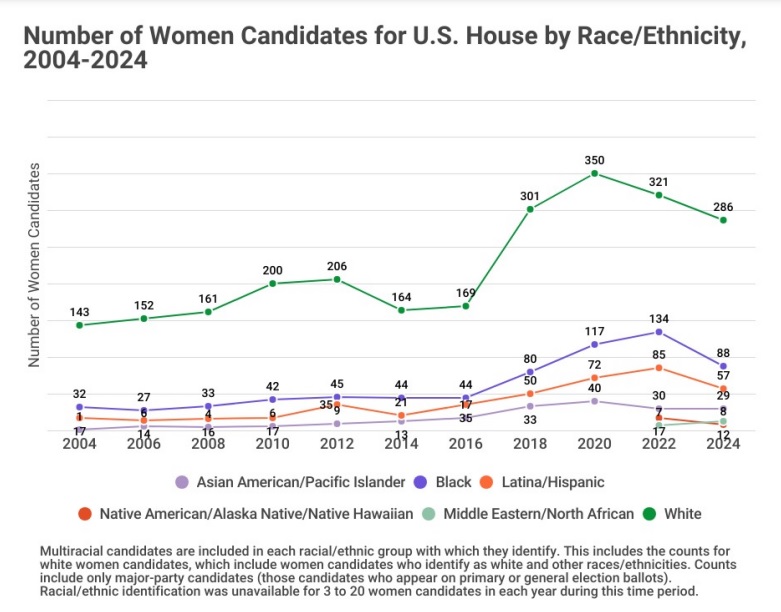
The candidacy of Harris is another bright spot for women. Debbie Walsh, director of the center, said the quick securing by Harris of enough delegates to win the nomination could change the conversation around the race for a host of reasons, including her gender and her Black and Asian background.
“First, Kamala Harris is electable,” Walsh said. “A persistent barrier facing women and specifically women of color in U.S. politics, is the perception that they cannot win over electorates that have long selected white men. This electability bias works to the advantage of white men in politics, but it is one that can be combated and overcome. Already, a woman won the national popular vote for president.
“Women voters are key to every election, no matter who is on the ballot,” Walsh continued. “They outnumber and outvote men … it’s fair to evaluate if and how the vice president’s identities might generate enthusiasm and affinity among voters. Women don’t simply vote for women, and we wouldn’t expect that in 2024. But gender and intersectional identities are tied to lived experiences and perspectives that can be leveraged as values added to a campaign and office holding at least some of the strong enthusiasm for and even defense of Harris and her campaign.”