
 Credit: (AP Photo/Seth Wenig)
State lawmakers have a little over a week to avert a government shutdown and pass a new annual budget that funds everything from direct property-tax relief programs like Anchor to state aid for public schools.
Also still hanging in the balance is Gov. Phil Murphy’s call for a $1 billion tax hike on the most profitable companies doing business in New Jersey.
That tax proposal has been widely panned by leading business-lobbying groups, but the revenue from it is needed to fund Murphy’s record-high $56 billion spending plan for the new fiscal year that begins July 1.
Under the New Jersey Constitution, state government is required to shut down if an annual spending bill is not introduced, approved in both houses and signed into law by the governor, all by July 1.
Lawmakers — who earlier this year voted to give themselves a big pay raise — received a final revenue update from the Department of the Treasury during budget committee meetings in mid-May.
Those meetings closed out a lengthy public review of Murphy’s budget proposal, which he put forward in late February.
More on the long wait for final budget details
Decisions to be made
But since then, majority Democrats who control both houses have yet to formally introduce a spending bill or the legislation needed to establish the corporate-tax hike sought by Murphy, who is also a Democrat.
Several other tax and fee hikes needed to support Murphy’s record-high, $56 billion spending plan are also pending in the Legislature in the run-up to the deadline.
Lawmakers, who voted earlier this year to hike their annual pay from $49,000 to $82,000, starting in 2026, have so far rebuffed calls for a more timely and transparent budget process.
It was just last year that more than $1 billion in new spending was added by Democratic lawmakers to Murphy’s final draft of the annual budget, but only following private budget negotiations that played out in the final days before the constitutional deadline.
Amid last year’s rush to beat the shutdown clock, lawmakers canceled all public comment on the final appropriations bill prior to crucial budget committee votes in both the Senate and Assembly.
Change is possible
Earlier this week, NJ Spotlight News highlighted suggestions that have been put forward by policy experts and others who have been calling for an overhaul of the largely opaque nature of the final stages of New Jersey’s annual budget-making process.
Examining that budget-making process is part of The Change Project, a multimedia series from NJ Spotlight News that for the last several months has highlighted possible solutions to some of New Jersey’s most pressing social and economic problems.
Among the ideas put forward by policy experts from across the partisan divide is a proposal that would see the Legislature itself face a set deadline for the formal introduction of the annual spending bill, just as the governor each year must generally reveal to lawmakers his latest budget vision before the end of February.
The identities of the individual sponsors of last year’s last-minute revisions to Murphy’s final draft of the annual budget were not formally disclosed to the public by legislative leaders until months later.
Indeed, even Murphy, who is now term-limited after winning reelection in 2021, has acknowledged concerns about this stage of the budget-making process.
“There’s an enormous amount that gets done at the last minute, and so I’ve said for several years, I would support … some mechanism at the end, that there’s a minimum 72 hours to review X or Y,” Murphy told a group of municipal-finance analysts in New York City earlier this year.
“I, in particular, think it would help our residents, advocates, other stakeholders feel like they had a process that they were really a part of,” he said.
Lack of transparency
For their part, lawmakers — whose earlier vote grants them a raise from $49,000 to $82,000 a year starting in 2026 — have so far rebuffed such calls for change.
Moreover, the identities of the individual sponsors of last year’s last-minute revisions to Murphy’s final draft of the annual budget were not formally disclosed to the public by legislative leaders in both houses until months later.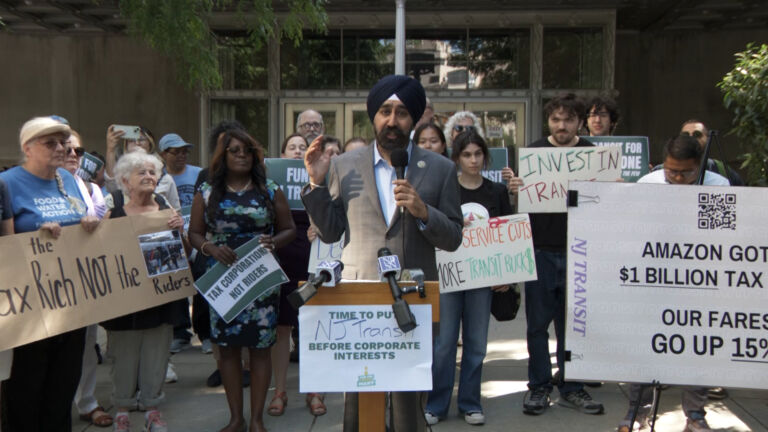
That left the public with no way to verify in real time whether those seeking the add-ons had any conflicts of interest, such as family ties to recipients of the added spending.
The last government shutdown in New Jersey occurred in 2017, after Republican Gov. Chris Christie and the Democratic-controlled Legislature remained deadlocked on a new budget until July 3. It was a time perhaps best remembered for the infamous aerial image of Christie and his family on the beach in the Island Beach State Park when it was closed to the public.

