 Credit: (Giorgio Trovato via Unsplash)
WASHINGTON — Rodney Frelinghuysen has not been in Congress since January 2019. But his campaign is still active — in a sense.
Just since 2023, Frelinghuysen’s campaign account has cut checks for 19 candidates running for Congress or elected positions in New Jersey, including a $2,000 donation to fellow Republican Jon Bramnick, who is running for governor.
In March, Leonard Lance, who represented New Jersey’s 7th Congressional District until 2019, gave $500 to the campaign for Curtis Bashaw, the GOP nominee for the U.S. Senate.
And former Rep. Albio Sires, now mayor of West New York, gave $2,000 to the primary campaign of Rep. Rob Menendez, a fellow Democrat who succeeded him in Congress. The Sires campaign also made contributions worth $10,500 to an organization linked with Union City Mayor Brian Stack; a $2,500 gift to a civic group former Gov. Jim McGreevey started, and $26,000 last year to a political campaign that helped Sires win the mayor’s office.
‘Having pots of money that can be tapped indefinitely can raise questions.’ — Michael Beckel, research director, Issue One
These transactions are slivers of a political reality that exists after the glad-handing, speechifying and door-knocking is over: When campaigns end, candidates retire, lose reelection or die, the spending that fueled their runs for public office continues.
This overlooked world of post-election political spending has prompted bipartisan interest in Congress to require campaigns to close out these so-called zombie campaigns, placing particular focus on lobbyists and foreign agents. But legislation to do so is highly unlikely to become law soon, leaving former candidates the chance to use their donors’ money to scare off would-be rivals, aid political allies and give money to benefit their lobbying interests.
Winding down
Under Federal Election Commission rules, once a campaign ends, its funds can be used to wind down the operation by paying for moving costs, staff salaries and making “nominal” donations to people other than the candidate’s family.
The campaign arm of the late Rep. Donald Payne Jr., who represented the 10th Congressional District until his death in April, is in this wind-down process, spending on costs like payroll, health insurance, taxes, office rentals and storage space.
Excess money can also legally be given to charities, as long that payment doesn’t benefit the candidate personally.
Former New Jersey Sen. Bob Torricelli kept an active campaign account until 2016. He left the U.S. Senate in 2003.
“The biggest bright line is that campaign contributions are supposed to be used for campaigns,” said Michael Beckel, research director at Issue One, an advocacy group seeking to reform political spending. “Having pots of money that can be tapped indefinitely can raise questions.”
Some of the pots of campaign money still registered and active at the FEC, the national agency that regulates federal campaigns in the U.S., date back to the 1970s. A campaign account for John LaFalce, a Democrat who represented western New York for decades, is still active. It donated $21,328.02 from 2023 through March of this year, largely to charities and for financial operating costs.
Waxman to Waxman?
Over the same period, a campaign account for former California Democrat Henry Waxman, who left Congress in 2015, has been sending money to charities like Doctors Without Borders, the American Civil Liberties Union and the Kennedy Center, as well as Democrats running for office.
A registered health lobbyist, Waxman appears last year to have sent himself $6,960.31 from his campaign account, which was registered July 11, 1978.
 Credit: (AP Photo/Joe Marquette)
The account has also made dozens of payments to someone named Henry Waxman listed at mailing addresses in Maryland and Washington, D.C. Since he retired from Congress in 2015, Waxman has stayed in the Washington region, where he runs a public affairs and communications company.
And former New Jersey Sen. Bob Torricelli kept an active campaign account until 2016. He left the U.S. Senate in 2003.
A more recent “zombie” account is the 2012 presidential campaign of former Speaker Newt Gingrich, which is more than $4.6 million in debt and owes money to an array of vendors.
New career as lobbyist
Since Frelinghuysen retired — Rep. Mikie Sherrill (D-11th) now holds his seat — he has lobbied for a variety of clients, including automaker Hyundai, consulting firm McKinsey & Company and the Chinese tech giant Alibaba, records show.
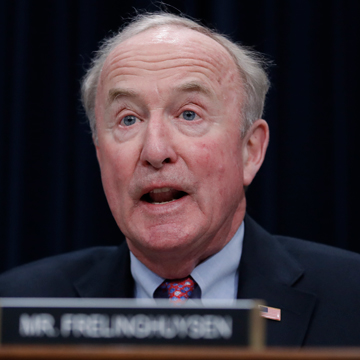 Credit: (AP Photo/Carolyn Kaster)
“There is no timeline on which the FEC requires politicians to wind down their campaign accounts,” Beckel said during an interview with NJ Spotlight News.
Millions in the bank can also serve as a deterrent against future challenges, enabling a lawmaker who is out of office to cast their political shadow over a given seat. They can also be a springboard back into office.
“They might use it to run for higher office,” said Anna Massoglia, editorial and investigations manager at OpenSecrets, the nonpartisan watchdog group that tracks money in state and federal politics.
Neither Waxman nor Frelinghuysen returned requests for comment about why their accounts are still active and who is in control of the money.
‘I didn’t have that kind of money’
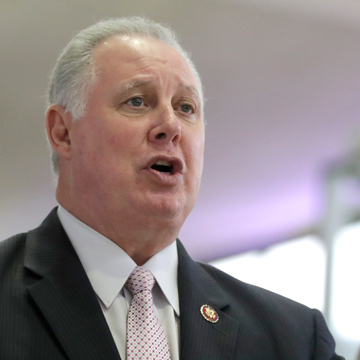
Sires, who served in the House from 2005 until 2023, said in an interview his campaign account should be shut down over the summer, after bookkeeping costs were paid.
 Credit: (AP Photo/Julio Cortez, File)
“Did I have $100,000 when I left? I don’t even know,” Sires said by phone. “It’s going to run out pretty soon,” he said. “Believe me, I don’t want to have that hanging over me.”
His campaign account had about $20,000 left at the end of March, the latest filing period available. Sires contrasted the money he left with after he departed Washington with the campaign money of other departing members.
“You’re allowed to carry them for as many years as you want,” Sires said of the dormant campaign account practice. “There are people that walk out of there with $1 million or $2 million,” he said of retiring members of Congress. “I didn’t have that kind of money.”
Little evidence of oversight
An FEC spokeswoman, Judith Ingram, declined to comment about steps the commission is taking to rein in spending by dormant political committees. Ingram referenced a memo the commission issued in 2018 in which the FEC said it would “examine the use of campaign funds by dormant committees as part of its review of campaign finance disclosure reports, to ensure the activity meets the regulatory standards for permissible use.”
Since the FEC issued that memo in 2018 and sent out some letters to political committees, there has been little activity on zombie or “dormant” campaign spending, said Shanna Ports, senior legal counsel on the campaign finance team at the Campaign Legal Center, a nonpartisan advocacy group.
Critics of the FEC’s low-energy regulation of zombie campaign accounts say they can be particularly useful for lobbyists who want to help their clients.
“There’s been no movement since then,” Ports said in an interview. “There has not been any sort of widespread crackdown on this by the FEC.”
After a campaign is over, expenses that could be justified as elements of running for office become personal.
“These zombie campaigns continue spending on things like cell phone bills,” Ports said. “We also see campaigns paying family members for consulting,” she said.
“An expense like that becomes personal when the campaign is over. There’s really not much specifically governing this.”
Dormant legislation
One bipartisan bill (H.R. 2484) in the House would require campaigns and political action committees to spend their unused money within a two-year period. It would also require campaign money to be spent before the former candidate starts lobbying or registers under U.S. law to work as a foreign agent, advocating for a client abroad.
A similar bill from Senate Democrats Michael Bennet of Colorado and Elizabeth Warren of Massachusetts has not been refiled in this Congress.
‘It’s hard to get them to make tighter rules for themselves. I think some of them feel, “Why should I give up some of the influence I have?”’ — Aaron Scherb, Common Cause
Critics of the FEC’s low-energy regulation of zombie campaign accounts say they can be particularly useful for lobbyists who want to help their clients.
As of 2019, at least 17 former members of Congress registered as agents for foreign clients or overseas political parties held on to money in their campaign accounts, the Campaign Legal Center found in a recent report.
‘Somewhat cheated’
When donors give to a campaign, they expect their money will go to phone banks, yard signs, T-shirts, fundraisers and dinner parties with a single goal: winning the election at hand.
If a former lawmaker sits on the campaign cash, using it to run for office years later or giving it away to other causes, donors might feel slighted, said Aaron Scherb, senior director of legislative affairs at Common Cause, a nonpartisan government organization.
“Especially as small donors, you could feel somewhat cheated, depending on the situation,” Scherb said in an interview.
For retiring members of Congress heading for lobbying jobs, the money they bring with them is an asset for clients, along with their connections on Capitol Hill.
“Zombie funds kind of further a culture of pay-to-play politics,” Scherb said. “Certainly not all members of Congress keep big war chests, but a lot do.”
Getting Congress to rein in itself is tough, Scherb said.
“It’s hard to get them to make tighter rules for themselves,” he said. “I think some of them feel, ‘Why should I give up some of the influence I have?’”
“Nobody’s really watch-dogging people when they’re no longer running for Congress,” Scherb added.