
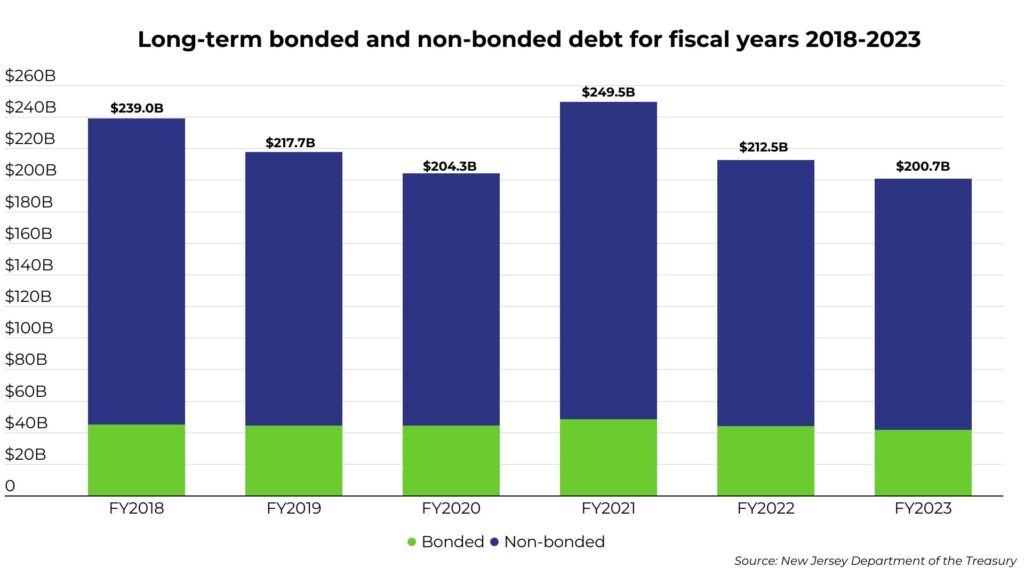
New Jersey’s bonded debt dropped to $41.5 billion during the past fiscal year, a reduction of more than $2 billion compared with the year before, according to new calculations included in a financial report released last week.
Gov. Phil Murphy and lawmakers have prioritized debt relief after bonded debt soared to a record-high $48.2 billion during the 2021 fiscal year. The year-over-year decline during the past fiscal year is the second straight since the launching of that effort.
Murphy, a second-term Democrat, is seeking this year to divert nearly $600 million from the state’s restricted debt defeasance and prevention reserve to help sustain a planned increase in annual spending that is projected to outpace growth in revenue.
The new sum for how much taxpayers owed state bondholders at the end of the 2023 fiscal year, which closed June 30, was included in the latest version of the state’s “Annual Comprehensive Financial Report.”
The year-over-year reduction of more than 5% came as the state made $4.8 billion in payments on principal and interest on its existing debt, according to the report. An estimated $1 billion in borrowing was retired using funds previously deposited into the debt defeasance and prevention reserve, the report said.
At the same time, the state issued $3.4 billion in bonds during the 2023 fiscal year, including $1.5 billion in “new money” borrowing. Another $1.9 billion in refunding bonds was issued, generating an estimated $121 million in savings, the report said.
Keeping an eye on nonbonded debt
The report also tracked progress in the state’s nonbonded obligations, which includes the long-term costs of government-funded pension and health benefits for retired public workers, which are some of the state’s largest financial commitments.
In this category, New Jersey’s grand total decreased by more than $9 billion year over year, according to the report. That reduction came as the state’s net pension liability increased by $4.7 billion, but as changes in actuarial assumptions helped lower the total for other postemployment benefits, often referred to as “OPEB” in financial documents, by $13.9 billion, the report said.
Taken together, New Jersey’s grand total for both bonded and nonbonded obligations was just over $200 billion as of the end of the 2023 fiscal year, according to the report. That represents a 5.5% improvement year over year, the report said.
The debt defeasance and prevention reserve was created by law in 2021, several months after Murphy and lawmakers borrowed roughly $4 billion without voter approval to help keep the state budget afloat amid the outbreak of the COVID-19 pandemic.
Seeded with a nearly $4 billion deposit, the reserve has since been replenished with more than $5 billion in additional deposits, according to Treasury documents.
Tapping into reserve resources
Earlier this year, the reserve’s resources were tapped by the administration to retire $484 million in outstanding state bonds, saving taxpayers an estimated $160 million in interest payments, according to Treasury officials.
Over the past three years, similar efforts have yielded an estimated $1.36 billion in taxpayer savings, according to a breakdown included with the fiscal year 2025 Budget in Brief document released by the Murphy administration in late February.
During budget hearings last week, lawmakers praised the savings realized in recent years as a result of the debt-relief efforts.
No plans for further deposits
But some have also noted there are no plans to make additional deposits into the reserve this year. Instead, the administration is seeking to take $585 million out of the reserve to help offset a nearly $2 billion gap between planned annual spending and projected revenues during the 2025 fiscal year, NJ Spotlight News reported last month.
If lawmakers go along with Murphy’s plan, the transfer would be carried out using language written into the annual budget to override the state statute that says the reserve’s balances can generally only be used to either retire existing bonded debt or to fund capital projects on a pay-as-you-go basis to prevent the need for new borrowing.
Asked during the hearings about the administration’s latest proposals involving the debt-relief account — which also includes plans to use about $330 million in reserve funds to cover several pay-as-you-go capital projects — Treasurer Elizabeth Maher Muoio suggested the latest budget is a “balancing act” between a number of competing priorities.
“There was just not the luxury of being able to replenish that (reserve) with some of the savings that was created by using the money the correct way,” asked Sen. John Burzichelli (D-Gloucester) during a Senate Budget and Appropriations Committee hearing.
“No, there was no additional funds placed into this because of, again, the balancing act I referred to earlier,” Muoio said.
