
 Credit: (Rich Hundley III/ NJ Governor's Office)
New revenue estimates from the Legislature’s top nonpartisan fiscal experts largely agree with projections drafted last month by Gov. Phil Murphy’s administration, establishing some early consensus in the annual budget-making process underway in Trenton.
For the current fiscal year, which ends June 30, state tax collections would come in $210 million higher than the administration’s forecast for the same period under the estimates released Monday by the Office of Legislative Services.
Looking ahead, the OLS analysts’ tax-collection estimates for the new fiscal year that begins July 1 are virtually identical to the administration’s forecast for generally modest year-over-year growth.
Trajectories in sync
Finding agreement on the trajectory of the state economy and the pace of expected tax collections is a key concern each year for the governor and lawmakers in the run-up to the start of each fiscal year.
The state Constitution requires the governor and lawmakers to enact a balanced budget by July 1 each year.
“You’re spending more than you’re bringing in. That’s how you define a ‘structural deficit’.” — Assemblywoman Nancy Munoz (R-Union)
Last year at this time, forecasts drafted by the Murphy administration and the legislative analysts differed by about $1 billion heading into the always-crucial spring income-tax-return season, just underway this year. It took Murphy and fellow Democrats who control the Legislature until the end of June to reach agreement on a new fiscal-year budget last year.
This time around, if the OLS forecast holds true for the current fiscal year, it would give Murphy and lawmakers more money to spend, or to sock away in surplus, than currently anticipated by the administration.
“I don’t know if we’ve ever been closer on our revenue projections than we (are) this year,” said Treasurer Elizabeth Maher Muoio during a lengthy Assembly Budget Committee hearing on Monday.
Making the case for the budget
Still, concerns about overall spending, the size of the surplus and plans to boost property-tax relief for seniors were among other key topics of discussion during the hearing, which saw both legislative analysts and administration officials come before lawmakers to discuss the budget on Monday.
‘At the risk of oversimplification, the current fiscal picture can be synopsized as follows: Stagnating revenue collections and increasing spending are eroding the state’s relatively elevated reserves.’ — Thomas Koenig, the Legislature’s nonpartisan budget and finance officer
Under a $55.9 billion spending plan proposed by Murphy for the 2025 fiscal year, the state would spend nearly $2 billion more than it plans to take in from taxpayers over the course of the full fiscal year, using either the administration’s or the OLS forecasts, according to budget documents.
That level of spending will help cover several line items where costs are rising, including complying with state law for funding K-12 public schools, which increases the line-item by nearly $1 billion year-over-year, Muoio said.
Financial crisis ahead?
But Assemblywoman Nancy Munoz (R-Union) raised concerns about the administration’s plan to operate with a structural deficit, something she suggested could set the stage for a “financial crisis” to emerge in New Jersey within a matter of years.
“You’re spending more than you’re bringing in. That’s how you define a ‘structural deficit’,” Munoz said during Monday’s hearing.

The answer is for more than 5% of spending — proposed by a governor who in the past disparaged the practice
Budget documents provided last week to NJ Spotlight News in response to a public-records request indicate the administration is planning to take more than $2 billion out of the state budget surplus to help cover annual spending during the next fiscal year.
After a similar drawdown in the current fiscal year, the surplus is on course to drop from over $10 billion at the start of the current fiscal year to just above $6 billion by the end of the 2025 fiscal year.
Thomas Koenig, the Legislature’s nonpartisan budget and finance officer, offered lawmakers a warning about the state’s current fiscal trajectory given the latest tax collection and spending trends, including the repeated drawdown of surplus.
“At the risk of oversimplification, the current fiscal picture can be synopsized as follows: Stagnating revenue collections and increasing spending are eroding the state’s relatively elevated reserves,” Koenig told lawmakers during the hearing.
“The surplus is still substantial by the state’s historical standards, but were the current trend to persist, we would return to pre-pandemic surplus sizes around the end of (fiscal year) 2027,” he said.
Muoio: Surplus is key
The size of the state surplus was also a concern raised by Muoio when it was her turn to address lawmakers.
While there may be a temptation to reduce it further to support more spending, the treasurer said the surplus is a key factor looked at by major credit-rating agencies. She also cited national figures that indicate the average surplus for states as a group is equal to 23% of projected annual spending this fiscal year, well above New Jersey’s projected rate of roughly 15%.
“While surplus level is another typically non-splashy headline item, it is nonetheless a critically important tool with respect to fiscal preparedness,” Muoio said.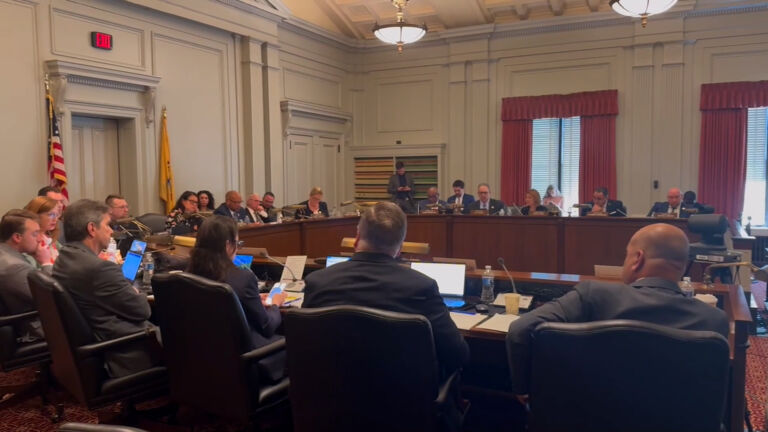
Meanwhile, the size of the surplus is now a key concern for top Democratic legislative leaders after they agreed to link it to plans to establish a new property-tax relief program for New Jersey seniors, called Stay NJ.
Due to debut in early 2026, the proposed program would fund annual tax-relief benefits for eligible senior homeowners that would max out at $6,500, according to current law. But the same law, enacted last year, includes a series of superseding fiscal goals that also have to be met before the new relief program can be launched.
Murphy’s proposed budget would meet thresholds for public-worker pension funding and K-12 public-school aid written into the Stay NJ law, but the projected closing surplus of $6.1 billion would fall just below a 12% threshold that’s also in the law, assuming that section remains unchanged.
During Monday’s hearing, Muoio told lawmakers the administration earmarked $200 million that is required by law to be set aside to help pre-fund the relief program in the new fiscal year and is also hoping to work with lawmakers to meet the surplus requirement to keep the Stay NJ program on track.
“We wanted to make sure that the money was there for implementation down the road,” she said.
Governor wants more money for public education, new corporate levy to help fund NJ Transit
