
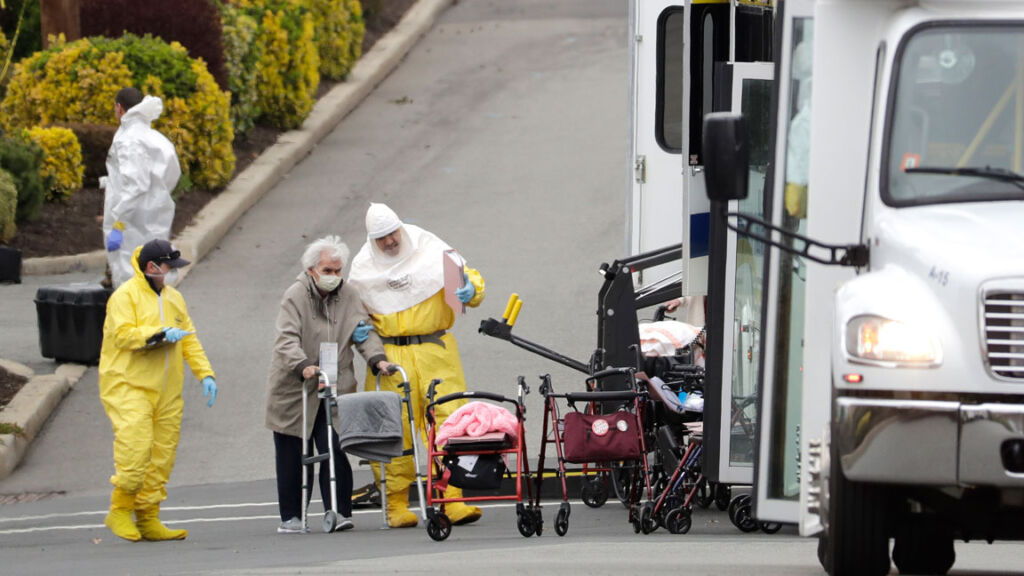
With predictive modeling telling them COVID-19 patients would overwhelm New Jersey’s hospital system within weeks, state officials took drastic steps to expand acute care capacity in March 2020, setting up field hospitals and negotiating space on a U.S. Navy hospital ship docked in New York City.
And to ensure that hospitals could still discharge patients who were no longer critically ill but too weak to return home on their own, the state Department of Health directed nursing homes to admit any resident — even if they still had COVID-19 — as long as those infected could be safely isolated.
But according to an independent report on New Jersey’s COVID-19 response released Monday, that order confused nursing home operators. They were already facing growing levels of sickness, a shrinking workforce and limited tests and protective gear. And that confusion likely enabled the coronavirus to spread more quickly among some of the state’s most vulnerable residents.
The directive also became a target for Republicans and other critics, who have said Gov. Phil Murphy should be held responsible for the high number of deaths in nursing homes here.
COVID-19 contributed to the death of some 16,256 people in nursing homes through March 2022, according to the report. Of those, more than 10,500 nursing home residents died during the first four months of the pandemic alone, 45% of New Jersey’s COVID-19 fatalities during that early period. This contributed to New Jersey’s standing as the state with the second-highest number of fatalities nationwide between March 2020 and July 2020.
Confusion reigned
Feedback from industry leaders “consistently highlighted the challenges encountered in interpreting the NJDOH’s guidance. The rapidly evolving nature of the virus complicated the Department’s task of crafting and disseminating clear, actionable directives for [long-term care facilities], and its communication strategy led to notable inconsistencies and confusion among [facility] administrators,” wrote Paul Zoubek, an attorney with Montgomery McCracken Walker and Rhodes, who oversaw the review process with assistance from the Boston Consulting Group.
“I remember being very confused about what the government was requiring,” said Andy Aronson, president and CEO of the Health Care Association of New Jersey, which represents nursing homes here. At the time, Aronson was chief counsel for a large nursing home, he told NJ Spotlight News. “It was a very confusing time.”
Health Department leaders held a conference call with nursing home operators on the same day the order was issued, March 31, 2020, in an effort to clarify the directive, but it appeared to have limited impact. Many industry leaders said that when state health officials “issued, revised or updated guidance, there was often no clear indication of what information had changed,” the report notes.
By the end the day, nearly one-third of the state’s nursing homes had told the department they did not have the staff, protective gear or other resources to safely admit people with COVID-19. Two weeks later, Health Department officials revised the policy again to prohibit admissions unless facilities could meet strict federal infection-control guidelines. But by then the disease had already taken root in New Jersey’s long-term care system.
The report also notes that the state directed the bulk of the masks, gowns and other protective gear to hospitals early in the pandemic, which at times left nursing homes short.
At the time, then-Health Commissioner Judy Persichilli repeatedly insisted that nursing home residents who had been hospitalized had every right to return to the long-term care facility that had become their home. But the directive also reflects the priority Murphy and Persichilli placed on protecting acute care services, according to the new report and an early assessment of the state’s nursing home response conducted in May 2020 by consultants at Manatt Health.
“Hospitals are only one element of a broader health ecosystem. Other healthcare facilities are equally important in ensuring that hospitals have enough space for patients. But if no space is available at a rehabilitation facility, the patient cannot be released from the hospital,” Zoubek notes. The report also praises the state’s efforts to expand hospital capacity, especially given the challenges it faced with limited resources and an early surge of infection.
Pandemic balancing act
In balancing these decisions, the state was driven by the need to ensure space at acute care facilities more than the needs of long-term care, Aronson said. “The state’s health care policy was very focused on the hospitals,” he said, noting that while New Jersey has taken steps to strengthen the long-term care sector, more needs to be done. The report also notes that the state directed the bulk of the masks, gowns and other protective gear to hospitals early in the pandemic, which at times left nursing homes short.
“Despite New Jersey’s ability to improve its handling of subsequent surges of the pandemic, the State’s severe fatality rates during the Initial Surge translate to a national ranking of 43rd in cumulative nursing home death rates,” the report notes. The Health Department did not respond to a request for comment on this aspect of the report Wednesday.
Long-term care operators were not the only group confused by some of the Health Department’s directives during the pandemic, the report found.
Overall, the report found New Jersey, and the nation, were unprepared for the COVID-19 pandemic, which has sickened millions here and left nearly 37,000 people dead, and both remain at risk for the next public health threat. It provides 33 recommendations to address these gaps in New Jersey, and Murphy, who called for a full review of the state’s response early in the pandemic, has promised to work with lawmakers to meet these needs. Zoubek was paid $3.7 million for the work through November.
Scathing criticism
Long-term care operators were not the only group confused by some of the Health Department’s directives during the pandemic, Zoubek found. Business leaders were often flummoxed by guidance on social distancing and other health precautions designed to keep people safe as they reopened, the report notes, and school systems were sometimes overwhelmed by orders they received from state health and education officials.
Sometimes, different branches of government struggled to effectively communicate with each other, Zoubek found. “For example, some [agencies] were surprised by the short time they were given to prepare for vaccine mandates for their workers or implement other emergency guidelines. In some cases, they learned of tasks assigned to them via the Governor’s daily press conferences,” he wrote.
Some Republicans pointed to the new report as proof that Murphy failed to properly protect vulnerable nursing home residents, include those in the state-run veterans homes that have been the subject of several scathing critiques. Sen. Anthony Bucco, (R-Morris) the GOP leader in the state Legislature, said the report reinforces how the state would have benefited from bipartisan hearings on these issues early on. “We must never forget how our nursing homes were ravaged and businesses destroyed as our communities were trying to wrap their heads around this mysterious virus,” Bucco said in a statement.
