
 Credit: (Edwin J. Torres/Governor's Office)
State lawmakers are on the verge of passing their first pay increase in more than two decades under fast-tracked legislation that cleared key committee hurdles along party lines on Thursday.
The proposed increase for lawmakers’ annual salaries, from $49,000 up to $82,000, would take effect in 2026. The same bill also calls for other taxpayer-funded salaries to be increased, including raises for, among others, legislative staff, the governor and cabinet members.
“As it stands, it has been 24 years since legislators have had their pay increased, which makes it harder for people who are not independently wealthy to run for office,” said outgoing Sen. Richard J. Codey (D-Essex), the bill’s primary sponsor.
Meanwhile, another measure that moved closer to the finish line on the final day of committee voting in this lame-duck legislative session would make a handful of changes to pension and health-benefit rules for public employees, including some that will likely benefit elected officials and top gubernatorial staffers.
That bill and the pay-raise legislation were approved by lawmakers without fiscal notes detailing exactly how they will impact the state budget or the public-worker pension system, which is among the nation’s worst-funded despite some recent improvement.
Murphy will have the final say
In classic lame-duck form, the pay-raise legislation was introduced earlier this week, just days before the current legislative session is due to conclude on Jan. 8.
Its advancement comes as many lawmakers, including Codey, are stepping aside after not seeking reelection in the fall, giving them the opportunity to cast their votes without having to go back before voters. Gov. Phil Murphy — who has the final say on the pay raises — is also term-limited after winning reelection to a second term in 2021.
In addition to hiking pay for lawmakers and staff, the same bill would increase the governor’s annual salary, from $175,000 to $210,000, also beginning in 2026.
Before voting Thursday, one lawmaker questioned colleagues for choosing to propose a pay raise for themselves at a time when many retired public workers who are collecting a pension in New Jersey continue to go without cost-of-living adjustments during a period of high inflation.
That’s due to a bipartisan pension reform enacted in 2011 that froze such adjustments as a cost-saving measure.
“We have officers that have retired after 25 years of service, or more, firemen that have retired after 25 years of service, or more, (retired) teachers that haven’t gotten a cost-of-living increase,” said Assemblyman Antwan McClellan (R-Cape May).
“We have those people that have served their communities that I think deserve a little boost, as well, for their retirement,” said McClellan, who was one of three Republican lawmakers to vote against the pay-raise legislation as it cleared the Assembly Appropriations Committee with all majority Democrats voting in favor.
How NJ compares
There was less discussion of the pay-raise issue in the Senate Budget and Appropriations Committee, where majority Democrats also flexed their muscle to keep the legislation on track for final approval in both houses on Monday.
“The bill is in front of you (and) nobody has signed up to testify,” said Committee Chair Paul Sarlo (D-Bergen), who voted in favor of the legislation, after briefly going over last-minute amendments.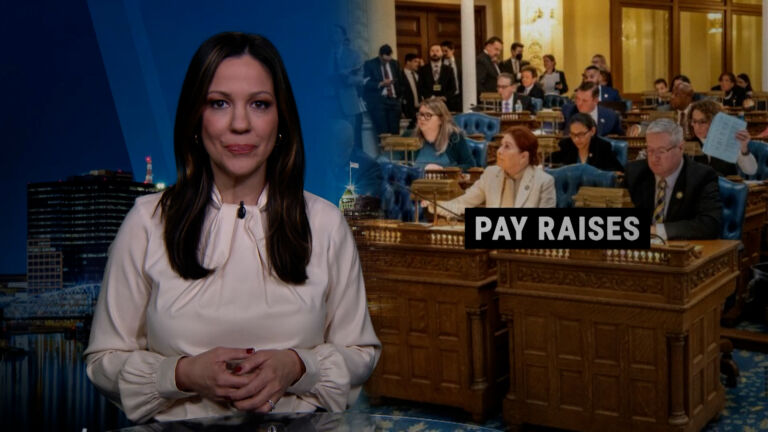
According to the National Conference of State Legislatures, lawmaker salaries vary nationally at the state level, ranging from $100 in New Hampshire to $142,000 in New York.
New Jersey lawmakers last voted to hike their own salaries in early 2000, a 40% increase that boosted their annual pay from $35,000 to $49,000. This time around, the proposed increase totals 67%.
But if the amount set in 2000 were adjusted annually for inflation, the salary for New Jersey lawmakers would have grown to nearly $90,000, which is less than the current median household income but well above per-capita income for New Jersey, according to the U.S. Census Bureau.
Making the case for…
During Thursday’s debate, some lawmakers also noted that while New Jersey technically has a part-time Legislature, their colleagues often put in long hours, including those with children who are facing ever-rising child-care costs.
“We spend a lot of time away from our family,” said Assemblywoman Pamela Lampitt (D-Camden), who also highlighted proposed increases for legislative staff as she spoke in support of the bill.
Rachel Goemaat, a spokeswoman for the Assembly majority, pointed to provisions that would ‘ensure elected office holders do not gain additional pension credits while serving in office.’
In addition to hiking pay for lawmakers and staff, the same legislation would also increase the governor’s annual salary, from $175,000 to $210,000, also beginning in 2026. Increases of the same amount would go into effect sooner for cabinet members, according to the bill. They last received pay hikes under legislation enacted by Murphy, a Democrat, in 2018.
Meanwhile, a provision of the pension and health benefit bill, which was also approved along party lines in both committees after last-minute revisions were made public for the first time on Thursday, includes language that would allow, under certain circumstances, a governor’s chief of staff or chief counsel to retire from government service that is eligible for pension benefits, while still being eligible to be paid to work for the administration.
… and the case against
Another provision would also undo a 2011 pension reform by letting elected officials who hold public jobs retire from those positions and begin collecting pensions without having to give up their elected office — and any salary that comes with it.
“We have people struggling, and we’re just going to allow people to double dip. This is totally insane,” said Assemblyman Brian Bergen (R-Morris).
But asked earlier in the week about the original draft of the legislation, Rachel Goemaat, a spokeswoman for the Assembly majority, pointed to provisions that would “ensure elected office holders do not gain additional pension credits while serving in office.”
“A social worker who retired after thirty years and then decides to run for town council shouldn’t have to give up their pension to serve,” Goemaat said.
“It is a reasonable approach to allow retired public employees to serve in public office and we do not anticipate significant increased unfunded liability to any pension fund.”

