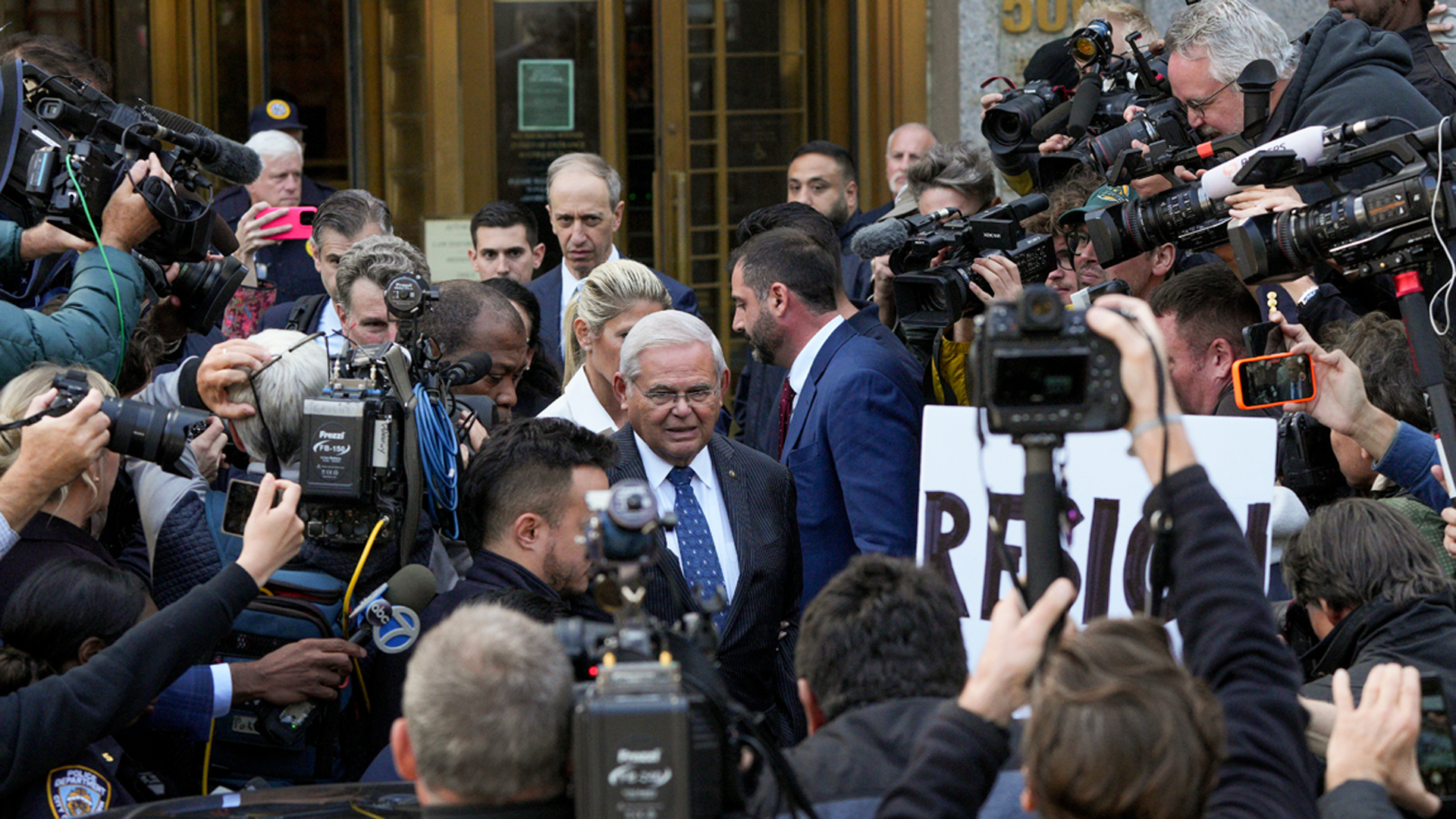
 Credit: (AP Photo/Jeenah Moon)
WASHINGTON — In the 86 years since Congress established a law to track foreign agents and propaganda efforts within American borders, no sitting member of Congress had been charged with working as an asset for another country.
That changed in September with the indictment by officials in the Southern District of New York of U.S. Sen. Bob Menendez, who is accused of working for years to benefit the governments of Egypt and Qatar by trading sensitive information and using his position of power in exchange for hundreds of thousands of dollars in bribes.
“By all appearances, in terms of the indictment itself, his constituency was no longer just the people of New Jersey, it was also the government of Egypt,” Casey Michel, director of the Combating Kleptocracy Program at the Human Rights Foundation, an advocacy group headquartered in New York City, said by phone, referencing Menendez.
“It really is a first, and it’s pretty astonishing,” Joshua Rosenstein, an attorney for Sandler Reiff Lamb Rosenstein & Birkenstock, said in an interview. Rosenstein, whose work includes foreign-lobbying compliance, said he could not recall another case against an elected official in office “that so clearly set out a pattern of acting at the behest of a foreign government, effecting change in U.S. policy.”
Menendez has denied the allegations, saying in part through his lawyer that his interactions with foreign officials have always been professional and based on “the best interests of the United States.” He could face decades in prison if convicted on all charges. The scheme Menendez ran spanned roughly 2018 through 2023, prosecutors alleged.
“This is an unprecedented accusation,” Menendez said Tuesday during a defiant speech from the Senate floor again proclaiming his innocence and denying the foreign-agent allegation. “It has never, ever been levied against a sitting member of Congress.”
Enacted in 1938
The case against New Jersey’s senior senator is the latest in a string of high-profile prosecutions in recent years anchored to foreign lobbying activities, including cases against members of the 2016 Trump campaign team, and the Menendez indictment has reinvigorated calls from experts in foreign lobbying to revamp the federal law that governs what foreign entities disclose about their activities in the U.S.
Prosecutors accused Menendez and his wife, Nadine, of helping three New Jersey businessmen, including real-estate developer Fred Daibes, meet foreign contacts, avoid prosecution for separate crimes and obtain U.S. government approval of business contracts, among other steps.
In response to propaganda activities in the years directly preceding World War II, including pro-Nazi rallies in Madison Square Garden in the 1930s, Congress enacted the Foreign Agents Registration Act, or FARA, in 1938. The law has been amended 12 times, including a 1966 charge that bars anyone working in any branch of the federal government — including members of Congress — from lobbying for a foreign power or entity.
At its core, the law requires people who represent foreign governments, political parties, businesses or other non-American entities to register with the Justice Department and maintain private records of their activities for inspection.
Menendez’s wife, Nadine, and the three New Jersey businessmen also charged in the Menendez case fall into this category. Prosecutors have accused Nadine Menendez and the three businessmen of committing fraud, violating foreign lobbying requirements and bribing a federal official. Like the senator, all of his co-defendants have pleaded not guilty to all charges.
Transparency as goal
“It’s really just designed to be a transparency statute,” Ben Freeman, director of the Democratizing Foreign Policy program at the Quincy Institute for Responsible Statecraft, a think tank in Washington, D.C., said in an interview.
“If you’re registered under FARA, there’s no restriction on who you can work for, what you can say or who you can try to lobby,” Freeman. “It’s really just designed to get the folks who are doing this type of foreign-influence work to register with the Department of Justice and provide some details and some transparency about what they’re up to.”
Enforcement of the law has had a bit of a revival in recent years, including the indictment of Russian nationals linked to interfering in the 2016 presidential election, the 2018 conviction of former Donald Trump campaign adviser Paul Manafort for violating FARA and a guilty plea from Michael Flynn, a former national security adviser to Trump.
In court papers, prosecutors pointed out that Menendez was aware of FARA, even though he could not register under it. Menendez had made multiple attempts to get a former member of Congress to register under the law, according to prosecutors. Menendez wrote to Justice Department officials, once in 2020 and again in 2022, to get this former lawmaker, who is unnamed in court filings, to register.
Anna Massoglia, editorial and investigations editor for OpenSecrets, a nonpartisan watchdog group that tracks money in U.S. politics and government, said in an interview that the Menendez case underscores why foreign-lobbying disclosure matters.
If the Egyptian and Qatari officials had been registered under U.S. law, there would be a paper trail to follow, Massoglia said.
“If there was a registration of the people trying to access Menendez, we would be able to see those meetings. We would be able to see gifts that are given,” she added. “We would be able to chart, assuming they disclosed it, all of the communications and actions that took place.”
A revamped database for foreign lobbying would also help scrutinize foreign interests working domestically, Massoglia said. Documents recently were filed as PDFs, which can be hard to search, or written in Sharpie, making online documents difficult to search, she said. “Standardizing them, making them more searchable is really important.”
Menendez in key roles
Foreign powers could hardly have picked a better member of Congress to cultivate than Menendez, given his high-ranking positions on the Senate committee with jurisdiction over foreign-aid programs, State Department nominations, treaties and weapons sales.
“The icing on the cake is that this isn’t just anybody,” Michel said. “It was the chair of the Senate Foreign Relations Committee,” he said. “If you’re a foreign regime and you want to target any member of Congress, this is who you want.”
Members of Congress, particularly if they’re on committees with purview over international topics, meet with foreign officials and counterparts frequently. But Menendez breached standard procedure by allegedly passing sensitive information about personnel at the U.S. Embassy in Cairo to Egyptian officials, ghostwriting letters for Egyptian officials and freelancing without approval of the State Department, experts said.
‘It’s really just designed to be a transparency statute.’ — Ben Freeman, Quincy Institute for Responsible Statecraft, a think tank in Washington, D.C.
Egypt, which since 2013 has been under military rule, is a top recipient of U.S. military aid, with $1.3 billion earmarked for the country annually.
Menendez chaired the Senate Foreign Relations Committee since January 2021, and before that was the panel’s highest-ranking Democrat. He stepped down when he was indicted in September.
As a committee member, Menendez would be alerted under federal law to pending arms sales to foreign nations and could place a “hold” — an informal but effective legislative pause — on such a sale, said Freeman, who added that Qatar is also a top beneficiary of American military aid. As of 2021, Qatar had more than $26 billion worth of active military sales from the U.S., according to the State Department, making it the third largest recipient of U.S. arms of any country.
Prosecuting FARA cases can be difficult because the law requires a high burden of proof, said Rosenstein, the attorney whose practice includes foreign-lobbying compliance.
Prosecutors may set out to generate a vivid picture of illegal activity before trial, he said. Court papers filed by prosecutors included details of gold bars, fingerprints, encrypted phone messages, seized stacks of cash, FBI house searches, images of Menendez and his wife, Nadine, with Egyptian officials and businessmen in his office and in restaurants around Washington.
“The picture that it paints is one of someone in a position of trust with access to national security documents who may have been compromised,” Rosenstein said.