
College campuses in New Jersey and across the country have increasingly become centers of public debate over the Israel-Hamas war, with individual classrooms — from the small seminar to large lecture hall — serving as the front lines.
NJ Spotlight News recently visited three college professors across New Jersey to talk about that classroom dynamic and how they teach about the war in these complex times.
One professor teaches international diplomacy, another religion and ethics, and the third is a scholar of Jewish history and culture. And while each said his lessons in many ways haven’t changed, they said there has certainly been more attention and engagement from their students.
Joseph Huddleston, assistant professor in the School of Diplomacy and International Relations, Seton Hall University
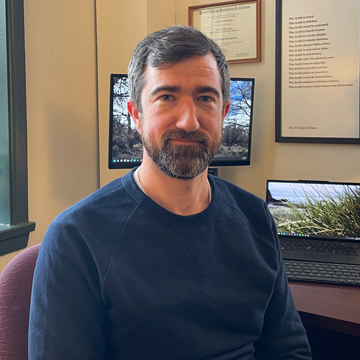 Credit: (Meagan Kane)
Huddleston’s courses at Seton Hall go by the names of International Conflict and Security, Causes of War, Politics of Terror in the Middle East and more. And they couldn’t be timelier.
Huddleston said although his teaching material hasn’t changed much since the Hamas attack on Israel on Oct. 7, certainly there is generally more awareness of the conflict and its historical context.
“Those who study and teach on the issues might have seen their materials change the least,” Huddleston said. “We are not changing; everyone else is kind of caring more about it in a way they didn’t before.
“That’s actually an interesting change for me, that the stuff I focus on in the classroom now has … broader interest than it does when the conflict is quieter.”
One lesson, for sure, is students who take his courses are taught the conflict was predictable.
“My students will understand that what we’re seeing there, as tragic as it is, is pretty predictable, it’s a pattern,” Huddleston said. “If we want to prevent these sorts of things, we need to pay attention to the rest of the equation that leads to that kind of moment.”
When asked about what can and can’t be said in his class, Huddleston said he wants open discussion about the conflict.
“I’m much more worried about being sensitive to the fact that we have both Jewish and Palestinian students here, a lot of them, and on either side there are people and their families who are suffering as a result of this conflict,” he said.
Huddleston said he hopes to leave students with perspectives they had not considered before.
“What I’ve had happen a bunch of times with some events we’ve done is that some students will come up to me afterwards and just tell me they’ve never heard this perspective before,” Huddleston said.
“They’ve always heard justifying this one side, justifying this other side, or an interpretation of history that does that one side or another,” he said. “By far the most common conversation I’ve had is students coming in to talk to me just wanting to talk about why it’s happening.”
Gregory Hotchkiss, director of general education, Berkeley College
 Credit: (Meagan Kane)
Hotchkiss, a faculty member at Berkeley College in Woodland Park, teaches a religion and ethics course.
Hotchkiss said his class has inevitably turned to topics related to the Israel-Hamas war, as well as well as war and terrorism.
His students come from many different backgrounds, he said. “Unlike some other colleges, Berkeley is a career college,” he said. “It doesn’t mean it wouldn’t come up, but the focus is a little different… and [as] a commuter college [that] might also affect the fact that we don’t have any protests. When it comes up in class — and it’s not a lot from what I can tell — the professors are generally wanting respectful dialogue, and that’s what they get.”
He spoke to one faculty member who teaches an ethics course which covers war and terrorism and said the Middle East war came up quickly.
“He said [students] were unified really in two areas,” Hotchkiss continued. “They spoke about Hamas and what they did as an act of horrific terrorism… Without taking sides, they see huge problems on each side and particularly with the [Israeli] response.
“Not particularly in the sense it’s worse, it’s just more of the same,” he said. “What do we have — some 15,000 dead, including children? They don’t see that as justified.”
Jacob Ari Labendz, director of the Gross Center for Holocaust and Genocide Studies, Ramapo College of New Jersey
 Credit: (Meagan Kane)
Labendz started by explaining his classroom philosophy in teaching about the war.
“In the classroom, my job is to be an instructor, my job is to teach people how to think and not what to think,” Labendz said. “That’s my main job with students, teaching them how to think about history, not what to think about history.”
Labendz said in teaching Jewish history, the topics of Israel, Zionism and Palestine inevitably surface in discussions, but he keeps his own opinions to himself.
“I certainly have my own perspectives that I share more off campus than on,” he said, “because I recognize that there is a power difference between me and my students, and I don’t want to get in the way.”
In the end, Labendz said his teaching hasn’t changed since Oct. 7, except in one important way.
“I’m more sensitive to students now,” he said. “I think that something fundamental to understand about the humanities — and I consider history part of the humanities — is that we come to it as fully human.
“I understand that a lot of people are justifiably angry, a lot of people are justifiably afraid, whether for themselves or for others, and many people are confused.”
The issue of student protests and other actions has come up, as it has on other campuses, and the conversations with students have been illuminating.
“I’ve met with people from the Student Government Association, I’ve met with individual students who have things they want to discuss, students who perhaps want to do one sort of action on campus or another,” he said. “And it’s not just me, the administration has been really open to supporting students in this way.”
“There’s a nice culture here,” Labendz said. “If anything, I expected more public contention.”