Credit: (Taylor Jung/NJ Spotlight News)
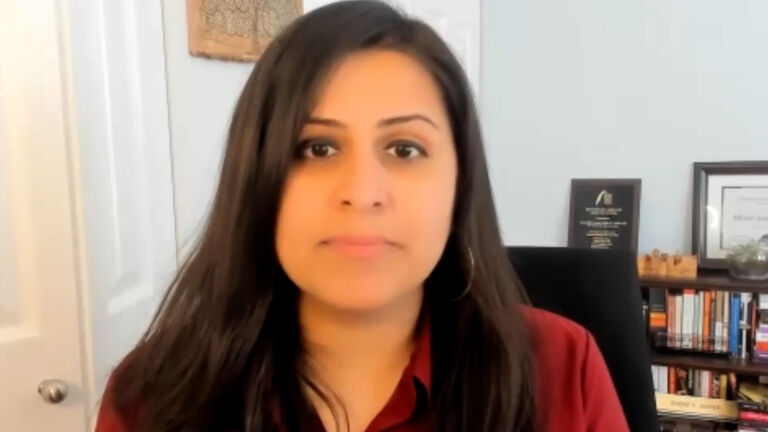
Former Assemblywoman Sadaf Jaffer (D-Hunterdon) left office after just one term because, she says, of the racist and Islamophobic hatred she faced throughout her political career.
“Infiltrating savage,” read one social media comment.
“Muslims need to be removed from the planet by any means necessary,” said another.
Those are some of the messages Jaffer said she received when running for mayor of Montgomery Township in 2019 and her Assembly seat in 2021. Jaffer, 40, was concerned the slurs would affect her nine-year-old daughter, and so she decided in early 2023 she would not run for reelection. Her last day in the Assembly was Jan. 8.
Jaffer was lauded by fellow Democrats as the first Muslim woman mayor in the United States and one of the first Asian American and Muslim women lawmakers to join the Legislature. And yet, Jaffer recalls, when she tried to speak to some fellow party members about what she was experiencing while campaigning, she did not get much support.
A familiar problem
To many elected officials, political activists and advocates, Jaffer is an example of what countless women of color across the representation endure when running for office. People of color, particularly women of color, are underrepresented across all levels of government around the country and in New Jersey. Racial representation at the state level is a particular struggle for New Jersey. While this past election brought opportunities to elect a more diverse New Jersey Legislature from redistricting, the new class sworn in earlier this month did not show much progress in racial or gender representation from the previous Legislature.
Just one third of New Jersey’s 120 state lawmakers are women. Only 5% are Asian American, compared to 12% of the state population. And Jaffer was one of two Muslim legislators — despite the state having one of the largest Muslim populations in the country.
To solve what many say is a decades-long problem for New Jersey, it is not enough to just elect more diverse candidates, said Jaffer. They need to be supported for the challenges they face because of their identities, she continued.
Before Jaffer decided to step down from office, she told her Democratic party members that she needed a moment to think about whether or not she’d run for reelection.
Support is critical
“The response I got was, ‘Let us know by 10 a.m. on Monday.’ So it wasn’t like, ‘Can we do something?’ It’s not that I need to be coddled. I just don’t think that there is really dedication to actually supporting minority candidates and women of color,” she said.
 Credit: (Taylor Jung/NJ Spotlight News)
Losing any amount of people of color, or women of color in office can be significant. Women, in general, are underrepresented across all levels of elected positions in New Jersey, according to a recent study by the Center for American Women and Politics. The center’s research showed that women make up 51% of the population — but only 30% of elected office. White men are overrepresented in elected office, and women of color in particular are underrepresented.
While there are several reasons for these gaps such as of people of color or fundraising disparities across gender and race — research has shown that racism can often be a barrier for people of color entering office.
Support is critical to help retain women of color, said Jaffer. Legislative Black Caucus Chair Shavonda Sumter (D-Bergen) agreed and discussed how working with some of the most transformational lawmakers of color — Lt. Gov. Sheila Oliver (D), U.S. Rep. Bonnie Watson Coleman (D-12th), former state Sen. Nia Gill (D-Essex) and former state Sen. Sandra Cunningham (D-Hudson) — gave her a different orientation.
“The women in the Legislature continue to grow and women of color — although, our support rests with each of us. And that’s the sisterhood that I’ve always valued, and Sadaf was a part of that,” Sumter said.
Before Jaffer joined the Legislature, though, she didn’t know who to ask for advice about running. When Jaffer’s district Assembly seat opened up, Jaffer remembers thinking — who could she ask for advice about running? Who was the first Asian American woman legislator in New Jersey?
A pioneering path
“I realized there’s never been an Asian American woman in the state Legislature. And I think that that motivated me even more, because I thought it was so shocking,” Jaffer said.
But she couldn’t go through, yet again, the racism she faced during her campaigns. An Assembly opponent told voters not to support Jaffer, saying people should “reject extremism.” She told NJ Spotlight News in May 2023 she received “all sorts of harassment” on social media, with people telling her she “wasn’t American,” despite being born in the country.
She tried to discuss what she was going through with party members when she was running for her Assembly seat. The sense she got, Jaffer said, was, “You can easily be replaced,” and, “Be happy we’re supporting you.”
“I think there isn’t really an acknowledgement of the extra burden that certain people have to deal with … and how this sort of stuff has much more of a potential to be dangerous for certain people with minority identities and from certain religious backgrounds than it is for the average white male politician,” she added.
A loss of any person in the Legislature is the loss of someone who could understand their communities’ needs. But women of color, in particular, can understand various needs because they have a dual identity, said Sumter — they are women and people of color.
“We have (multiple) communities that we have to bring their faces, voices, struggles and triumphs to the tables of leadership,” she said.
In Jaffer’s case, she was a primary sponsor on bills that established the child tax credit program and provided mental health funding for public colleges, and cosponsored legislation to solidify reproductive rights.
“I think it’s an example of government working: legislators seeing the need for community and then working in partnership with those advocacy groups and seeing it through to the finish line is really rewarding,” she added.
Jaffer is thankful, she said, that representation is steadily increasing in the state. Three South Asian women mayors started in their roles, and she had the opportunity to swear one of them in to office. A Muslim woman also reached out Jaffer for advice on running for office in a different state — which made her happy.
Jaffer’s life in politics isn’t necessarily over. She has a new role as a policy advisor for Jersey City Mayor Steven Fulop on his Democratic gubernatorial campaign, and Jaffer plans to continue helping other people of color run for office.
“If we’re truly going to get equal representation for women, or if we’re truly going to get equal representation for minorities, those who have privilege need to really put in the effort to recruit and retain women and minorities into the Legislature,” she said.