
 Credit: (Andrew S. Lewis)
Just as the last sand-and-seawater slurry was pumped onshore and bulldozed into place on the beachfront at Strathmere, Cape May County, earlier this month, Gov. Phil Murphy declared a state of emergency. Yet another powerful winter storm was bearing down on the New Jersey coast. As the Atlantic began to churn, the inevitable question surfaced: How much sand would be clawed back by the ocean this time?
The Strathmere replenishment is one segment of an ongoing $33.7 million project by the Army Corps of Engineers that, when completed in spring, will see 1,353,000 cubic yards of sand — almost 113,000 dump trucks’ worth — pumped onto barrier island beaches in Ocean City, Upper Township (Strathmere), and Sea Isle City. Another recently completed project, in Cape May City, saw 517,000 cubic yards of sand pumped onto 2.6 miles of shoreline — price tag $16.1 million.
Neither effort is an emergency measure, but periodic “nourishment” cycles that are part of a 50-year commitment between New Jersey and the Army Corps, established in the early 1990s, in which the federal government covers the majority of the projects’ costs. In the case of this winter’s Ocean City/Upper Township/Sea Isle City replenishment, the federal government is responsible for 65% of the cost; the state and local municipalities will split the remaining 35%.
In the replenishment project that just ended earlier this month, Strathmere received another 456,000 cubic yards of sand — almost the same amount that was pumped onto its shoreline in 2016.
Sea level rise, combined with the slight but steady subsidence of the coastal plain upon which southern New Jersey rests, has for years been the climate-change bogeyman most often blamed for the staggeringly fast erasure of equally as staggering amounts of sand from the Atlantic shoreline. While sea level rise does play a role — the Atlantic City tide gauge shows over 18 inches of rise since 1910, a foot of which has occurred since 1950 — more recently, climate change’s impact on localized weather events has been an increasing concern.
“With added warmth, there is a more energized atmosphere [that] can hold more water vapor, and evaporation is more effective from warmer ocean waters,” New Jersey’s State Climatologist, David Robinson, told NJ Spotlight News. “In terms of beach erosion, the key here [is] storms that are somewhat stronger than what they likely would have been without the added warmth and energy. This results in stronger winds and more wave action.”
The scene in Strathmere
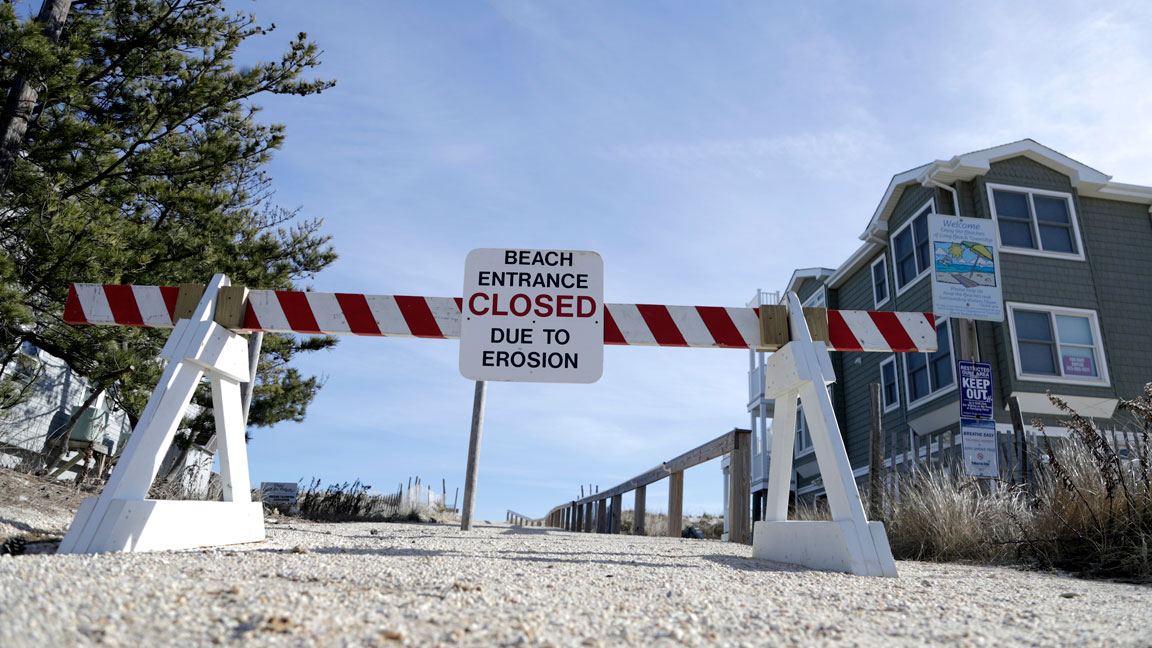
Of the three locations, Strathmere was the most in need of sand. Before pumping began in December, the dune system along the town’s northern edge was scarped in half. Beach accesses had to be closed because their walkways abruptly dropped off several feet.
The scene called to mind the years before 2015, when many of Strathmere’s streets ended at worn oak bulkheads regularly lapped by the ocean’s waves and when finding pockets of dry sand to lounge on were hard to come by. In April 2015 the Corps initiated its first replenishment effort at Strathmere under its 50-year commitment with the state.
Over the next 12 months, the old bulkheads and a series of moss-covered groins gradually disappeared under a steady stream of dark grey, sand-infused seawater pumped from an offshore “borrow source.” The slurry was sculpted into 50-foot-wide dunes and a beach that, in some places, stretched hundreds of feet between those dunes and the ocean. In total, around 600,000 cubic yards of sand was pumped onto Strathmere’s shoreline. The project, combined with replenishment in nearby Ocean City and Sea Isle, totaled 4.2 million cubic yards and cost $57.6 million.
 Credit: (Andrew S. Lewis)
By 2019, the beaches had thinned and dunes in some places were being eroded. In came another 2.4 million cubic yards to the three locations; out went $32.5 million. By last summer, beaches and dunes were again emaciated, none more than Strathmere’s. Even its manmade dunes, which since 2016 had developed mature swaths of beach grass and were just beginning to resemble a natural barrier system, were falling away. In the replenishment project that just ended earlier this month, the town received another 456,000 cubic yards of sand — almost the same amount that was pumped onto its shoreline in 2016.
More destructive weather systems
Then came January’s series of powerful winter storms. Not even a week completed, the Strathmere replenishment suffered “minor to moderate erosion, depending on area,” said Stephen Rochette, spokesman for the Army Corps’ Philadelphia District, which oversees central and southern New Jersey beach nourishment. At only midway through winter, there is little doubt more destructive weather systems will come before Memorial Day weekend, the official opening of summer in New Jersey.
This fall and winter’s coastal storms fall “in line climatologically with conditions associated” with a strong El Niño episode, which is indeed the case this year, Robinson said. An El Niño is triggered by higher than normal sea surface temperatures and calmer than normal winds in the central Pacific Ocean, and it influences global weather patterns, from New Jersey to India. On top of that, 2023 saw record-breaking water temperatures in the tropical Atlantic Ocean.
“Moisture and energy from tropical and subtropical regions join forces with colder conditions poleward in the middle and high latitudes to generate powerful storms, though not necessarily as strong and frequent as seen lately,” Robinson wrote in an email. “But Mother Nature has been known to put on a show in these types of winters.”
Since 1922, over $2.6 billion has been spent on augmenting the state’s coastline. But each year, the four counties that encompass the Jersey Shore barrier islands … generate roughly $25 billion in tourism revenue alone.
Of course, sand — and the barrier island beaches it forms — is meant to move, especially in places like Strathmere, where nearby Corson’s Inlet creates strong lateral currents that sweep sand off adjacent beaches far faster than beaches at the midsection of the barrier island, said Kim McKenna, interim executive director of Stockton University’s Coastal Research Center, which has been producing annual surveys of most Jersey Shore beaches since 1986.
“Inlets wreak havoc along the coast,” McKenna continued. “They’re dynamic features along the coast, and we don’t seem to be talking about how they’re interconnected with beach nourishment and the shoreline changes.”
If the right sand runs out…
Sand that arrives unnaturally to a beach, via the dredge and pipeline of a Corps contractor, is also meant to move. When your job is building a beach, “you anticipate losses,” Rochette of the Army Corps said. “It’s just part of these projects, so it’s something we do anticipate and try to plan for.”
 Credit: (AP Photo/Julio Cortez)
But Matt Gove, the mid-Atlantic policy manager for the Surfrider Foundation, a national environmental organization that has long been critical of beach replenishment, pointed to the fact that the sand used for replenishment is itself diminishing.
While the Corps does draw sand from inlets like Corson’s, the majority comes from offshore sources, of which there are 14 actively being utilized in New Jersey. Due to the cyclical nature of coastal morphology, some of the sand that has been pumped onto beaches does return to those sites — but not all of it.
‘But taxpayers across the country are subsidizing these beach towns, and often fancy second homes. You can’t just be doing replenishment every single season.’ — Matt Gove, the Surfrider Foundation
“It’s important to get the word out that not all of the sand lost from a replenished beach is gone forever,” McKenna said. But, she added, “Sometimes that sand gets moved well offshore, and it can’t be recovered.”
Eventually, borrow sources have to be closed, not necessarily because they no longer hold the kind of pure, fluffy sand a Jersey Shore beachgoer would recognize, but because further dredging would negatively impact the marine ecology.
‘Not a long-term solution’
In such a reality, Gove wonders at what point the loss from both beaches and borrow sources becomes too much for beach replenishment to be effective — in other words, its diminishing returns.
“Climate change is going to create bigger and more frequent storms, so if you add that to sea level rise — that’s a lot of erosion that we just can’t keep up with,” Gove said. “It’s just not a long-term solution.”
Despite its Sisyphean nature, though, the cost of beach replenishment — the majority of which is covered by the federal government — remains more than worth it for New Jersey and the Shore municipalities. Since 1922, over $2.6 billion has been spent on augmenting the state’s coastline. But each year, the four counties that encompass the Jersey Shore barrier islands — Cape May, Atlantic, Ocean, and Monmouth — generate roughly $25 billion in tourism revenue alone.
“OK, maybe they’re still making more money than it’s costing,” Gove said. “But taxpayers across the country are subsidizing these beach towns, and often fancy second homes. You can’t just be doing replenishment every single season. Processes need to start now to get people, within the government and in coastal communities, to come up with a new plan — because if they don’t come up with a plan, nature will.”
