 Credit: (Troy Benson via Flickr)
On Dec. 14, 2015, Demeka Jennings-Johnson was at work when she received a phone call that her adult son, who had Type 1 diabetes, had been sent to a hospital in Brick. But before she could get to the hospital, she received news that he had died from complications of his health condition. Her son, Gerome DelShawn Meminger-Jennings, was 25 years old.
Jennings-Johnson mourned the loss of her son. But what she didn’t understand was that her other children — then 13, 15 and 18 — were also grieving. What she didn’t know was that children grieve differently than adults.
“My 13-year-old went to school one day and the guidance counselor called saying that they didn’t know how to support her through her grieving process,” said Jennings-Johnson, 51, who lives in Toms River and works as a school-based mental health practitioner in the Trenton public school system.
“Because of the fact that her grades were kind of slipping, but she wasn’t socializing. She wasn’t going to lunch. She ended up having to go inpatient to get the services that she really needed,” said Jennings-Johnson, a certified grief counselor through the American Academy of Grief Counseling and doctoral student at Walden University.
Adding grieving to the curriculum
Jennings-Johnson was one of several people who testified before the Assembly Education Committee last week to support a bill that would require school districts throughout the state to include instruction on grief in grades eight through 12 as part of the districts’ implementation of the New Jersey Student Learning Standards in Comprehensive Health and Physical Education.

Comfort Zone Camp brings together children and teens whose lives have been touched by suicide, creating a community of emotional peers
The push by advocates and lawmakers to address grief among adolescents comes as children navigate mental health issues exacerbated by the pandemic and the deaths caused by the coronavirus. As of September 2022, it was estimated that more than 265,000 children in the United States had lost a parent, custodial grandparent or grandparent caregiver because of COVID-19, according to studies cited by the National Academies of Sciences, Engineering, and Medicine in a report released earlier this year.
What’s more, this burden of loss was disproportionately borne by communities of color, with Black, Latino and Native American children experiencing the loss of a caregiver at rates significantly higher than white children, the report notes. As of mid-2021, the death of a caregiver had affected one in 753 white children, one in 412 Latino children, one in 310 Black children and one in 168 Native American children, according to studies cited in the report.
Under the bill, the state Board of Education is required to adopt standards pertaining to grief to be taught in health and phys ed. Specifically, the instruction must include, at a minimum, information on the physical, emotional and behavioral symptoms of grief, coping mechanisms and techniques for handling grief and loss, and the resources that are available to students, including in-school support, mental health crisis support and individual and group therapy.
Compassionate community
“In providing instruction on grief, we empower students with the tools to navigate the complexities of loss, fostering a compassionate and supportive community,” said Assemblyman Reginald W. Atkins (D-Union), a primary sponsor of the bill. “Together, this is a way for us to holistically develop the future of our leaders right here in the state of New Jersey,” Atkins said.
The legislation, if signed into law, would also require the education commissioner to provide school districts with “age-appropriate resources” concerning grief.
“Enhancing and providing mental health services to children, to students, [and] to the general community has been a priority for I would say all of the leadership in the Legislature and it’s something that is very important to me,” said Assemblywoman Sadaf F. Jaffer (D-Middlesex), a member of the Assembly Health Committee.
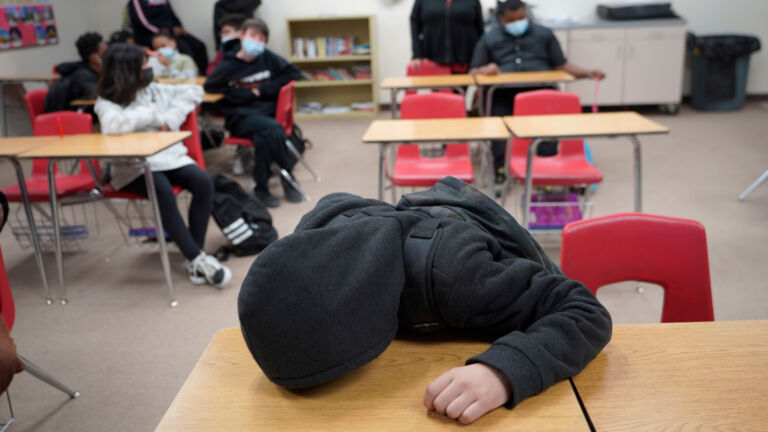
Hopelessness, depression, suicidal ideation — bills attempt to counsel and protect students before their problems bring on a full-blown crisis — or worse
The move by state legislators also comes at a time when young people nationally continue to grapple with loneliness, lack of access to care and high rates of suicide, among other mental health concerns. Black people, ages 10 through 24, are experiencing the fastest increasing suicide rates, while young people in rural areas, ages 10 through 24, are nearly twice as likely to die by suicide as those in large metro areas, according to studies cited in a report released earlier this month by The Jed Foundation, a nonprofit organization that aims to protect emotional health and prevent suicide for teenagers and young adults across the country.
“(It) aims to kind of round out the social emotional learning,” said Julie Larrea Borst, the executive director of Save Our Schools New Jersey Community Organizing, of the legislation.
Social and emotional learning is the process through which all young people and adults acquire and apply the knowledge, skills and attitudes to develop healthy identities, manage emotions and achieve personal and collective goals and feel and show empathy for others, among other skills, according to the Collaborative for Academic, Social, and Emotional Learning, a Chicago-based nonprofit.
“Clearly, during COVID across the country, so many people died, and so many family members of children died, including here in New Jersey. And of course, we lost teachers and administrators here as well. That having an understanding of grief and that it’s a part of life and how to help deal with that and being expressly taught, that seems like a very good idea,” Borst said.
Reducing grief to a ‘checkbox’
But some school officials, including superintendent Dr. Jeffrey Moore of Hunterdon Central Regional High School District, remain concerned that the approach taken in the legislation runs the risk of reducing the effort to teach grief instruction “to a checkbox on an already long list of things to cover.”
“If the bill passes, I will be most interested in seeing how quickly the Department of Education offers sample learning activities and resources, and the quality of those,” Moore said in a statement. He added that schools often work with experts to train staff and educate students on such difficult topics.
“I hope that the department does the same, and also takes the opportunity to expand what has proven to be thin support for schools and mental health professionals working together,” he said.
Jennings-Johnson’s then-adolescent daughter is now 22 years old, enrolled at Kean University and “thriving.”
“With this bill, we can get teachers, principals, even just … school counselors as they’re called now, to really provide the supportive services to our students proactively instead of reactively,” Jennings-Johnson said.
The bill passed the Assembly Education Committee unanimously. There is an identical bill in the Senate (S-3330).
The legislation is back up for a vote during an Assembly session on Thursday.