
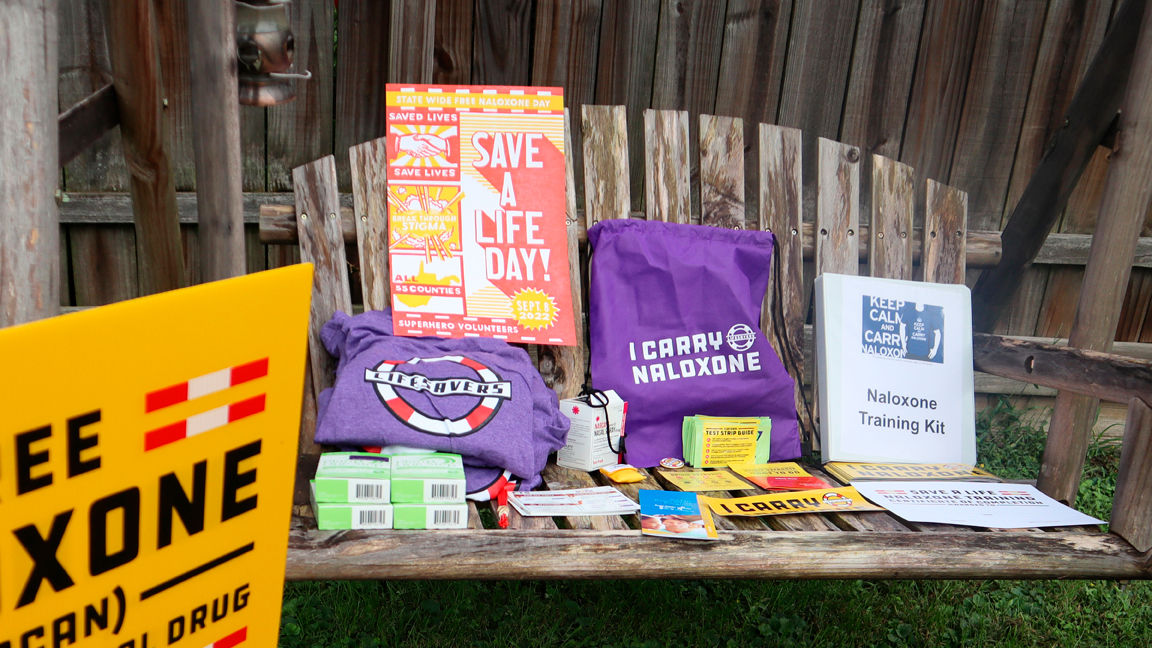
 Credit: (AP Photo/Leah Willingham)
New Jersey is set to collect $1.1 billion over the next two decades to combat the opioid epidemic. The money will come through settlement agreements with several opioid manufacturers, distributors and retailers, according to a state report released in late September.
About half of the settlement will go directly to the state to administer and, after litigation fees are paid, the rest will be distributed directly to all 21 counties and eligible municipalities that have populations over 10,000 or that filed related lawsuits, according to the report.
Already, New Jersey has received over $100 million in funds from various opioid settlements, according to a spokesperson in the governor’s office.
Plans for mobile treatment centers, transportation to services, drug-sniffing dogs
But some lawmakers want to make sure their preferred programs get a share of the money and they’re working to pass a law to force the state to spend that portion the way they want.
“The money could be appropriated by the administration for that project or those projects (addiction recovery programs), but putting it in law ensures that the money is spent specifically the way that the legislators want to,” said Sen. Joseph F. Vitale (D-Middlesex), chair of the Senate Health, Human Services and Senior Citizens Committee, explaining why there is a state law to allocate the money in the bill to addiction recovery programs. “It wouldn’t be left up to the administration to agree to do it. This would be requiring them to do it.”
State money, local money
The bill itself aims to distribute nearly $2 million from the Opioid Recovery and Remediation Fund to the state Department of Human Services. That agency would add additional money to addiction recovery programs that are managed by the state, receive federal government funding and aim to provide case management and recovery support services to people with substance-use disorders. The Opioid Recovery and Remediation Fund was created by the state Department of the Treasury to oversee the money received as a result of the national opioid settlements.
But of the nearly $2 million carved out in the legislation — a small portion of the $1.1 billion New Jersey and counties are expected to receive over the next two decades — more than $192,000 would go toward creating an addiction-recovery program for people with substance-use disorders who have recently been released from state, county, or local jails and prisons in Passaic County.
“While money from the fund can be disseminated without legislation, it is our hope that this will help to expedite the process to bolster and expand the STAR (Support Team Addiction Recovery) program as soon as possible,” said Sen. Nellie Pou (D-Passaic), a primary sponsor of the bill.
While the bill passed the Senate Health, Human Services and Senior Citizens Committee last week, some lawmakers raised concerns that the legislation did not include funding for addiction-recovery programs in all 21 counties.
“Why are we selecting just a handful of counties?” asked Sen. Edward Durr (R-Salem), a member of the Senate Health, Human Services and Senior Citizens Committee. “The opioid crisis is rampant throughout the state. I know in one county that wasn’t included was my own, Salem County. And it’s a crisis there. They need help. So I think this should be extended to all 21 counties,” he said.
Looking a lot like Christmas?
State lawmakers have a long history of setting aside money for projects that they would like to fund directly through legislation, including for legislative pet projects that are often referred to as “Christmas tree” items.
The state has received over $100 million in funds from various opioid settlements and will continue receiving allotments over the next two decades, according to a spokesperson in the governor’s office.
But, as Mystic Island residents know, adequate services are not always available
Additionally, if the state Legislature decides that they want to appropriate funding after it approves a state budget for the fiscal year beginning July 1, it has to be done through legislation, according to Sen. Vin Gopal (D-Monmouth), a member of the Senate Health, Human Services and Senior Citizens Committee. “That’s the intent because this bill came up post-July 1st and so that’s why we did it through law. So it’s clear and it’s dedicated to the appropriate place,” Gopal said.
The push by lawmakers to bolster addiction-recovery services comes as the state, counties and municipalities are set to receive more than $1.1 billion over the next two decades to combat the opioid epidemic through settlement agreements with several opioid manufacturers, distributors and retailers, according to a state report released in late September. About half of the settlement dollars will go directly to the state and, after the payment of litigation fees, the rest will be distributed directly to all 21 counties and municipalities that have populations over 10,000 or that filed related lawsuits, according to the report.
“We believe that this expansion of funds, and the promise that it brings will reach people who have nowhere else to turn, and families who have endured indescribable grief, as well as emotional and financial stress because of this crisis,” Pou said in a statement.
Making local plans
Meanwhile, local governments plan to use their share of the $1.1 billion in the years to come for mobile treatment centers for people who use drugs and are living on the street, along with transportation to services, recovery housing and peer coaches to help people navigate life after addiction. State data shows that suspected drug deaths decreased from 2021 to 2022 and that the total number of suspected drug deaths this year are on track to be lower than the previous two years. Still, over 2,300 people in the state have died from suspected drug deaths this year, including 182 in November alone, according to the office of the chief state medical examiner.
Some criminal-justice experts say that the bill, if passed, “would be a move in the right direction” because many people transitioning out of jails and prisons have struggled with substance abuse.
“The focus on a jail expansion program in Passaic County, for example … it can enhance public safety because for one you’re providing support to individuals transitioning, especially from jail facilities, which often have more transient populations,” said Dr. Michael B. Mitchell, an assistant professor in the Department of African American Studies and Criminology at The College of New Jersey.
A majority of people, 65%, in state prisons report using some illicit substance in the 30 days prior to their arrest, whereas in the general U.S. population, only about 11% of people age 18 and older have used illicit drugs in the past month, according to a 2022 report from Prison Policy Initiative, a nonprofit and nonpartisan organization based in Massachusetts that aims to research and advocate for criminal-justice reform. The report analyzes data from the Bureau of Justice Statistics’ “Survey of Prison Inmates,” collected in 2016 and released in late 2020.

State officials want to hear from people on how best to use lawsuit funds
Additionally, the report says that half of people in state prisons met the criteria for a substance use disorder, including about 59% of women and 48% of men.
While the state continues to distribute funding from the national opioid settlements, some advocates would also like to see some of the money go directly to smaller organizations that are in communities closest to people suffering with substance-use disorder.
“By mandating the funds to the Department of Human Services, you’re almost … giving them dominion over who will receive the funds and who won’t,” said Dr. Jason Williams, an associate professor of justice studies at Montclair State University. “But it’s (the bill) well-intentioned and I’m still willing to give it an applaud because when was the last time they allocated funds like this to this issue?” Williams asked.
Additional funding in the bill would go towards salary increases for case managers and recovery-support specialists who work at addiction-recovery programs for people reentering society from jails and prisons in Atlantic, Bergen, Camden, Essex, Gloucester, Hudson, Mercer, Middlesex, Monmouth and Ocean counties.
