Credit: (Bonnie Cash/Pool Photo via AP)
[Editor’s note: This article has been updated with comments from U.S. Sen. Bob Menendez sent after publication.]
In 1954, a year into the Cuban Revolution, Bob Menendez was born in New York City to Cuban émigrés — a seamstress and carpenter. He has described his parents as fleeing “an oppressive regime” during the island nation’s intense political moment.
The family moved to Hudson County, where Menendez soon established his political career. He went from the Union City Board of Education to the state Assembly, then to the U.S. House of Representatives and ultimately the U.S. Senate in 2006.
“He’s the son of Cuban migrants who, like many at the time, mostly in the middle and upper classes, emigrated and were afraid of the revolution and what it would do when it came to power in 1959,” said Mikael Wolfe, associate professor of history at Stanford University and historian of modern Latin America.
Menendez’s origin story became a launch pad to influence U.S. foreign policy in Cuba. Now, all that could be undone by the scandal that has left Menendez charged with corruption and bribery, and depending on his fate, help change the U.S.-Cuban policy going forward, according to experts and others.
The Cuban connection
The ties to Cuba have been a defining chapter of Menendez’s life story rooted in the north Jersey-New York area, which is home to the nation’s largest population of Cuban Americans outside of Florida. And those ties have always been about reversing the seismic changes the revolution caused in Cuba, bringing Fidel Castro to power and spurring Menendez’s family to leave the country.
“He rose to prominence in Union City, New Jersey and sort of relayed that into this position of extreme power in the Senate,” said Jake Johnston, senior research associate at the Center for Economic and Policy Research and expert on economic policy in Latin America.
The central vehicle for controlling Cuban economic and political affairs was the U.S. embargo, which remains to this day, with Menendez a strong and important supporter during his time as the influential chair of the Senate Foreign Relations Committee.
In May, Menendez as chair of the committee wrote a letter to colleagues in the House, opposing their calls for President Biden to reverse sanctions policies on Cuba and Venezuela.
“…Cubans and Venezuelans are leaving their homeland because of one simple fact: they are suffering under the yoke of brutal dictatorships,” Menendez said in his letter, defending his stance on extreme sanctions. “These actions, not U.S. sanctions policies, are responsible for the ongoing exodus of Venezuelan and Cuban refugees and migrants. Removing U.S. sanctions on Cuba and Venezuela will only betray our democratic values and further empower criminal dictators.”
Sanctions on Cuba
Over the last 60-plus years, how has the U.S. embargo impacted the Cuban people?
The sanctions were always meant to crack the political and cultural spine of Cuba, according to Johnston. This is one reason some critics liken the U.S. policy to “economic warfare.”
Sanctions in general “have tremendously negative impacts on the economies that are impacted,” Johnston said. “And who is impacted by that? The people, right? It’s sort of often framed like, these are targeted things that [we] can go after … leaders we don’t like or bad leaders, however you want to put it. But the reality is, when you are limiting the maneuvering space for these economies, it’s going to hurt everybody.”
“The point is the pain, right? And if you strip away the rhetoric, it’s really clear … you’re basically hoping that you can inflict enough pain that the population turns on their government,” Johnston said.
Yet Cuba’s government and leadership have largely remained the same.
“The government is still in power, right?” Wolfe said. “So it clearly doesn’t work. People just suffer because of the embargo. It’s one of those peculiar policies that sort of defy economic and strategic logic for the United States.”
Menendez has remained steadfast in his support of the embargo and sanctions of Cuba, citing the more than 1,000 political prisoners detained in the country.
“For those who call for a change in the U.S.-Cuba relationship, they do not truly understand the sinister and repressive nature of the Cuban regime,” he said in a statement sent Friday. “As long as the regime continues to oppress its people and place a stranglehold on democracy and freedom, my position on U.S. foreign policy toward the island will not change.”
President Obama in 2014 took a different path. The White House announced the president was “rejecting the failed, Cold War-era policy era of the past to chart a new course in Cuba,” according to the Obama White House Archives.
Then-Secretary of State John Kerry rescinded Cuba’s designation on the State Sponsor of Terrorism list, the U.S. Embassy reopened in Havana and the Cuban Embassy reopened in Washington. Restrictions were lifted for Cuban Americans to travel to Cuba and send remittances to their families, and steps were taken to increase trade and commerce between the U.S. and Cuba.
Menendez attacked Obama for visiting Cuba in 2016. “It is totally unacceptable for the President of the United States to reward a dictatorial regime with an historic visit when human rights abuses endure and democracy continues to be shunned,” he said in a statement.
Alliance with Trump
A key juncture for Menendez came with the election of Donald Trump as president, the start of an unexpected alliance between the two when it came to Cuba.
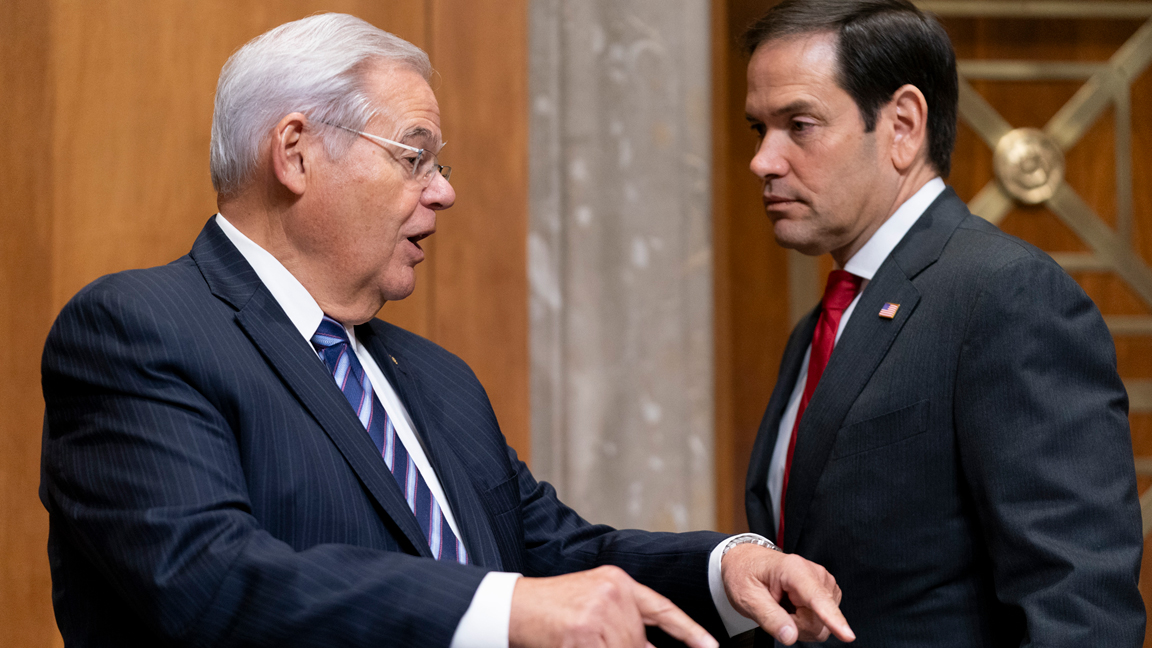
Menendez “saw an opportunity and joined forces with Marco Rubio, his Republican counterpart in the Cuban American lobby to exert maximum pressure on Cuba, so to tighten the sanctions even more ostensibly to bring about either a change in political behavior or maybe even a regime change,” Wolfe said.
 Credit: (AP Photo/Stephanie Scarbrough)
Not all were pleased. “It was terrible because it came right after the first change in U.S. policy towards Cuba, which was the Obama years … (and) things were looking up,” said Daniel Montero, a Havana-based journalist and producer with Belly of the Beast, a U.S.-based media outlet focusing on Cuban politics and culture. Montero is currently working on a special project about Menendez’s rise to power, the corruption charges against him, and how he’s helped shape U.S. policy on Cuba.
“I spent all of my years [while in college] as a tour guide working mostly with U.S. tourists … Trump comes in and everything changes. I mean, for me, my personal business, I felt it. There are less and less tourists coming to a point now where there’s very few people from the U.S. coming to Cuba,” Montero said.
The Biden administration in 2022 reversed some Trump-era policies, easing restrictions for families to visit relatives in Cuba and increasing visa processing on the island. However, the move came a year after Biden hit Cuban officials with additional sanctions.
Is change possible?
Will U.S. policies on Cuba change with Menendez’s falling political fortunes? New Jersey’s senior senator stepped down from his influential post as chair of the Senate Foreign Relations Committee after he was indicted in September. Sen. Bob Cardin, a Democrat from Maryland, took over the role.
In a superseding indictment in October, Menendez was charged with conspiring to act as an agent of the Egyptian government. Ben Rhodes, a former deputy national security adviser in the Obama White House, pointed out the contradiction between Menendez supporting an Egyptian dictator while critiquing the Cuban government.
“Menendez has had a de facto veto on U.S. Cuba policy, piling sanction after sanction on an impoverished people wrapped in the language of democratic values while apparently supporting the Egyptian dictatorship for personal gain,” Rhodes tweeted.
“Maybe we can now return to a rational, humane Cuba policy that actually helps the Cuban people and serves U.S. interests,” Rhodes went on to say.
Others said Menendez’s resignation as Senate committee chair could signal a change. “He may very well have to resign because of these corruption charges. We could see a policy change,” Wolfe said. “Ben Cardin has in the past expressed support for Obama’s policy of engagement.”
Montero, though, said he’s not exactly optimistic about U.S. policy changing toward Cuba, but merely “less pessimistic.”
“I would be even less pessimistic if he [Menendez] were not to be reelected,” Montero said. “Because even without his position in the Foreign Affairs Committee, he’s still obviously a very important person…he knows how to play his cards. And this is his issue.”
Biden’s policies
Of course, the policy is greater than just Menendez or Cardin, and it is yet to be seen how the Biden policies on Cuba develop.
“I’m quite surprised Biden has not returned at least in some degree to Obama’s policy of engagement with Cuba. He campaigned on it. He seemed to support it when he was vice president. I’m not sure what the holdup is,” Wolfe said.
“The best thing Biden could do that doesn’t require an act of Congress is to remove Cuba from the sponsors of terrorism, which was completely baseless,” Wolfe said. “That would be a low hanging fruit for Biden to do and would really improve the situation in Cuba … (it) makes it very difficult for Cuba to get loans from banks and for financial transactions, because it’s constantly flagged.”
Cardin has signaled that he approves of Cuba being removed from that State Department list.
“The State Department’s recommendation to remove Cuba from the list of State Sponsors of Terrorism, the result of a months-long technical review, is an important step forward in our efforts to forge a more fruitful relationship with Cuba,” Cardin said in 2015.
In early November, the U.N. General Assembly voted 187-2 to condemn the U.S. embargo of Cuba. Only the United States and Israel opposed the resolution.
Cuban Foreign Minister Bruno Rodriguez said that the “blockade prevents Cuba from accessing food, medicines, and technological and medical equipment.” But for now, the U.S. embargo on Cuba remains.