Credit: (AP Photo/Rick Bowmer, File)
A legislative committee held off action on a bill to require all electricity in New Jersey be emission-free in 2035, making it more unlikely the measure will be enacted into law during the lame-duck session.
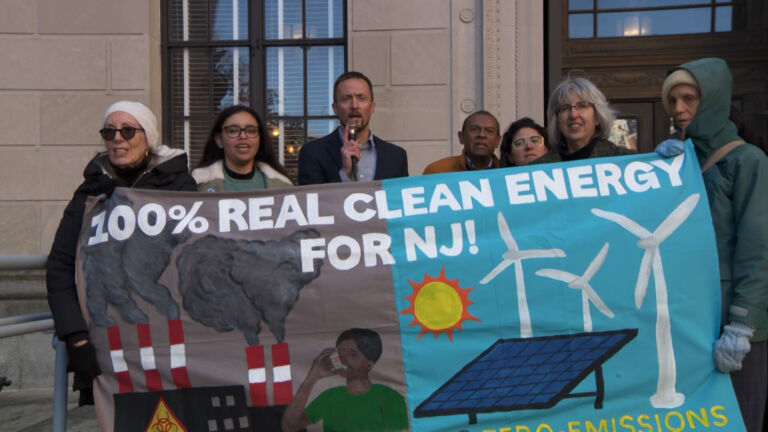
After a marathon five-hour hearing on Monday, the Senate Environment and Energy Committee adjourned without voting on the measure, a top priority of clean-energy advocates and the Murphy administration. The legislation drew opposition from labor and environmental justice advocates who sought changes in the bill to clamp down on harmful pollution in overburdened communities.
The committee is expected to vote on the bill on Dec. 18, according to Sen. Bob Smith, its sponsor and committee chairman, who acknowledged “additional fixes need to be made.’’ The bill would codify an executive order Gov. Phil Murphy issued last year to require a 100% clean-electricity standard in 12 years.
Before then, however, Smith (D-Middlesex) may have to resolve concerns raised by labor groups and others that it could chase jobs out of New Jersey, particularly in the solar sector.
Environmental justice advocates called for amendments to ensure harmful pollutants, such as lead and mercury, are not emitted by facilities in their communities.
‘Close to zero’
“We want as close to zero emissions as possible,’’ Melissa Miles, executive director of the New Jersey Environmental Justice Alliance told the committee. Miles also criticized a provision in the bill allowing facilities to purchase clean-electricity credits to offset emissions in overburdened communities.
‘By any measure — jobs, affordability and public health — New Jersey is better off with this legislation than without it.’ — Eric Miller, Natural Resources Defense Council
Introduced more than a year ago, the legislation (S-2978) is viewed as crucial to achieving the state’s ambitious goals to transition away from fossil fuels and drastically slash global warming pollution.
“This bill offers an opportunity to establish New Jersey as a clean-energy leader,’’ said Jesse Jenkins, an assistant professor at Princeton University, describing the bill as truly historic. The bill provides that in 2035 at least 65% of electricity come from clean-energy sources in New Jersey and lower electricity costs in 2035 and create up to 24,000 jobs, according to Jenkins.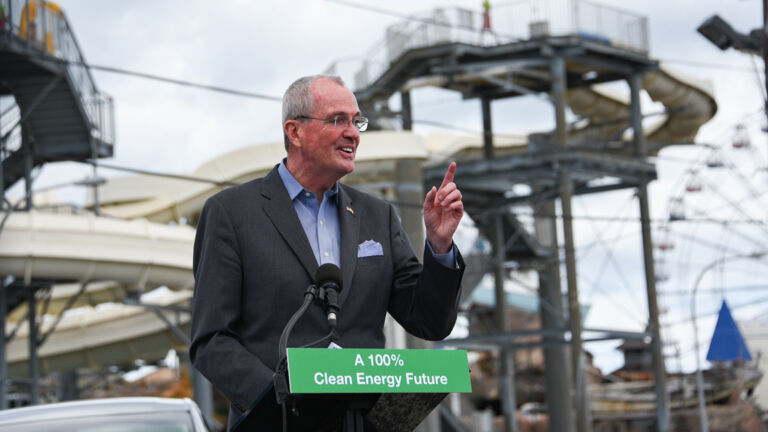
“By any measure — jobs, affordability and public health — New Jersey is better off with this legislation than without it,’’ said Eric Miller, director of New Jersey energy policy for the Natural Resources Defense Council.
Business groups and other critics argued, however, the bill moves too quickly to a clean-energy transition, putting reliability of the power grid at risk and increasing energy costs in a state with the nation’s 11th highest electric bills.
Natural gas plants stay
Even though the bill calls for 100% emission-free electricity, it does not eliminate the state’s natural gas plants, a significant source of carbon pollution. Those plants will still operate and provide power at times when they are needed to maintain reliability of the power grid.
Existing gas plants will not close and will continue to sell power into the grid, according to Raymond Cantor, deputy government affairs manager for the New Jersey Business & Industry Association. “The ‘clean power’ built in other states will never reach New Jersey nor will the economic benefits,’’ he said.
Barbara Blumenthal, research director for the New Jersey Conservation Foundation, argued the goals in the bill are achievable. “It’s not a big lift,’’ Blumenthal said. More than half of the state’s electricity is generated from resources viewed as clean, including renewables and nuclear.
Solar advocates said the bill leaves no room for new growth for the sector in New Jersey, but Smith countered the state has provided plenty of incentives for the industry over the past two decades. It was never the intention of the bill to support solar, Smith said.