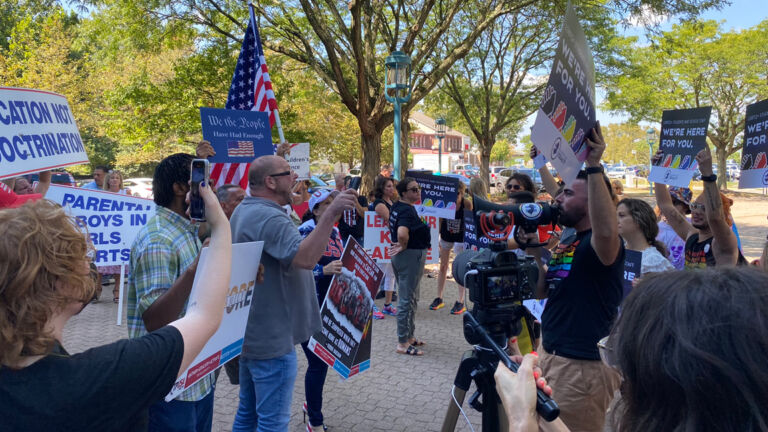
In the ’70s and ’80s, the state Board of Education was no stranger to controversy when Susie Wilson and other board members led the fight for sex education in schools, which was called family life education at the time.
New Jersey would become the second state in the country to adopt such standards, even if the battle cost Wilson her seat.
Today, the battle on the board over teaching about sexuality in schools has shifted from a focus on teen pregnancy to matters involving the LGBTQ+ community, but Wilson sees a lot of similarities to what she went through.
On the eve of the board meeting this week to further discuss the issues, Wilson shared with NJ Spotlight News her perspective on how today’s conversations relate to those from decades ago. The following are highlights of that interview which have been edited for length and clarity.
NJ Spotlight News: How did you first get involved in the push for sex education in schools?
Susie Wilson: I asked a question at a board meeting and it changed my life. The commissioner of health spoke to the board about rising rates of teen pregnancy, abortion and STIs and asked the board what, if anything, they had done about it in the past or were planning to do. I was the only one of 13 people on the state board to ask a question, which was about what age young people need to have this information. She said by the end of fourth grade.
At the end of the meeting, the president of the board said he wanted to form a subcommittee to look into this issue and he asked me if I would chair. What this resulted in was this requirement for K-12 programs in all school districts.
NJSN: In New Jersey, parents can now opt their children out of the sex-ed curriculum. How do you feel about that?
SW: I don’t think we would have gotten a requirement through without that policy. Opt out is far better than opt in, which causes huge administrative headaches. What we’ve found is very, very few parents opted their kids out of this program.
NJSN: What did the pushback directed at the board look like?
SW: I used to get a lot of mail. We didn’t get any threats. Maybe it was a bit more civil. But I always said that the opponents never sleep. They don’t give up. They may lose a battle here and there, but they are absolutely, passionately committed to this issue.
There was a show called “The Phil Donahue Show.” They asked me to come out with five of the opponents (to talk about) what we were doing. I was alone, defending what the board was doing. There was no question that the audience was solidly on my side, but after I got back, I received about 25 letters, all from opponents. I made an effort to make a response to every single one of those letters. You could feel the fear. You just felt that they were so afraid that they were going to lose their children and something awful was going to happen to their children. I assured them that the State Board of Education wouldn’t do anything that would hurt young people. I don’t know if I was persuasive or not.
NJSN: Do you see similarities in how fear might be playing a role in similar battles today?
SW: When I was on the board, everyone was aware of LGBTQ+ issues, but not to the extent that it seems to have risen to the top of the issues today. It’s terrifying for some parents to think their children might not be who they think they are when they’re born and want to change what their gender is. I think that can be very scary.
One thing our opponents used to talk about is that they kept saying sex ed would cause abortion, masturbation, homosexuality and bestiality. Those were the issues that kept coming up that parents were opposed to back in the late ’70s, early ’80s.
I think the whole idea of fear that education is going to be destructive, not constructive, that still runs through the arguments. Teen pregnancy is a very different issue than gender issues. There wasn’t as much focus on that as on reducing teen pregnancy. That was the big issue of my time.
NJSN: Why is sex education such a controversial issue?
SW: People believed that if you educated young people about sex it would lead to more sexual activity, not less. All the information that we ever found showed it was the opposite. The more educated young people were, the more likely they were to postpone sexual involvement. If they were actually having sex, they used much more reliable forms of contraception.
I think our opponents acted out of fear. They were good people; they were just consumed by fear. They really thought that good education would lead young people to experiment, to have more unprotected sex. They also believed very strongly in the idea of abstinence before marriage.
NJSN: Is there anything else to note about your work and where we are today?
SW: There’s been very little evaluation of what goes on in these districts. I’m all for evaluation. It should have been written into the policy. It should say that at the end of every six years, 10 years or something that these programs should be evaluated, including asking young people: Are you getting properly educated? Can you remember a particular lesson? Did it affect your behavior?