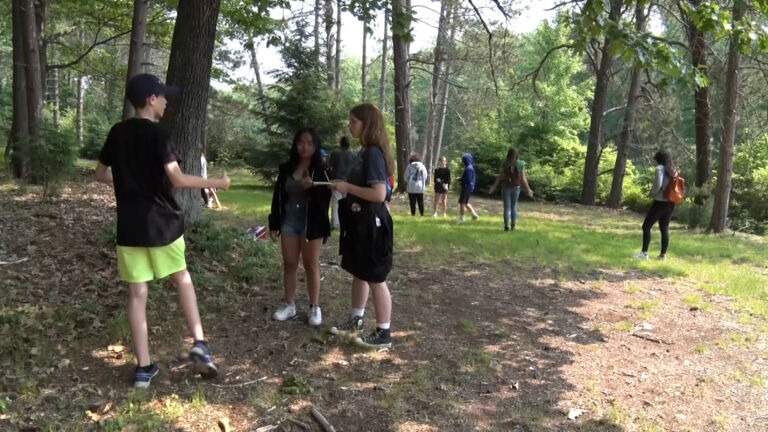
Credit: (New Jersey School of Conservation)
Kerry Pflugh readily recalls when she first set eyes on a remote wooded tract deep in Stokes State Forest. She was 5 years old and at the end of a long family trip from Michigan to check out the place her father would soon lead.
“There I was in this enchanted forest,’’ remembers Pflugh, whose dad ended up serving as executive director of the New Jersey School of Conservation for 38 years, the longest tenure ever. “That forest ended up as my playground.’’
So perhaps it is hardly surprising the school — once internationally known as the oldest and largest environmental field center in the nation — will be led by Pflugh, a lifelong advocate for the facility and a key figure who helped rescue it from its sudden closure three years ago.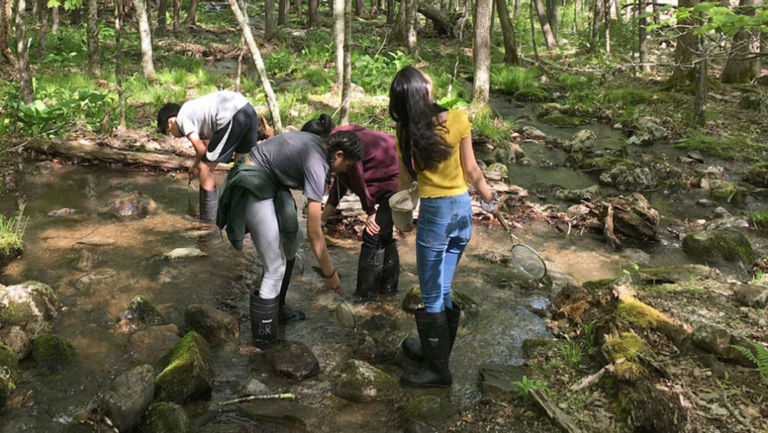
Pflugh, the president of the Friends of the New Jersey School of Conservation, will take over on Dec. 1 as executive director of the facility, located on a remote 240-acre tract amid the rolling hills and streams of the state forest in Sussex County. She will be the first female director.
The field center shuttered briefly in 2020 during the COVID-19 pandemic, the victim of long-standing financial problems as funding dried up to provide environmental education and conservation stewardship programs — a threat to end its seven-decade run of touching the lives of thousands of students each year.
Built in the 1930s by the Civilian Conservation Corps, it was originally set up as a children’s summer camp with a man-made lake, but it evolved into an environmental and conservation center that tutored nearly a half-million visitors over its history.
 Credit: (New Jersey School of Conservation)
“It’s a magical place,’’ says Pflugh, who retired recently from the state Department of Environmental Protection after working there for 35 years. “It is where you learn about the environment, but you also learn about people and how to get along.’’
Pflugh’s family spent their first three months in New Jersey at the camp, and she returned every summer, initially to spend the months with her friend, the business manager’s daughter, then later as a counselor and aquatic director. Pflugh is lifelong friends with people she met there when she was a child.
Building it back
When the school was abruptly closed in the summer of 2020, the Friends group persuaded the state to allow the organization to partially reopen and start to fix up dozens of buildings and cabins that had fallen into disrepair.
With an infusion of $3 million from Trenton, the Friends signed a 20-year lease with the DEP this spring, allowing the organization to resume stewardship programs at the school.
‘It’s a magical place. It is where you learn about the environment, but you also learn about people and how to get along.’ — Kelly Pflugh
The school recently resumed overnight stays for students, but only six of 12 cabins are open and two of four bathrooms usable, she said. Roofs need fixing, electric wiring requires upgrades, bathrooms are being replaced and kitchens are being brought up to code.
“My goal is to get all of our buildings to comply with code,’’ she said. Her to-do list includes contacting corporate partners to help achieve that goal, a task she has already started.
The biggest challenge remains an aging dam, rated a significant hazard by the DEP. A consultant has been hired to come up with a plan of how to eliminate deficiencies, according to Pflugh.
The school now has two full-time educators, as well as 20 part-time teachers, many who taught there in the past, Pflugh said. In addition, there are four employees working on various restoration projects.
“I want the school to be the gold standard for which all environmental centers aspire,’’ Pflugh said.
— Editor’s note: A correction has been made to state the school was built by the Civilian Conservation Corps.