Credit: (AP Photo/Bebeto Matthews, File)
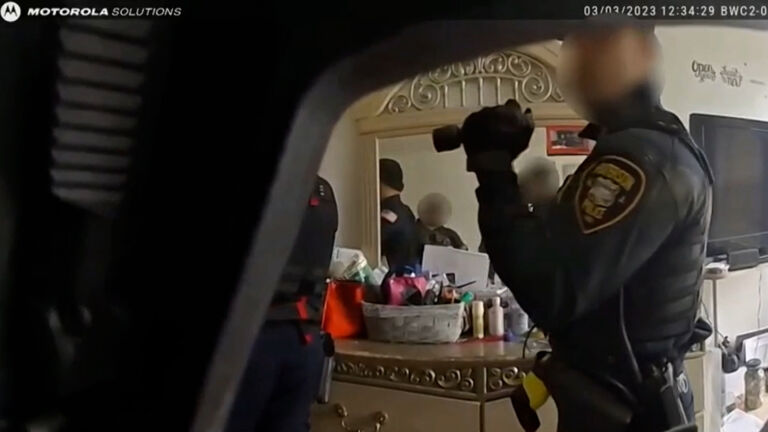
Paterson Police Department plans to use an artificial intelligence program to analyze police body-camera videos, with the hopes of decreasing misconduct and improving people’s interactions with law enforcement.
The department will be the first in the tri-state area to use Truleo, an AI body-camera review program that automatically scores an officer’s language and detects events like use-of-force, according to the attorney general’s office. Attorney General Matt Platkin and Paterson Police Department’s Officer-in-Charge Isa Abbassi announced their plans to use the platform on Sept. 26, six months after the attorney general’s office took over the police department.
Top Paterson police officials are suing the state over its takeover, according to court documents.
The state assumed control following years of mismanagement, alleged misconduct and use-of-force, with the final decision coming after community protests sparked when police killed Najee Seabrooks during a mental health crisis in March.
The AI tool is part of the attorney general’s office’s plan to reform the Paterson police department. The plan also includes efforts to retrain police officers and reestablish community trust. It was shaped by feedback from residents and police officers during public meetings as part of the takeover.

Cameras alone are not enough
While there was a years-long push in the state for more officers to wear body cameras, Truleo CEO and co-founder Anthony Tassone says it’s not enough to only use cameras – less than 1% of the footage is ever reviewed, leaving missed opportunities to correct or praise officer behavior.
“Why is trust broken? Why can’t you [law enforcement] hire anybody? Why is recruiting low retention slow? It seems like this is a crisis,” said Tassone. “One of the things I realized was that they don’t review or watch any of their body camera videos.”
“I suspected that the body camera data was loaded with valuable insights that could help patrol officers become better officers,” he added.
Truleo is currently active in 22 police departments across the country and is scheduled to be implemented in Paterson starting in November.
The program, company officials said, utilizes natural language processing, a part of artificial intelligence that gives programs the ability to “understand” words being used. The program takes the audio from body-camera footage and turns it into text to be analyzed. That means subjective qualities like tone, volume and cadence are not measured. Words spoken by people who are not police officers are also filtered out. The program then categorizes what an officer says. It determines if the officer is being professional, if the officer cursed directly at a person and if force was used, among other categories.
The program creates reports in a dashboard, similar to an email interface. And that provides sergeants the opportunity to coach the officers, Tassone said. Sergeants are checked by their supervisors who receive reports about how often they’re using the program to ensure that they’re actually checking it.
Alameda’s police department in California has already seen a 36% drop in use-of-force since it began using Truleo last year, according to Tassone.
“There are a huge portion of these interactions that can still have positive outcomes. If we incentivize officers to slow down and deploy strategic communication upfront – before things get out of control – when you do that, you have a 36% drop in use-of-force,” Tassone said.
Tassone said his research showed that when younger officers encountered someone who was non-compliant, he noticed they would only provide commands without explanation. Those interactions would end with the police using profanities or force. However, the opposite occurred with older officers that had “good outcomes” – meaning they didn’t use force.
“What we saw was that those older officers all did the same thing. They gave a lot of explanation. They didn’t use profanity (directed at the person), insults or threats. They gave negotiation, they gave explanation,” he said.
Insights like these could help change how a police officers interact with civilians and lead to a reduction in use-of-force by providing opportunities to coach officers, said Tassone.
Accountability or surveillance?
However, local ACLU chapters across the country have expressed concern about Truleo as a surveillance tool, citing privacy concerns for officers and civilians involved. ACLU New Jersey’s Dillon Reisman said he is skeptical of the program and doesn’t want it to detract from the fight for accountability, like the push for civilian complaint review boards to oversee police misconduct.
“Why would we put all of our stock in looking for some technological silver bullet that isn’t really addressing the problem?” he said.
Reisman said that surveillance can’t be the answer every time there is a problem. There are already complaints about officers that go “unsubstantiated” or “unaccounted for,” he said.
“I don’t think the police themselves have trouble knowing which one of them is maybe not good at working with the public. I think the problem we have is that the public gets no transparency over it. And the police departments don’t do anything to hold officers accountable,” Reisman said.
‘Why would we put all of our stock in looking for some technological silver bullet that isn’t really addressing the problem?’ — Dillon Reisman, ACLU New Jersey
Categorizing what constitutes police “professionalism” is also subjective and culturally dependent, said Reisman, and potentially racially biased. He is also concerned that while the program doesn’t analyze civilian behavior today, police departments could use something similar to do so in the future.
“Although we might think that we are okay trying this out on police officers for accountability purposes, we cannot accept that these kinds of behavioral surveillance are a thing that computers can do,” said Reisman.
Reisman is also concerned that “without transparency, the police could deploy AI-powered metrics to support its own narratives and withhold unfavorable information.” Vallejo and Seattle police departments terminated their contracts with Truleo after the program flagged alleged problematic behavior from their officers.
Tassone, though, believes Abbassi is up to the challenge of reforming his department.
“I think if you can show a turnaround [in Paterson], it’s really going to open the eyes of a lot of departments around this country. And it’s why I wanted to partner with him,” he said.