
 Credit: (AP Photo/David Goldman)
With costs escalating, states banking on offshore wind to help avert the worst impacts of climate change are exploring new ways to lower their outlay and make the technology more affordable for the residents who will foot the bill.
In the first agreement of its kind in the nation, three New England states have agreed to jointly procure power from offshore wind projects, a step taken as rising borrowing costs, supply chain constraints and inflation have disrupted the economic projections of offshore wind developers.
The challenges have led to delays in offshore wind projects. Developers are pressing states to rewrite contracts to increase power prices and some are walking away from projects they agreed to build. In Connecticut last week, Avangrid decided to pay a $16 million penalty to cancel a project there.
Blocking the wind
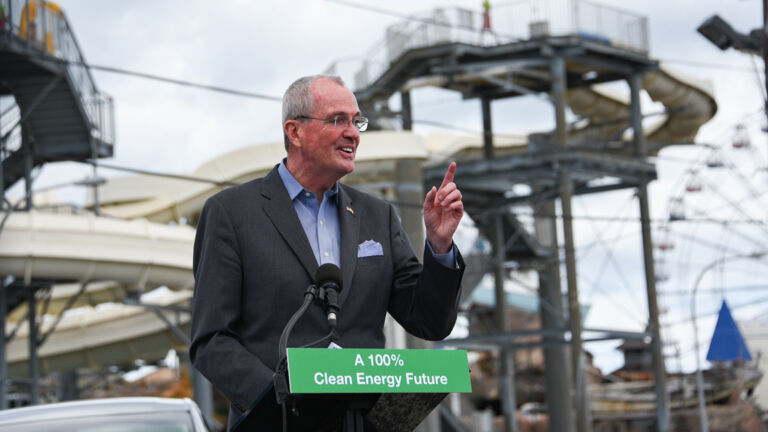
In New Jersey, concerns about rising costs and other factors spurred Republican lawmakers to call for a pause on offshore wind development in the state. The Murphy administration wants to develop 11,000 megawatts of offshore wind power, the biggest target in the nation.
New report from state DEP doubles down on electrifying transportation and building sectors, among other ambitious goals
By joining together, Connecticut, Massachusetts and Rhode Island will procure up to 6,000 megawatts of electricity from offshore wind projects. The agreement, announced last week at an offshore-wind conference, aims to develop multistate projects to expand benefits for the region and reduce costs by developing projects at scale.
The approach may be a model for other states along the Eastern Seaboard, including New Jersey, that are pursuing offshore wind farms as a crucial tool in decarbonizing their economies in response to an intensifying climate crisis, according to clean-energy advocates.
“Not only are there economies of scale, but it also scales the supply chain in a smart way, in a regional way,’’ said Kris Ohleth, executive director of the Special Initiative for Offshore Wind. “It seems to make a lot of sense.’’
Under the memorandum of understanding, two or three of the states may agree to a multistate proposal(s) up to each states’ procurement authority and split the anticipated megawatts and renewable energy certificates.
“We can go further when we work together, and I’m excited to be collaborating with our neighbors in Massachusetts and Rhode Island on this MOU, which opens up the potential to procure clean energy from offshore wind together at more competitive and affordable rates, for the benefit of the residents and businesses in our respective states,’’ Connecticut Gov. Neil Lamont said in a press release announcing the agreement.
Costs and collaboration
Paul Patterson, an energy analyst with Glenrock Associates in New York City, said the recent spikes in offshore wind costs may have spurred the three states to enter into a collaborative approach for offshore wind development.
“I’m surprised it hasn’t happened before, ‘’ he said. With relatively smaller populations and economies, it is not as easy to dilute the cost of such projects as it is with other states, like New York and New Jersey that have a larger base, Patterson said.

“It’s a rather expensive undertaking. In a state like Rhode Island, you find it harder to dilute the expensive nature of the technology. These things are getting expensive and these states are more receptive to collaboration.’’
Regionalization of offshore wind development is a smart way to go in many aspects of the sector, including transmission, the supply chain and for dealing with stakeholders’ interest, according to Ohleth.
Part of the attraction of offshore wind is the new manufacturing opportunities it offers, but Ohleth said not every state will be building wind turbines, wind towers or foundations for the turbines.
Doug O’Malley, director of Environment New Jersey, agreed, saying more coordination in the region should be welcomed. “Hopefully, this could be a model for more collaboration between New Jersey and New York,’’ he said.
But offshore wind critics are skeptical.
“This seems like a desperate attempt by government and governors to make offshore wind work,’’ said Michael Makarski, a spokesman for Affordable Energy for New Jersey. “The economic numbers for offshore wind didn’t work before COVID, during COVID, and now. With Avangrid, it is more cost effective to pay a termination fee of $16 million than to build an offshore wind farm.’’
