
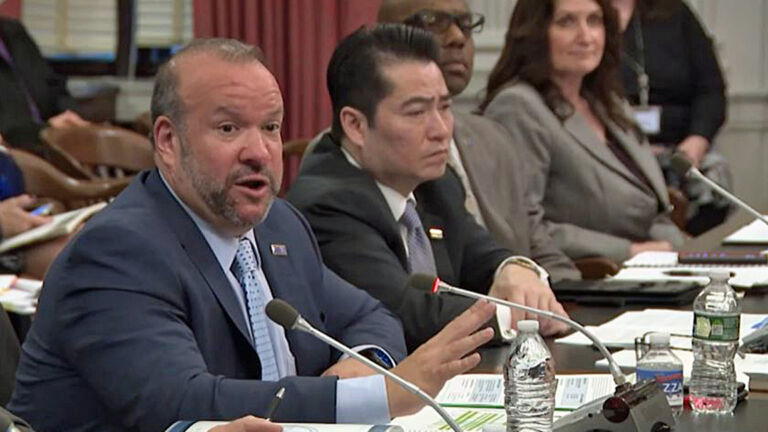
 Credit: (AP Photo/Matt Rourke)
New Jersey’s unemployment rate has steadily risen over the past year and now ranks among the highest in the nation. But while some economists and others suggest that’s a cause for concern, the topline numbers may not tell the full story.
The state unemployment rate has soared from 3% to 4.2% over the past year, according to the latest jobs report released by the state Department of Labor and Workforce Development.
That easily tops the national jobless rate of 3.8%. It also puts New Jersey among the states with the highest unemployment rates in the country, with Nevada topping out at over 5%.
Yet at the same time, New Jersey has also enjoyed healthy employment gains over the past year. Nearly 70,000 jobs have been added over the prior 12 months, according to the latest jobs report.
Also running slightly ahead of last year’s pace in August were monthly state income tax collections, reflecting what Department of Treasury officials called a “steady job market” in a recent news release.
Soft landing or hard?
What exactly to make of these uneven economic indicators heading into the fall remains a key question amid a period of national economic uncertainty. A long-sought “soft landing” nationally would likely keep New Jersey’s current fiscal-year budget right on track, but a tumble into recession could force Gov. Phil Murphy’s administration to draw down reserves or bring on other, more significant spending adjustments.

NJ would offer aid with websites, social media and more
According to Robert Asaro-Angelo, the state labor commissioner, regular discussions with New Jersey employers still suggest there are reasons to be optimistic, including a continuing strong need for labor across the state right now.
“The biggest metric that I use, which is not reported publicly, is what I hear from employers,” Asaro-Angelo said during a recent interview with NJ Spotlight News.
“I have not yet heard employers say, ‘We’re done looking for employees, we’re all good now,’” he said. “So the demand is still there, the market for labor is still tight.”
Still adding jobs
In all, New Jersey added 67,300 nonfarm jobs over the 12-month period that closed at the end of August, according to the latest preliminary figures included in the most recent monthly jobs report.
In August alone the state added 12,300 jobs, which was the largest monthly increase recorded since the beginning of the year, when 19,400 jobs were added in January.
Still, there have been several months with net job losses over the past year as well, according to the state jobs data. As of the end of August, only California (4.6%) and Nevada (5.4%) had higher unemployment rates than New Jersey, according to data released by the federal Bureau of Labor Statistics. However, several of New Jersey’s regional peers also had unemployment rates higher than the national jobless rate, including Delaware (4.1%) and New York (3.9%).
‘We’re at basically historic numbers of workers and employers in New Jersey, which is a great place to be.’ — Robert Asaro-Angelo, commissioner, NJ Department of Labor and Workforce Development
A news release issued by the state Department of Labor and Workforce Development earlier this month linked the August rise in unemployment in New Jersey to growth in the state’s overall labor force, which can often be viewed as a positive development.
The same release also highlighted monthly gains experienced in seven out of nine major private-sector categories, including leisure and hospitality (+1,700); professional and business services (+1,500); education and health services (+1,400); other services (+1,100); manufacturing (+800); information (+600); and financial activities (+400).
“Private-sector job growth remained steady for the month at 6,700, while the state’s unemployment rate increased to 4.2% due to more residents joining the labor force and fewer residents being employed,” the release said.
The impact of a still-growing labor force was emphasized by Asaro-Angelo as he discussed the state economy during his interview.
Historic numbers
“We’re at basically historic numbers of workers and employers in New Jersey, which is a great place to be,” said Asaro-Angelo, who was also bullish on the state economy back in April when he testified before members of the Assembly Budget Committee in Trenton.
“More folks are entering the labor force, which is a positive, for many different reasons,” he said.
‘We came out of the pandemic employment recession pretty strongly, particularly compared to our regional peers.’ — Will Irving, Bloustein School of Planning and Public Policy, Rutgers University
Charles Steindel, Treasury’s former chief economist, noted in the latest monthly analysis of the state’s labor statistics released by the Morristown-based Garden State Initiative think tank that the recent job gains also included a large concentration in the public sector.
And overall, the latest unemployment numbers, including a downward revision of job gains that had been recorded in July, to net negative, are “concerning,” Steindel said.
Divergent stories
According to Will Irving, a professor of practice at Rutgers University’s Bloustein School of Planning and Public Policy, it’s not unusual to have divergent indicators when it comes to the jobs and unemployment data because the results come from two different surveys.
Irving also said it’s important to remember New Jersey, just before the latest increase in the unemployment rate, had been enjoying a period of significant job growth coming out of the worst part of the COVID-19 pandemic.
“We came out of the pandemic employment recession pretty strongly, particularly compared to our regional peers,” said Irving, who researches historical trends and also does economic forecasting.
‘It’s not 2008, it’s not 2020, but we’re trending in a direction we don’t like.’ — Kyle Sullender, New Jersey Business & Industry Association
The increase in unemployment experienced over the past year or so in New Jersey has also come amid a series of interest rate hikes enacted by the Federal Reserve as part of efforts to tame inflation, which remains higher than the Fed’s goal of 2%.
That suggests New Jersey could be on the leading edge of a rising unemployment trend that could spread to other states in due time.
“This year, we’ve kind of crested, and turned the corner, and I would expect, over the next several quarters, to see other states start to see a similar move,” Irving said, before adding, “New Jersey certainly could conceivably get hit a little harder.”
Troubling uncertainty
Offering the perspective of the New Jersey business community, Kyle Sullender, director of economic policy research for the New Jersey Business & Industry Association, said “there is still a lot of uncertainty” about the overall trajectory of the economy.
“It’s not 2008, it’s not 2020, but we’re trending in a direction we don’t like,” Sullender said.
Whether the economy heads toward a soft landing or a full-blown recession remains to be seen, but the uncertainty is “affecting everyday business decisions, affecting business owners, and, obviously that means, it’s affecting their workers and their employees, too,” he said.
“We want to be mindful that, regardless of if the unemployment rate ticks up, or down, in a given month, the broader trend is still that we’re trying to make sure that everybody is prepared and has the resources that they need, so that they can continue to navigate what is still a very unprecedented time,” he said.
— Charts by Genesis Obando
Labor commissioner extols ‘strong worker benefits and protections,’ pooh-poohs ‘naysayers’
