Credit: (AP Photo/Julio Cortez)
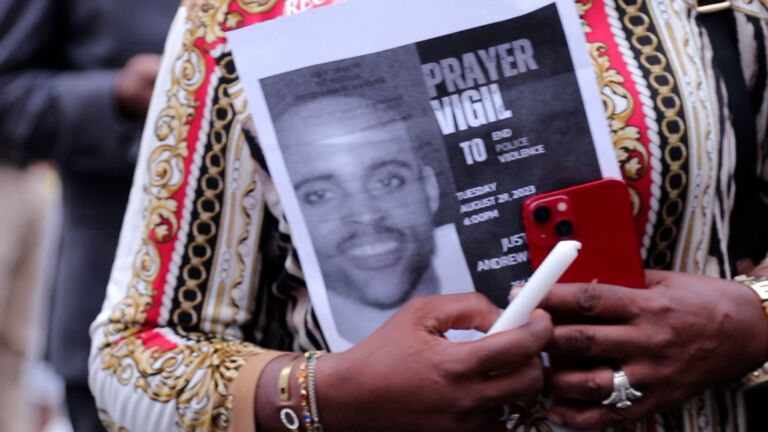
Calls for police reform continue a week after Jersey City police shot Andrew Jerome Washington, a 52-year-old Black man, on Aug. 27 at his home while he was experiencing a mental health crisis. His mental health struggles were well-known to family members and police.
“You don’t always have to shoot first and then ask questions later,” said Jason Williams, an associate professor of justice studies at Montclair State University. “What makes (this shooting) angry for the community … is that most people knew about this man’s condition and so they just don’t understand why this happened,” Williams said.
New Jersey has taken steps to change how police respond to people experiencing a mental health crisis, including the Arrive Together program — which weaves trained clinical professionals into policing to improve outcomes — now established in 40 communities in nine counties. State officials, who say the initiative has helped to significantly reduce violent interactions with people who are having mental health struggles, plan to expand the program to all 21 counties by the end of this year.
But Arrive Together doesn’t exist in Jersey City or Paterson, another city that has experienced high numbers of shootings by officers and has faced criticism for how police respond to those in psychiatric distress. In early March, Paterson police shot Najee Seabrooks, a 31-year-old anti-violence activist who worked for the Paterson Healing Collective, while he was experiencing a mental health crisis.
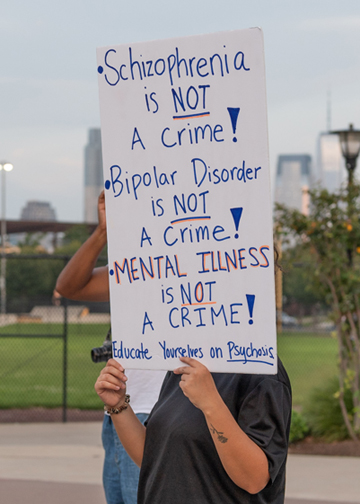 Credit: (Taylor Jung; NJ Spotlight News)
The reliance on traditional policing models leaves anti-violence activists seeking answers. State Attorney General Matt Platkin ordered a takeover of the Paterson Police Department just weeks after Seabrooks’ death and announced the creation of an Arrive Together program in Passaic County, but the new response model has yet to take shape there.
“As a community member, I can’t even vouch for the success of the program because we ourselves haven’t had the opportunity to witness it or even to shape what it looks like,” said Zellie Thomas, the lead organizer of Black Lives Matter Paterson. News of Washington’s death at the hands of Jersey City police was “eerily similar” to Seabrooks’ killing in Paterson, he said.
“Where the family of a man going through a mental health crisis were the ones to call emergency for help and instead of getting help, he was killed. And New Jersey still does not have a healthy response to someone with a mental health crisis who may or may not have a weapon on them,” Thomas said.
A different way
A growing number of cities throughout the country are using a non-law enforcement-led response that allows 911 dispatchers to send trained mental health professionals to nonviolent calls. Daniela Gilbert, the director of the Redefining Public Safety initiative at the Vera Institute of Justice in New York, said this approach — especially involving unarmed civilians in the response — needs to be expanded even more broadly.
State officials said they are eager to add Jersey City to the list of locations in the Arrive Together program. A spokesperson for the attorney general’s office said the program “relies on strong and willing partnership” between the state and local government. Officials are hopeful that success in other communities will convince Jersey City leaders “to embrace the program,” the spokesperson said. “We would welcome the opportunity to collaborate with the police department and the service providers of Jersey City to bring this incredible program to the city’s nearly 300,000 residents,” they said.
Jersey City did approve a similar program — which would pair mental health professionals with police officers — in 2022, city Councilman Frank Gilmore told NJ Spotlight News. But there has been no progress on that initiative, he said.
For now, Washington’s family members are left with multiple questions about the shooting. “If you have somebody who is going through something and they have an episode, you need trained professionals. But if the professionals look like the police, that creates anxiety,” said Damien Hall, a cousin of the victim, after a prayer vigil held in late August.
‘Until we realize that if we keep on doing the same thing, we’re going to get the same result.’ — Yannick Wood, New Jersey Institute for Social Justice
While some mental health services exist in Jersey City, Wesley Hall, another cousin of Washington’s, said they needed to be more accessible.
“We’re talking about Drew, so which means obviously we’re talking about bipolar and schizophrenia. But there’s so much stigma around mental health, and for a lot of people who suffer, a lot of internalized shame,” Hall said. “So the fact that they reach out for help at all is incredibly brave. We shouldn’t make the process more difficult for them.”
The sequence of events
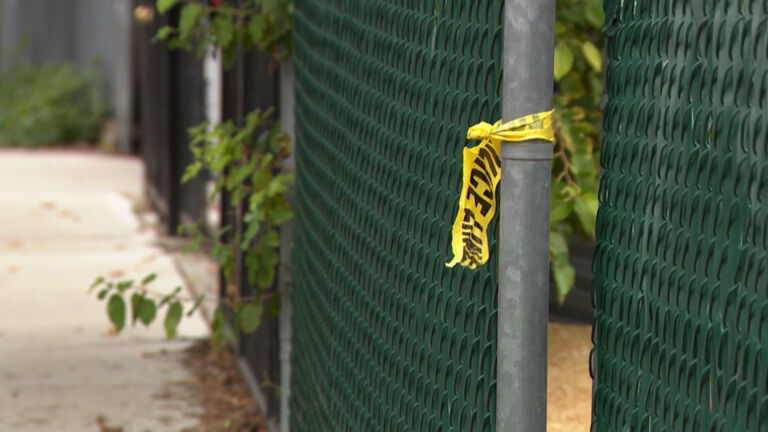
On Aug. 27, emergency medical services arrived at Washington’s Randolph Avenue home around 2:15 p.m., according to a press release from the attorney general’s office, and following a call from family members concerned about his welfare. The medical responders requested police assistance, which arrived shortly, but when Washington refused to open his door or communicate with the officers, they called in the city’s Emergency Service Unit. ESU officers spent about a half hour trying to convince Washington to open the door before they forced it open. According to the press release, Washington advanced toward them; one officer fired a stun gun, and the other officer fired his weapon twice. A knife was found nearby, according to police. Washington died after being transported to Jersey City Medical Center.
“Until we realize that if we keep on doing the same thing, we’re going to get the same result,” said attorney Yannick Wood, the director of the criminal justice reform program at the New Jersey Institute for Social Justice. “Then people are going to keep on dying. These are going to be brothers, sons, fathers who are going to end up dying,” he said.