
 Credit: (AP Photo/Ted S. Warren)
Planning officials in White Township, Warren County last week deferred a decision on a plan to build 2.8 million square feet of warehousing on local farmland, a bitterly contested project that epitomizes a statewide fight between developers of the giant buildings and affected communities.
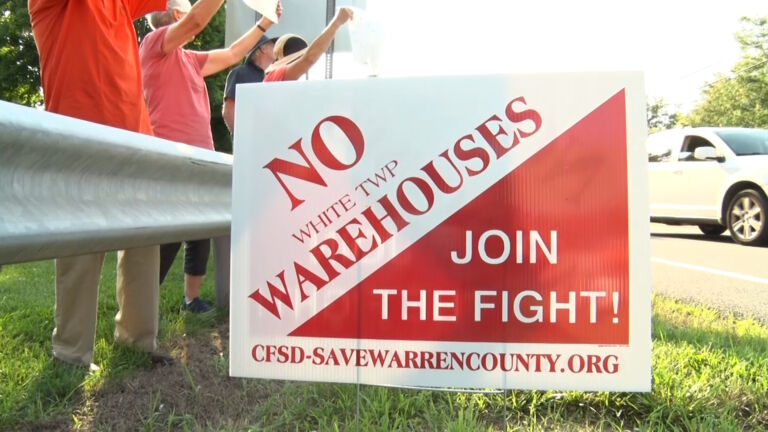
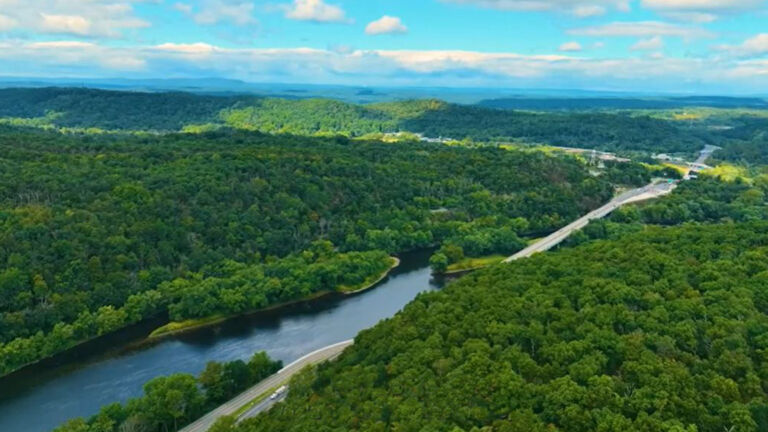
The plan by Jaindl Land Development of Allentown, Pa. has been under discussion in the largely rural community since June 2019, and although its size has been more than halved from an early proposal of some 6 million square feet, it is still fiercely opposed by hundreds of residents who argue that it will choke local roads with truck traffic, develop some 600 acres of farmland, generate stormwater runoff, and industrialize a rural corner of the state.
Developers and the business groups that represent them argue that New Jersey’s ongoing surge in warehouse construction creates jobs in a state economy that is heavily dependent on the sector and is a legitimate response to a shift to online shopping that drives strong demand for warehouses and the land they are built on.
Demand is also fueled by a flood of imported consumer goods arriving at the Port of Newark and Elizabeth, which now handles more containers than any in the U.S. New Jersey’s network of roads and rail lines, and by its geographical position, give logistics companies easy access to millions of customers in the populous Northeast market.
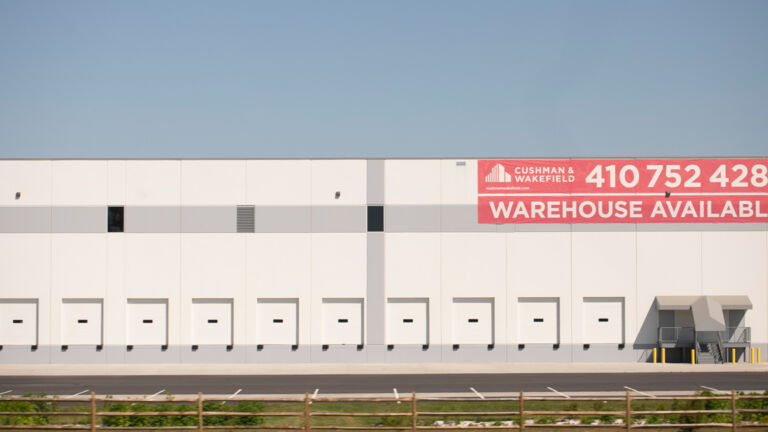
Warehouse construction across the state continued strong in the first quarter of 2023, according to industry reports. One, from the commercial real estate firm Cushman & Wakefield, said there were 12.5 million square feet of warehouse space under construction. Strong demand continues to push rents higher, according to Newmark, another real estate company.
Growing opposition
The boom has sparked strong opposition in communities including West Windsor in Mercer County, Allentown in Monmouth County, and Piscataway in Middlesex County. All are fighting their own anti-warehouse battles which have included lawsuits and acrimonious public meetings where opponents accuse planning officials of caving in to the demands of rapacious developers. In many communities, opponents argue that planned warehouses would snarl traffic, create flooding, worsen air quality and ruin their quality of life.
In White Township, public expectations that the local planning board would finally decide on the Jaindl application drew some 250 people to a public meeting last Tuesday evening. But they were disappointed when for the second month running, the panel delayed consideration of the plan, this time until its Aug. 8 meeting.
‘Based on my understanding, the board was concerned about the lack of movement in the application, and that lack of movement has come to an end, and we will be moving ahead with all dispatch, beginning with the August meeting.’ — Anthony Sposaro, an attorney for the developer
Even then, more than four years after the Jaindl plan was unveiled, the board is unlikely to decide whether to approve or deny the project, because the next meeting will see just the start of formal presentations by both sides, said Anthony Sposaro, an attorney for the developer. He predicted it will be “some months” before the process has advanced to the point where the board can make a decision.
Sposaro said the board decided not to consider the application last week because Jaindl has not yet formally presented its case, and representatives were not present for the second month running, but that they would attend the meetings starting in August.
The board previously said it would consider denying the project “without prejudice” — meaning that a developer can return with a new application — if the Jaindl team continued to stay away from the meetings, Sposaro said. But he predicted that it will no longer make that decision because the developer will be present from the August meeting until the process is finished.
“Based on my understanding, the board was concerned about the lack of movement in the application, and that lack of movement has come to an end, and we will be moving ahead with all dispatch, beginning with the August meeting,” he told NJ Spotlight News.
Lawsuit looms
But if, when the process concludes, the board issues any kind of denial, it can expect to be sued “without any doubt,” Sposaro said.
He blamed opponents for slowing the process by asking “repetitive, irrelevant” questions at public meetings, and he accused the chairman of the planning board, Tim Matthews, of giving opponents too much opportunity to speak out against the project.
Township officials did not return phone calls seeking comment.
Tom Bodolsky, vice president of Citizens for Sustainable Development, a White Township group that opposes the warehouse project, said the planning board missed a “golden opportunity” last week to deny the project without prejudice. He said the board “mysteriously modified” the agenda six days before the meeting to say there would be no discussion of the Jaindl matter that night — a decision that apparently went unread by many of the meeting’s attendees.
“We had 250 people there last night who attended the meeting thinking there was going to be a decision. Jaindl doesn’t show up. In my opinion, the board should drag an applicant in to explain why they should carry this matter,” he said, referring to the deferral until August.
If approved, Jaindl will build two warehouses on about 600 acres of undeveloped land for which the developer paid about $12 million, Sposaro said.
The application complied with the town’s “light industrial” zoning that was in effect when the plans were filed but would not do so now that the town has significantly reduced its building density in new zoning that became effective since the application, Sposaro said.
Truck traffic
While warehouse critics across the state complain that their communities will be overwhelmed by truck traffic, the problem would be worse in White Township because trucks serving its warehouses would have to travel some 10 miles down county roads to get to Interstates 78 or 80, the nearest highways, critics say.
Sposaro acknowledged that the warehouse would generate more traffic, but he argued that county roads will be able to cope with it because they were designed to go from one county to another.
“Will there be more traffic? Yes. Will there be some impact on levels of service — which is how traffic consultants measure the impact — there will be some, but the reality is that these are county roads. They provide links to interstate highways, and that’s why they exist,” he said.
‘There are more and more local communities that are organizing and mobilizing, and are aware of these warehouse proposals now, and are fighting them.’ — Pete Kasabach, New Jersey Future
Jim Gilbert, a former chair of the State Planning Commission, said the White Township project “so completely exemplifies dumb growth versus smart growth” by being on a rural site far from the interstate highways that logistics companies need.
Warehouses should be located near road, rail and port arteries but are increasingly being sited in rural places like White Township because land is scarce or too expensive in places that would make more sense for warehouse operators, Gilbert said.
“The developer will go out and buy the cheapest land he can get, and if it’s in the middle of a cornfield, he will do that,” Gilbert said. “What you have in White Township is the most ludicrous selection, and it’s done by a very aggressive and powerful development group who just couldn’t care less about what’s best for the state.”
Public opposition to the White Township plan is growing as more and more people, especially retirees, understand the effect it will have on the community, said Julia Somers, executive director of the Highlands Coalition, a nonprofit.
“Members of the retirement community are turning up in droves because it’s a beautiful part of New Jersey but it won’t be any more,” she said.
Zoning regulations
As warehouse developers scramble for land across the state, government officials and land-use advocates have urged municipalities like White Township to proactively change their zoning before applications are made so that land that they want to protect from warehouses cannot be used for that purpose.
But state officials show no appetite for diluting towns’ power over land use in a state where a tradition of home rule is strongly defended. A report from the State Planning Commission’s executive arm last year recommended ways in which municipalities can anticipate and respond to warehouse applications, but state officials stressed they have no power to impose planning regulations on towns.
In the Legislature, a bill by former Senate President Stephen Sweeney would have required municipalities facing warehouse applications to seek a buy-in for their plans from neighboring towns. But the bill died in the last legislative session. Several other bills were introduced in 2022 by lawmakers under pressure from residents to control the runaway pace of warehouse construction.
Pete Kasabach, executive director of New Jersey Future, a nonprofit that advocates for “smart growth,” said the long-running clash of a warehouse developer and the community in White Township appears to reflect what’s happening around the state.
“The dynamic right now is what you see there,” he said. “There are more and more local communities that are organizing and mobilizing, and are aware of these warehouse proposals now, and are fighting them.”
The lesson for developers, Kasabach said, is to think more about where they want to build warehouses, and to try to build alliances with community members early in the process.
Smart growth in the warehouse industry means they should be placed near highways and rail lines, and not along country roads, Kasabach said. “Anything that is placing large warehouses that generate a lot of truck traffic outside of that logistics network is a bad idea,” he said.
