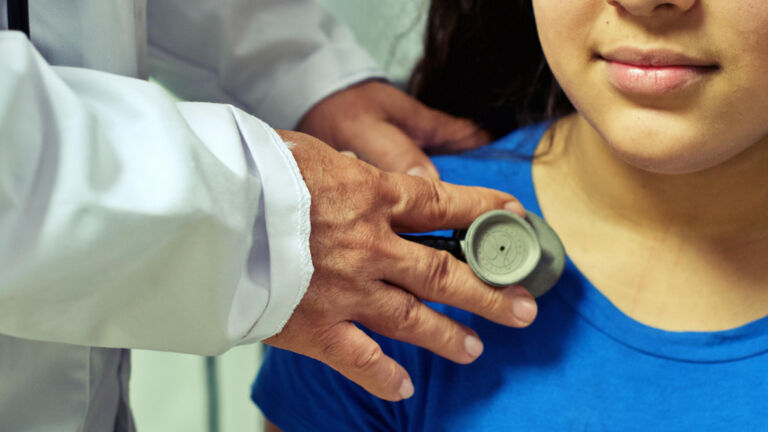
Credit: (Courtesy of Dr. María Rodríguez)
People immigrating to the United States face a host of challenges when adjusting to their new lives here, including separation from family, financial burdens, language barriers, racism and a loss of cultural practices.
These experiences — not to mention the perils for many of the journey to the U.S. — can exacerbate mental health concerns like anxiety, depression and PTSD (post-traumatic stress disorder).
Dr. María Rodríguez, the founder and chief executive officer of the Care Counseling Center — which has offices in Somerville and Princeton — knows these challenges well. Rodríguez was born in the U.S. but was brought by her father to the Dominican Republic when she was 2 years old. Seven years later, in 1986, she came back to the U.S, to Paterson.
“It was a culture shock for me,” said Rodríguez, referring to the return to the U.S. “I thought at that time everybody in the world spoke Spanish. (I) didn’t know one word in English. When I first started learning, I used to feel embarrassed because I would mispronounce words,” she said.
Rodríguez said she started taking classes to lose her accent because she felt embarrassed of her heritage at one point. “And that’s something that I see in kids who are first-generation American(s) or the kids who start growing up in the United States.”
At the Care Counseling Center, Rodríguez offers services to immigrants, including mental health counseling, naturalization applications, document translation services, applying for and renewing green cards and temporary protective status applications. The center also offers mental health support to veterans and to corporate business employees.
Her efforts to assist people through the immigration process come as immigration issues continue to be a contentious topic in New Jersey and nationwide. NJ Spotlight News spoke with Rodríguez about why she started the counseling center, her experiences of migration and how to combat the potential mental health impacts on people who have been held in a detention center.
NJ Spotlight News: When did you come up with the idea to start the Care Counseling Center and what services do you provide at the center?
Dr. Maria Rodríguez: I started the Care Counseling Center in 2016. I’ve been working in counseling for over 20 years. I was working for a different company and then decided to branch out to do my own thing because I had so many ideas in terms of immigration and families. I started to focus more on … bilingual families and immigration services. One of the reasons why I wanted to focus on these families is because, although I was born in the United States, I migrated from the Dominican Republic and I understood firsthand the challenges that you experience when you migrate to a new country in terms of language, (and) going to a country that you know nothing about culturally. You lost your friends, your family. It’s like starting fresh and you’re afraid, nervous and anxious.
NJSN: How did your own life experiences shape the work that you do today?
MR: One of the big services that I provide is family reunification. When I lived in the Dominican Republic, I did not live with my mom. Then when I migrated to the United States, now I’m living with my mom, and she’s a complete stranger to me. I just know her name. Now when I work with families, I notice that kids feel the parents are strangers, but parents expect this automatic love. And that’s when the conflict begins because the kids are like, “Well, I don’t know you and you’re telling me all this and you left me,” and they feel abandoned. And parents feel (like), “I did it for you. … I sacrificed my life and all this stuff for you and you’re ungrateful.” And there’s so much family conflict that they have to work through. In my personal experience, I had that with my mom. Working it through personally and then working with clients to help them have that healthy relationship, because you can, it takes a lot of forgiveness and understanding.
NJSN: Can you explain the mental health impacts for a family or a child being separated, or in a detention facility and what that does to a person’s mental health as well as to a family’s?
MR: The separation from the family is always very traumatic. I’ve had clients who have stayed in detention centers for eight months and once they leave, it’s like pressing the reset button. It’s very traumatizing. I have had clients that suffer from post-traumatic stress disorder (PTSD), especially for kids who are separated from the families. They go through a lot of emotional difficulties, nightmares, (and) that fear with being in a strange place and no support system.
NJSN: What are some of the best practices you use at the Care Counseling Center to combat some of the negative mental health impacts experienced in a detention center?
MR: When we are talking about immigrants and the trauma that they’ve experienced, compassion is first and understanding what they went through — acknowledging that they went through something difficult, acknowledging that it’s not their fault because sometimes they feel (like), “Oh, well, I came and it’s my fault because I made the decision to come.” No, you came because it was so difficult in your country that you made a decision that it was life or death for you and your family. Helping remove that guilt that you’ve left, you’re separated and now you’re going through this difficult time — those are key — and then adding … cognitive behavioral therapy. They’re also going through a lot of financial difficulties and just life in general. So putting all that together and working through all of that. It gets complicated because it’s not just post-traumatic stress disorder, it’s a whole bunch of things.
NJSN: In general, what challenges do people experience when immigrating to the U.S.?
MR: Sometimes people say, “Well, these people are crossing over (the United States-Mexico border).” I like to remind people that something so severe is happening in their country or to their family that they’re willing to risk their life to put themselves through that long journey that they may get through or not. When they do get to me finally, after they’ve lived this journey, they have to become stable in mental health (and) emotional stability. Now, how do we become successful and how do we address the fears so that you can move forward with your family and feel safe again in your community and building your own community? So, usually I talk to my families about defining what (does) success, what does safety mean to you as opposed to comparing it to what others have or what the American culture has.