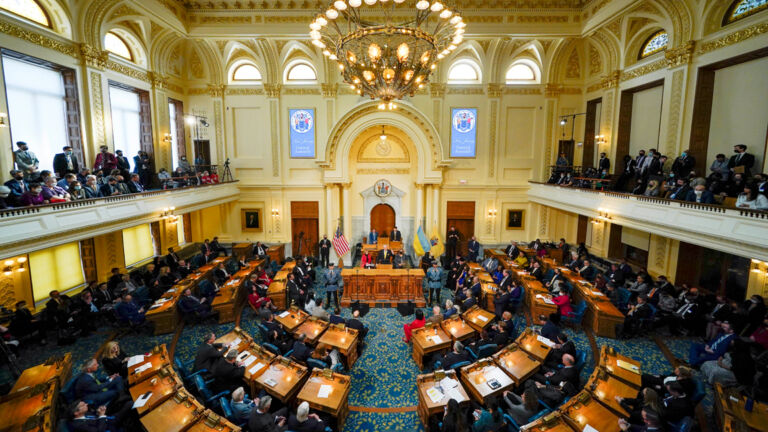
Credit: (AP Photo/Seth Wenig)
Gov. Phil Murphy signed a $54.3 billion state budget into law Friday after New Jersey lawmakers rushed through final votes earlier in the day just before the July 1 start of the new fiscal year.
The new spending bill includes more money for child tax credits, senior property-tax relief and K-12 public schools. The budget also includes over $31 million in grants-in-aid for the 988 call line for mental health crisis and suicide prevention, $43 million for a “hub-and-spoke” model that aims to provide more mental health services to more school students and $17 million for Medicare and Medicaid inspections of nursing facilities.
While Republican lawmakers expressed frustration over the budget process during final votes on the spending bill, citing concerns with a lack of transparency and fiscal responsibility, Democrats said the budget “achieves a number of historic investments and is the pinnacle of fiscal responsibility.”
In addition to the final voting on the state budget, over 200 bills were scheduled to be heard in front of both houses on the last day before lawmakers break for the summer. Here is a look at some of the highlights of the voting sessions last week. Copies of the bills and more details can be found at the Legislature’s website by searching on the bill number.
Social justice
Social justice advocates are concerned about a set of bills that they say will marginalize Black and Latino residents who are negatively impacted by the criminal justice system at disproportionate rates.
Bill A-5610 would address teens causing trouble at the Jersey Shore, sponsors said, but advocates fear it would potentially open the door to be used against Black and Latino kids in other parts of the state. The bill passed the Assembly on Friday.
A package of auto theft bills harken back to the 1990s “tough-on-crime” era, which created racial disparities in policing and incarceration, say advocates. Bill A-5034/S-3006, which would increase the severity of crimes for a leader of or a participant in an auto-theft trafficking network, passed both houses late June. Bill A-5189 would eliminate the presumption of pretrial release, a key provision of New Jersey’s bail reform, for those who commit certain auto theft crimes. The bill passed both houses and now heads to Murphy for his signature.
Key criminal justice and police reform measures proposed by the Legislative Black Caucus remain stalled. Social justice measures were championed by legislative leaders following 2020’s racial reckoning but have languished. Advocates and lawmakers have pushed for the creation of civilian complaint review boards (A-1515) and banning the use of chokeholds (A-1370) for years, if not decades.
Housing
Both houses passed A-5415, which would create a zero-interest, forgivable loan program to provide down-payment assistance for some first-time homebuyers and a pilot program for developers to rehabilitate existing homes and build new affordable homes. Murphy signed into into law on Friday.
Low-income residents would be eligible for $15,000 in down payment assistance to buy a home and they could get up to another $10,000 if they are also a first-generation homebuyer. Some $25 million would be available each year for this program.
Homes built through the pilot program would be available to people with a household income of no more than 120% of median income and who are either renters impacted by a storm or natural disaster or a first-time homebuyer. No cost is specified for the pilot program but funding for it would be drawn from federal American Rescue Plan money. The measure has been signed into law by the governor.
Criminal justice
Both houses passed, largely along party lines, two measures meant to help people of lower income who need legal representation in criminal matters.
Bill S-3771 would eliminate fees for the use of public defender services. Lower-income defendants can seek public defender representation, but those considered able to pay have in the past been required to provide partial reimbursement to the office. The measure would end those fee reimbursements and would erase any current liens or warrants issued against those who did not pay required fees. The nonpartisan Office of Legislative Services estimates the state would lose $4 million in the first year due to the elimination of fees. Murphy signed this into law on Friday.
And S-3772 would extend public defender representation to those seeking parole revocation. It would create a special unit within the public defenders’ office to represent those on parole who are charged with a violation that could result in parole revocation. It notes that this representation was recommended earlier this year by the state Criminal Sentencing and Disposition Commission. The annual cost of the unit is estimated at $1.1 million. This bill is awaiting the governor’s action.
Elections
The Senate gave final approval on Monday to A-5176/S-3594, a bill that would require county clerks to periodically report vote totals starting on Election night and continuously until final results are posted.
Counties would have to report results by midnight on election night and by 9 p.m. every day while counting continues, including by type of vote — vote by mail, early in-person and Election Day. The measure would also, for the first time, require counties to report partial results to the Division of Elections as the counting continues and have the state report results in a single place while vote counting continues. The secretary of state would develop a template for standardized reporting for all counties to follow.
The measure includes a $1.5 million appropriation to cover the anticipated additional costs to counties. If signed by Murphy, the new reporting requirements would take effect for this year’s general election in November.
Health care
Members of the Assembly debated a measure that would require New Jersey to create a website that outlines people’s reproductive rights and provides information on health-benefit coverage and reproductive services, with Republicans suggesting it should also include adoption resources. Both Democratic-led houses passed the bills (A-4828/S-3275).
Health care advocates welcomed news that lawmakers in both the Assembly and Senate approved legislation (A-2840/S-1615) that would create an independent board of experts to guide the state on prescription drug policy, a step many believe is critical to making medicines more affordable. Lawmakers also advanced several other prescription drug measures, including a Senate bill (S-1616) to increase transparency around pharmaceutical pricing. The Assembly had already passed a companion version.
The Assembly and Senate advanced various bills that would increase — and set in statute — Medicaid rates for certain health care services, including traumatic brain injuries and elder care. Only one was up for a vote in both: legislation (A-5082/S-3587) to set rates for pediatric medical day care, which provides assistance and activities to children with complex health needs or disabilities, which passed. Insurance companies and some policy experts have warned that rate-setting can drive up health care costs without protecting quality.
Education
Public education funding — the single largest slice of all state spending in New Jersey — was an early issue in the budget deliberations but appears to have been largely unchanged in the last-minute negotiations.
Under Murphy’s initial budget proposal, the state’s public schools were to receive a record increase overall from Trenton of more than $834 million, bringing the total of direct state aid to $10.7 billion for next year and boosts to more than 300 districts. Those increases stayed intact under the final budget bill.
The one major change came several months ago when legislators moved separately to restore more than $100 million in cuts to almost 200 districts, a move that Murphy ultimately went along with. The Murphy administration this spring also backed off an original budget proposal to revamp how mental health services are provided in schools, instead staying with its funding of school-based services while continuing to build out the state-proposed model.
But surviving from Murphy’s initial budget is also more than $100 million in aid for existing and expanded preschool, and another $20 million in incentives and other programs to help address the state’s teacher shortage.
Mental health
Lawmakers passed a bill (S-524) that would create a statewide mental health diversion program to keep people out of the criminal justice system and move them toward case management and mental health services. The goals of the program include reducing incarceration rates, increasing the quality of life for people in the program by connecting them with community-based mental health treatment providers and reducing recidivism and rehospitalization rates.
Another bill (S-3929), to allow a hospital or emergency department to involuntarily detain a person for up to six days, so long as they get a temporary court order, passed both houses. The court could grant a temporary order for a continued hold if the hospital or emergency department “exhausted all reasonable efforts” to place a person in a psychiatric facility or hospital and showed that there is a “substantial likelihood” that the person could harm themselves or other people based upon the views of two psychiatrists who have examined the person and have determined that they need involuntary commitment.
The Assembly passed a bill that would prohibit social media platforms from using certain practices or features that can cause children to become addicted to the platforms. The bill has not moved in the Senate since February.
Judicial nominations
The Senate confirmed without opposition Michael Noriega to the state Supreme Court. Noriega, a Union County Democrat and former public defender, fills the final opening on the seven-member court. He is the fourth justice put on the bench by Murphy.
— Additional reporting by Taylor Jung, John Mooney, Colleen O’Dea and Lilo H. Stainton
— Editor’s note: This story has been updated to correctly state the number of New Jersey Supreme Court justices as seven.