
 Credit: (Rich Hundley III/Governor’s Office)
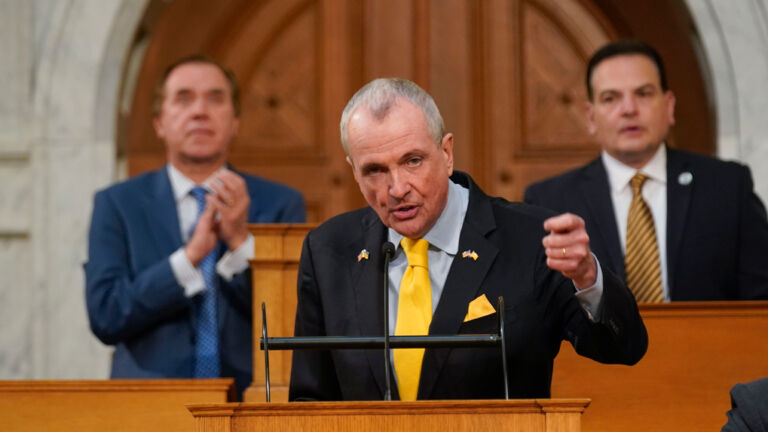
Gov. Phil Murphy and top Democratic legislative leaders say they are being responsible by waiting almost three years to deliver the election-year promise they’re making now to cut property taxes in half for many senior homeowners.
A policy agreement formally announced Wednesday at a news conference in the State House calls for many New Jersey homeowners age 65 and older to receive tax credits that could effectively halve their annual property-tax levies.
Governor and top lawmakers tentatively set $250 bump in property-tax benefits for next year
Moreover, the proposed tax credits will initially max out at $6,500 and won’t be offered to any senior making more than $500,000 annually, according to the agreement, which is expected to be incorporated into a new state budget Murphy and lawmakers must enact before the July 1 start of a new fiscal year.
The long delay between Wednesday’s announcement and when seniors can expect to see tax credits that deliver on the promise of cutting property taxes in half was labeled “cartoonish” by Republican Sen. Joseph Pennacchio (R-Morris), even before the agreement was officially announced.
Assembly Republican Leader John DiMaio (R-Warren) also weighed in, calling the proposal dubbed “StayNJ” an “election-year ploy.”
Justifying the delayed rollout
But Murphy, Assembly Speaker Craig Coughlin (D-Middlesex) and Senate President Nicholas Scutari (D-Union) offered a different take on their proposal, which also calls for a near-term increase in “Anchor” property-tax relief for seniors, during the 40-minute news conference.
For starters, Murphy, a second-term Democrat, said the proposed new relief program, which is likely to cost well over $1 billion once fully implemented, is “fiscally responsible.”
Under the agreement, which comes just weeks after new revenue projections drafted by the administration shaved a combined $2 billion off the forecast for the current fiscal year and the one that begins July 1, funding will be set aside over the next several fiscal years to help pay for the promised tax credits.
The three Democratic leaders have also agreed to legislative language that will ensure funding for the program won’t come at the expense of other top fiscal priorities, such as maintaining robust budget reserves and sticking to current K-12 school-aid commitments.
Assembly Speaker Coughlin stressed that the goal of keeping seniors in their homes — and in New Jersey — was an underlying ‘priority for all of us.’
Given concerns of a slowing economy that could be further dragged out by ongoing efforts to cool inflation, Murphy said the long runway also provides more time for a full economic recovery to occur.
“We’re doing it in a way that is fiscally responsible,” Murphy said during Wednesday’s news conference. “We’re not out over our skis.”
Meanwhile, the delayed delivery on the promised tax credits will also provide some time to complete the task of bringing online what appears to be a complicated new state program that will likely require cooperation from multiple departments and layers of government.
Among other provisions, the proposed new program calls for establishing a new application process for state-funded relief programs like Anchor and Senior Freeze, to determine whether seniors would benefit the most from those offerings or what would be provided under StayNJ. A six-member commission will be created to work through any “administrative challenges,” according to the agreement.
A reasonable runway
“This is a complex program to put in place, and we’re probably going to need to have a runway that’s reasonable to make sure we do it right when we get there,” Murphy said.
In the meantime, senior homeowners, as well as renters, facing immediate pressure from property-tax bills that now average close to $9,500, could receive a promised $250 increase in the size of state-funded Anchor property-tax relief benefits.
But competing proposals, revenue outlook complicate the prospects
The deal calls for senior homeowners making up to $150,000 annually to receive benefits worth $1,750 in the next round of Anchor payments, while senior homeowners making more than $150,000 up to $250,000 annually would receive $1,250.
For senior renters making up to $150,000 annually, the planned increase takes the size of their Anchor benefits from $450 to $700. The state provides property-tax relief to tenants through Anchor to account for property taxes paid indirectly through monthly rent.
Speaking about the negotiations that led to the agreement on senior tax relief, Coughlin stressed that the goal of keeping seniors in their homes — and in New Jersey — was an underlying “priority for all of us.”
“We have demonstrated over the course of the last several years that when we put our shoulder to the wheel and commit to doing something, we get it done,” Coughlin said.
For his part, Scutari also stressed the fiscal-responsibility message, suggesting a better-performing economy allows for the establishment of a new property-tax relief program.
“We have the luxury of providing this long-asked-for property-tax relief that we couldn’t have fathomed to be able to do,” Scutari said.
