
Editor’s note: This story was updated at 11:45 p.m. Tuesday.
New Jersey’s mostly quiet legislative primaries featured no surprises Tuesday and now, after some bitter contests for Republican nominations, the GOP prepares its uphill battle to take control of one or both houses of the Legislature this fall.
As of 11:45 p.m., The Associated Press had called nearly all the contested races in the state. The results showed that all incumbents who faced a challenge, including Republican Sen. Edward Durr in South Jersey and Democratic Sen. Richard Codey in the north, had either won a place on the November ballot or were leading. The only incumbent who lost was Sen. Nia Gill, who was moved into Codey’s 27th District and chose to face him, rather than retire after redistricting. Because so many candidates were unopposed, the AP was able to call 185 races at 8 p.m., as soon as the polls closed.
At least one Democratic or Republican nomination was up for grabs in about a third of the state’s 40 legislative districts, while the GOP filed no candidates for 13 spots in the Senate or Assembly and the Democrats did not field a candidate in two races.
The results of this election set up the matches for November’s general election, in which Republicans will try to win enough seats to wrest control from the Democrats, who have held majorities in both the Senate and Assembly for two decades. Currently, the Democrats hold 25 of 40 Senate seats and 46 of 80 in the Assembly.
Still, the way district boundary lines were drawn last year ensures that only a handful of districts will be truly competitive this fall, so this primary election likely decided the winners in most districts.
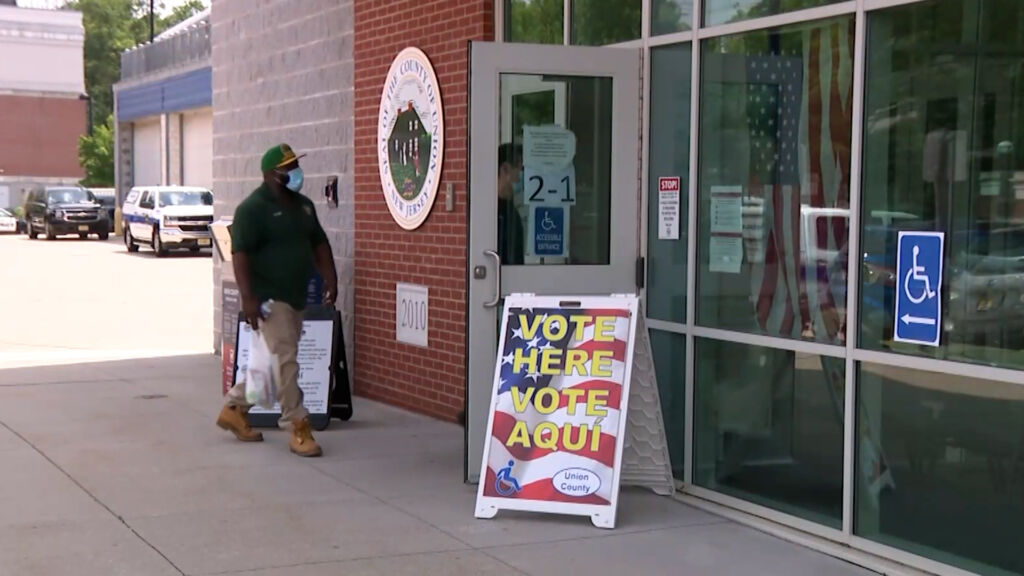
Many polling places throughout the state were quiet during the day. A survey of turnout in partially counted districts by NJ Spotlight News found that, as of 11:45 p.m., about 12.5% of registered party voters had voted, though it was unclear whether those reports included early voters or were all the ballots received so far. The last time the Senate topped balloting in 2011, just 13% of registered partisans voted.
A large percentage of voters took advantage of the state’s early voting options. More than 220,000 people used mail-in ballots and some 24,000 visited in-person voting centers Friday, Saturday and Sunday to cast ballots early on machines. While the number taking advantage of early in-person primary voting remained low, that turnout was about 20% higher than in 2021, when the governor’s race topped balloting in the first year it was offered. For last year’s congressional primary, about 27,000 cast ballots at early voting centers.
The most-watched races were in five districts.
27th District: Codey vs. Gill
With more than three-quarters of the votes counted, Codey had captured 60% of the vote. The Democratic senators faced off in the 27th District covering five Essex County communities and Clifton in Passaic County. Redistricting placed Sen. Nia Gill, who currently represents the neighboring 34h District, into the 27th. Gill was the only sitting lawmaker moved into a new district who decided to challenge the incumbent, rather than retire. The race was quiet.
Codey’s running mates, Assemblyman John McKeon and Alixon Collazos-Gill, wife of Essex County Commissioner Brendan Gill and no relation to Nia Gill, also won. Their ticket appeared to have the edge from the start as they won the backing of the Essex and Passaic Democratic organizations and were endorsed by big-name Democrats, including Gov. Phil Murphy on Monday. They also outspent Gill and her running mate Eve Robinson by more than 5 to 1. Craig Stanley, a former assemblyman, also sought to get back into the Assembly, running in the 27th District under the banner “Putting ‘The People’ First.”
3rd District: Durr vs. Sawyer
 Credit: (AP Photo/Matt Rourke)
In South Jersey’s 3rd District, covering Salem and parts of Cumberland and Gloucester counties, incumbent Republican Sen. Edward Durr defeated Beth Sawyer, a current assemblywoman and his 2021 running mate.
The Republican slate flipped this district two years ago, with Durr’s defeat of powerful Democrat Steve Sweeney, then the president of the Senate, rocking the state’s political world. Sawyer has since soured on Durr and criticized some of the controversial statements he has made regarding Muslims and women, while Durr accused Sawyer of jumping into the “Trenton swamp.” Durr and his ticket, Assemblywoman Bethanne McCarthy Patrick and Thomas Tedesco Jr., won the coveted party line backing and had more money than Sawyer, who ran with only one Assembly hopeful, Joseph Collins Jr.
McCarthy Patrick and Tedesco won, as well.
Durr said he was pleased with his victory and called for party unity going into the general election.
“I’m looking forward to mending fences and healing the wounds and let’s move forward because I want the party to unite,” he said. “We had our primary, the voters made their choice, now let’s unite and move forward. All the voters in South Jersey made their message clear that they continue to believe that I am a strong representative for the district, that they want to continue to have me serving the people, and they made that loud and clear in tonight’s victory.”
On the Democratic side, two full slates battled for the right to run in November and try to retake the 3rd District. John Burzichelli, the district’s former assemblyman who was ousted along with Sweeney two years ago, led a ticket that featured Heather Simmons and Dave Bailey Jr. for Assembly and got the party line. Burzichelli won nearly three-quarters of the votes and his ticket won easily. Opposing them were Mario DeSantis for Senate and Tanzie Youngblood and Robert Fitzpatrick for Assembly, who ran under the banner “The Good Democrats.” Burzichelli and his ticket won by a significant margin.
4th District: Another GOP battle
 Credit: (Gloucester County Board of Commissioners)
In the neighboring 4th District, which Republicans plan to make a battleground in November, The Associated Press called the fierce Republican Senate contest for Christopher DelBorrello, a former Washington Township councilman. With almost 80% of the votes counted, DelBorrello had more than 60% of the vote.
That was also a loss for South Jersey Democratic boss George Norcross. American Representative Majority, a dark-money group associated with Norcross, spent some $94,000 in the last two weeks of the campaign on mailers and ads trying to defeat DelBorrello, according to reports the group filed with the state Election Law Enforcement Commission. South Jersey Democrats would have preferred facing DelBorrello’s opponent, Gloucester County Commissioner Nick DeSilvio and his ticket, in November. The Gloucester Republican Party backed DeSilvio and running mates Denise Gonzalez and Michael Clark for Assembly, while Atlantic and Camden Republicans endorsed DelBorrello and Assembly candidates Matthew Walker and Amanda Esposito. Walker and Esposito won. A fifth candidate, John Keating ran under the slogan, “Lower Taxes Pro-Family Anti-Mandates.”
24th District: Five Republicans for two seats
 Credit: (Sussex County Board of Commissioners)
The race in the state’s northernmost district, the 24th, where two open Assembly seats drew a field of five Republicans, was still too close to call at 11:45 p.m. with 83% of the vote counted. Leading were Dawn Fantasia, a Sussex County commissioner and Chester Township Mayor Michael Inganamort, who ran with the backing of the Morris County GOP and of retiring Sen. Steve Oroho and Assemblyman Harold Wirths.
At the top of their ticket was Assemblyman Parker Space, who was unopposed in seeking the Senate nomination. Lafayette Board of Education President Joshua Aikens and Warren County Commissioner Jason Sarnoski, who survived a challenge questioning his residency, got the Warren County GOP’s backing. The Sussex County Republican Party does not endorse candidates. A fifth candidate, Robert Kovic ran under the slogan “A Fighter for our Fair Share” in Sussex and Warren counties.
26th District: The most expensive race
 Credit: (NJ Spotlight News)
Likely the most expensive primary in the state, with close to $1 million spent, it had two slates of Republicans battling in what has been a Republican district for a half-century. Pennacchio, a dentist who served in the Assembly before moving up to the Senate in 2008, faced a challenge from Morris County Commissioner Tom Mastrangelo, who recently won his fifth term on the county board despite running off the party line.
Mastrangelo and his running mates, former Assemblywoman BettyLou DeCroce and Robert Peluso, were running off the line again as Pennacchio and Assemblymen Jay Webber and Brian Bergen won the party endorsements. DeCroce, who lost Morris GOP backing two years ago and lost her seat, was hoping greater name recognition in the district would help her to get back to Trenton by beating Bergen, who currently represents the neighboring 25th District but was moved into the 26th in a redistricting shuffle. Mastrangelo, DeCroce and Peluso ran under the banner “Regular Republican Party.”
For comprehensive election coverage, go to our NJ Decides 2023 elections page. Live election night results will be posted on the NJ Spotlight News homepage.
— Michael Pappano contributed reporting.
