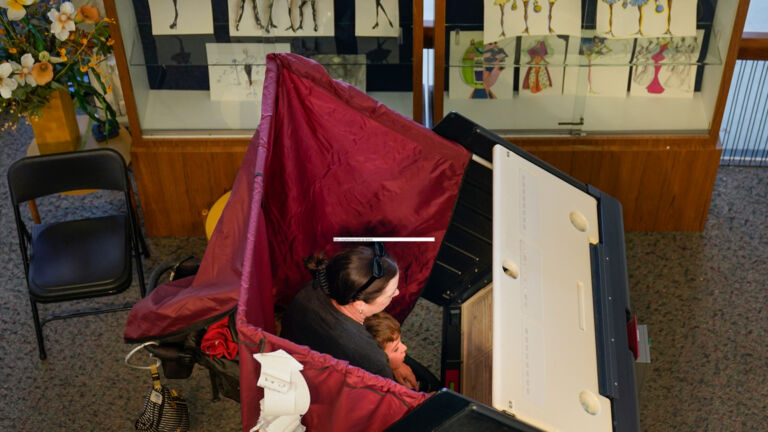
Credit: (NJ Spotlight News)
In-person voting in this year’s primary election is about to begin throughout New Jersey, though turnout is expected to be low — except in the few legislative districts with bitterly contested Republican primaries.
About 200,000 people have already voted by mail, representing close to 5% of the more than 4 million registered Democrats and Republicans in the state. More than 6.5 million New Jersey residents in total are registered to vote. And while those not affiliated with the major parties are allowed to vote in the primary by declaring for one of the parties, very few do. In 2011, the last time legislative races topped balloting, about 490,000 people, fewer than 13% of registered partisans, voted.
This will be the second primary election in which voters will be able to vote early in person on a machine. The number who show up at more than 140 locations that open statewide for three days beginning Friday at 10 a.m. is expected to be a fraction of those using mail-in ballots. Last June, the first primary with early, in-person voting, saw only about 20,000 voters turn out early. The November 2021 gubernatorial election was the very first election with machine voting prior to Election Day.
Despite the lack of interest, there are reasons for people to vote in many districts across the state. About a third of the state’s 40 legislative districts have contested primaries, with the most contentious on the Republican side. But even in quieter races, the winner of the primary almost always wins the general election because of the way political insiders draw district boundary lines. So voters who sit out the primary miss the opportunity to choose which Democrats or Republicans are likely to be representing them.
Colleen O’Dea on the latest on the race for the State House
The district lines were redrawn by a bipartisan commission last year, as they are once a decade to equalize population as counted by the decennial census. This is the first time candidates are running in these districts, so many voters are likely to see new names on the ballot. While redistricting could give some newcomers a better chance at success, incumbents always have an edge because of better name recognition and, usually, larger campaign accounts. But any candidate who gets party backing, known as the county line, also has an advantage in preferential ballot position along with the slate of other candidates supported by the Democratic or Republican parties.
Where the sparks fly
An unusually large number of seats are open on the ballot this year. After the boundary changes moved some lawmakers into different districts, several of them chose not to seek reelection. Factoring in legislators who decided to retire for other reasons, the number of open seats totals 21, close to one-fifth of the 120 total seats in the Senate and Assembly.
Most of the sparks are flying within the Republican Party.
In the 3rd and 4th districts in New Jersey’s southwest, GOP Senate and Assembly candidates have been trading jabs while not spending a lot of money.
Republicans think they can seize the 4th District, which covers parts of Atlantic, Camden and Gloucester counties and two full slates are running. The one headed by Gloucester County Commissioner Nick DeSilvio for Senate has the backing of the Gloucester County GOP and had spent the most — $31,000 — as of the most recent campaign filings with the state Election Law Enforcement Commission. Chris Del Borrello, a former Washington Township councilman who is heading the other ticket, is backed by the county Republican organizations in Atlantic and Camden counties and had more in the bank heading into the last month of the campaign: $51,000, compared to $19,000 for DeSilvio and his running mates.
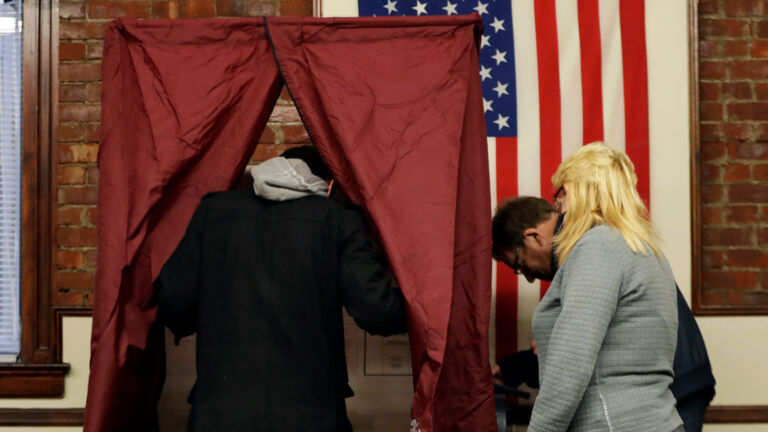
In the neighboring 3rd District, where Republicans ousted powerful Democrat Steve Sweeney two years ago, incumbent Sen. Edward Durr faces a challenge from Beth Sawyer, a current assemblywoman and his 2021 running mate. Unlike two years ago, Durr has some money this time around, with about $49,000 on hand as of the most recent ELEC filing, compared to Sawyer’s $12,000. Durr is running with Assemblywoman Bethanne McCarthy Patrick and Thomas Tedesco Jr. of Bridgeton, and his slate has won the coveted party line. Joseph Collins Jr. of Mickleton is running with Sawyer.
About 200,000 people have already voted by mail, close to 5% of the more than 4 million registered Democrats and Republicans in the state.
Two full slates of Democrats are also battling for the right to run in November, trying to retake the 3rd District. John Burzichelli, the district’s former assemblyman who was ousted along with Sweeney two years ago, is running for a Senate seat atop a slate that got the party line and outspent the opposing slate, which is running under the banner “The Good Democrats,” headed by Mario DeSantis for Senate.
There are also heated Republican primary choices in the 24th District, based in Sussex County, and the 26th in Morris County.
On the Democratic side, the marquee race has been quiet. In the 27th District in Essex and Passaic counties, Sen. Richard Codey, a former governor, and his ticket are facing Sen. Nia Gill, who was moved from her neighboring 34th District into the 27th, and one running mate. Codey, Assemblyman John McKeon and Alixon Collazos-Gill, wife of Essex County Commissioner Brendan Gill and no relation to Nia Gill, have the backing of the Essex and Passaic Democratic organizations and have outspent Nia Gill by more than 4 to 1. Nia Gill does not have a public campaign website.
For comprehensive election coverage, including information on candidates, voter registration, polling places and key dates, go to our NJ Decides 2023 elections page.