
 Credit: (Nicole Leonard/WHYY)
When Malcolm Talton, who is Black, tells people that he grew up in Haddonfield, he gets some dubious and skeptical responses.
It’s not surprising, he said, given that only about 1.1% of Haddonfield’s population today identifies as Black, according to the most recent U.S. census data. That’s down from about 2.2% of the population recorded in 1950.
Members of the small South Jersey community say as their numbers shrink, it has become increasingly important to commemorate and preserve local sites, figures and culture that have made up Haddonfield’s Black history over the years.
“I think everybody that lives here, or who has lived here, it’s our legacy,” Talton said.
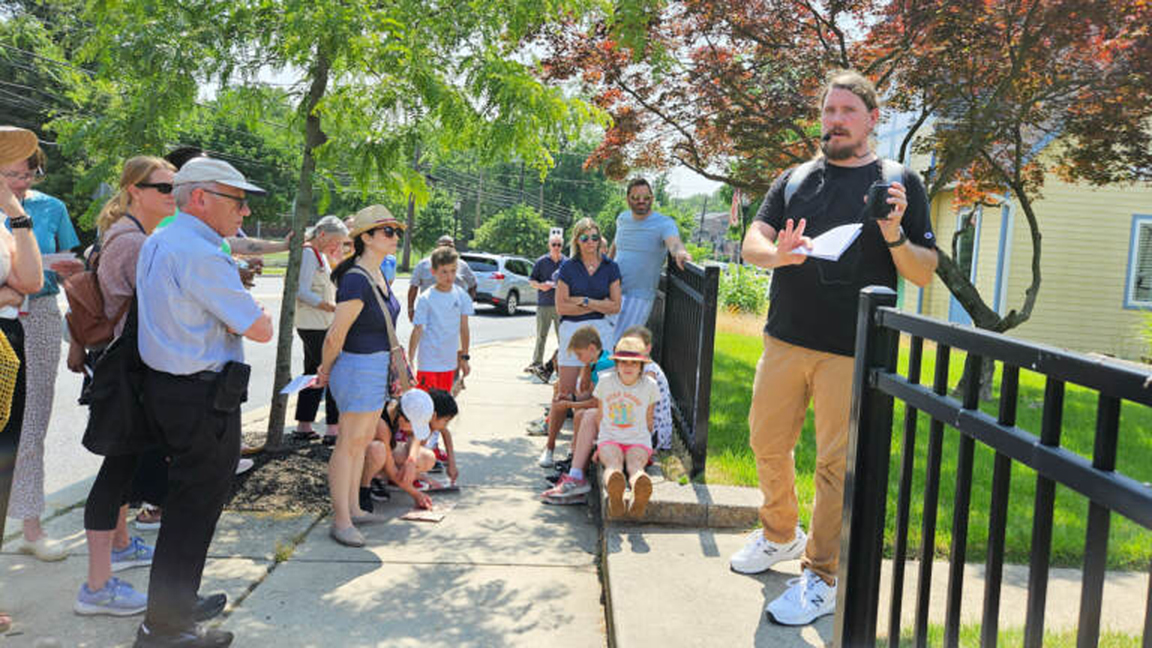
On Monday, in observance of Juneteenth, community members launched the borough’s inaugural walking tour of historical African American sites.
Where to start
“We are celebrating those who came before us,” said C. Adrienne Rhodes, whose family has lived in Haddonfield for six generations. “And if you’ve only got 50 [people] or you only have a dozen, that’s all you need. Start where you’re at.”
The walking tour was part of the Preserving Black Haddonfield History Project, an intercommunity collaboration between local historians, religious leaders, students and teachers, the Haddonfield Foundation, and current and former residents.
Tour guides led a group of adults and schoolchildren to various sites in a section of town formerly called “the Point,” an area home to a majority of Haddonfield’s Black residents since the 1700s.
 Credit: (Nicole Leonard/WHYY)
About a dozen stops included a private residence that used to be the Douglass Avenue Public School for Coloreds, a segregated elementary school for children; the former residence of Attee Leeman, Haddonfield’s first African American landowner in 1807; and Mount Olivet Baptist Church and Parsonage, one of two churches that still primarily serve the town’s Black community.
Finding context
Malcolm Talton’s cousin, Rev. Anthony Talton, has served as church pastor for 19 years since taking over the position from their grandfather.
“I believe the whole the foundation of why we’re having this is so that we can understand the exact significance of why we’re here,” Rev. Talton said. “What is the African American presence, and how can we unite that with others so that we can help build a community that looks not at the individual, but looks at the character of each individual.”
The Preserving Black Haddonfield History Project launched earlier this year with the publication of an anthology of first-person stories from community elders.
 Credit: (Nicole Leonard/WHYY)
Students from Haddonfield Memorial High School interviewed older Black residents about their lived experiences.
“The elders, they still have a lot of pain from things that happened here,” Malcolm Talton said. “Some of them didn’t want to talk. They’re still untrusting. And the kids, some of them had never talked to an older Black person. So, that’s really good.”
Rhodes, a co-founder of the history project, said the group is now airing a docuseries, plans to publish additional anthologies of first-person stories and will soon install historic markers at sites across town that have played a role in Haddonfield’s Black history.
“It’s important people know that we are everywhere, and we make contributions everywhere,” she said.