
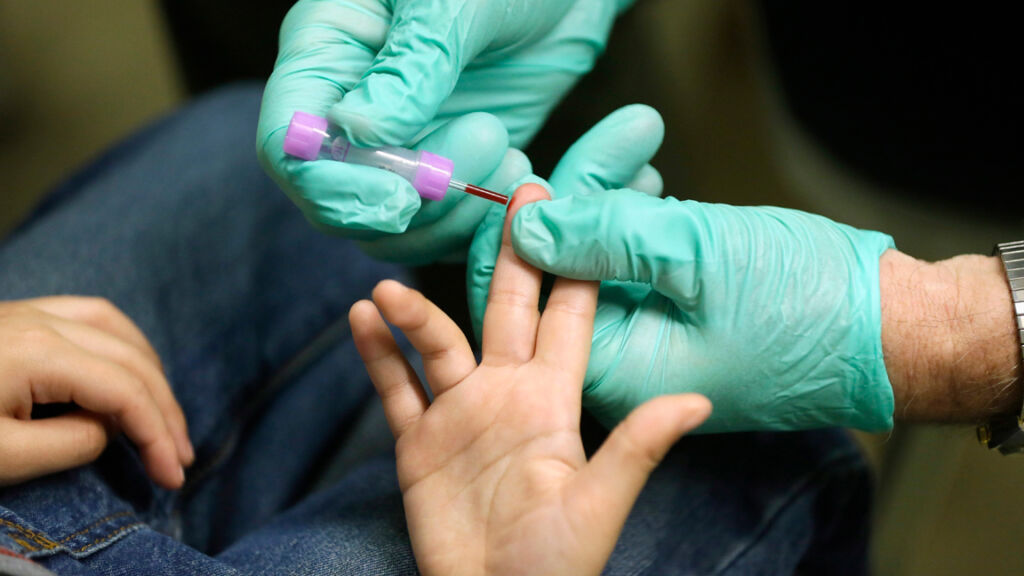
New Jersey wants to invest an additional $5.2 million to expand its program to screen children for lead poisoning, using stricter federal thresholds that would enable nearly twice the current number of youngsters to qualify for follow-up services.
Program data in Gov. Phil Murphy’s proposed state budget for fiscal year 2024 shows officials anticipate the revised screening requirements will identify almost 6,700 young children with concerning levels of lead in their blood, up from 3,500 this year. The new funding is designed to help local health departments pay for the costs associated with the increased volume of home inspections, case monitoring and additional interventions.
Who’s most at risk?
Lead is a highly toxic metal that can cause brain damage and more in children and adults. It is particularly dangerous to developing bodies and brains and can cause developmental and educational delays, hyperactivity and other problems for young kids. It is found in paint used in facilities built before 1978, contaminated soil and in some imported toys, cosmetics and hobby materials. Kids who are Black, from low-income families or are immigrants are more likely to live in communities where lead is a problem, according to the federal government.
“There is no lead level that is good. Our bodies do not make lead. Our bodies do not need lead,” said Bruce Ruck, managing director for the New Jersey Poison Control Center at Rutgers New Jersey Medical School, which tracks poisonings and educates the public on potential dangers.
To guard against lead poisoning, New Jersey law requires that children be screened at roughly 12 and 24 months by a doctor, community clinic or local health department. If the blood test reveals 5 micrograms or more of lead per deciliter of whole blood, the family is referred to local public health officials who then coordinate home visits to find the source and further assess the child’s needs.
“Separation from the source. That’s the most important thing,” Ruck said, noting the need for medical intervention is rare.
‘There is no lead level that is good. Our bodies do not make lead. Our bodies do not need lead,” said Bruce Ruck, managing director for the New Jersey Poison Control Center.’ — Bruce Ruck, New Jersey Poison Control Center
The state now plans to expand its program by lowering the threshold of concern to 3.5 micrograms/deciliter, a move that follows a federal recommendation from October 2021. It comes roughly four years after the state lowered the action level from 10 micrograms/deciliter to 5 — also in response to changing federal guidance — a shift that nearly quadrupled the need for follow-up services.
“The better the tests have become — the more accurate and sensitive they are — the lower the action level for lead has become,” Ruck explained. “So it was 10, now it’s 5 and it will drop to 3.5, all because we have the ability.”
Murphy’s $53.1 billion budget plan, which lawmakers must adjust and approve before the fiscal year starts in July, highlights the $5.2 million in extra funding for the Department of Health program, which also runs a multilingual public education program on lead. It also lists nearly $14 million in lead-remediation grants and program funding in the Department of Community Affairs and references additional dollars for lead cleanup in the Department of Environmental Protection. “These interventions will dramatically reduce the incidence and harm caused to young children by lead exposure,” it states.
Distributing remediation funds
The budget also highlights that the state began in February to distribute grants from a $180 million lead-remediation fund created over the past two years. The grant program was prompted by a spike in lead levels in parts of Newark’s water system, which became national news and prompted a $75 million project to replace miles of old, lead-lined water pipes.
It is unclear when the new blood-lead threshold will be enacted in New Jersey, however. The change was discussed during budget meetings with legislative staff last year and health department officials have been drafting regulations ever since. Representatives for the department did not respond to requests for an updated timeline, new data or other information on the program last week.
Some landlords balk
 Credit: (AP Photo/Stew Milne)
Chris Merkel, president of the New Jersey Association of County and City Health Officials — the trade group for 94 local offices that coordinate much of the response when kids are flagged with high lead levels — welcomed the lower threshold and the additional funding to meet the larger demand. But he said it is hard to get some landlords to remove toxic paint, tainted dust or other lead sources, a process that can cost $30,000. “More funding for abatement is definitely needed,” he said.
Merkel, the public health officer for Monmouth County, is also concerned about children who do not get tested — about 15% of the total, according to the state. “This is a very big gap,” he said. “Doctors provide scripts for children to get blood-lead tests. However there is no follow-up.”
Of the nearly 200,000 children screened in 2018, some 2.3% statewide were found to have elevated blood levels, according to health department data from that year, the most recent available. But rates varied widely by community, with cities ranging from 6.1% in Irvington and 5.9% in Trenton to 0.2% in Middletown and Brick.
