
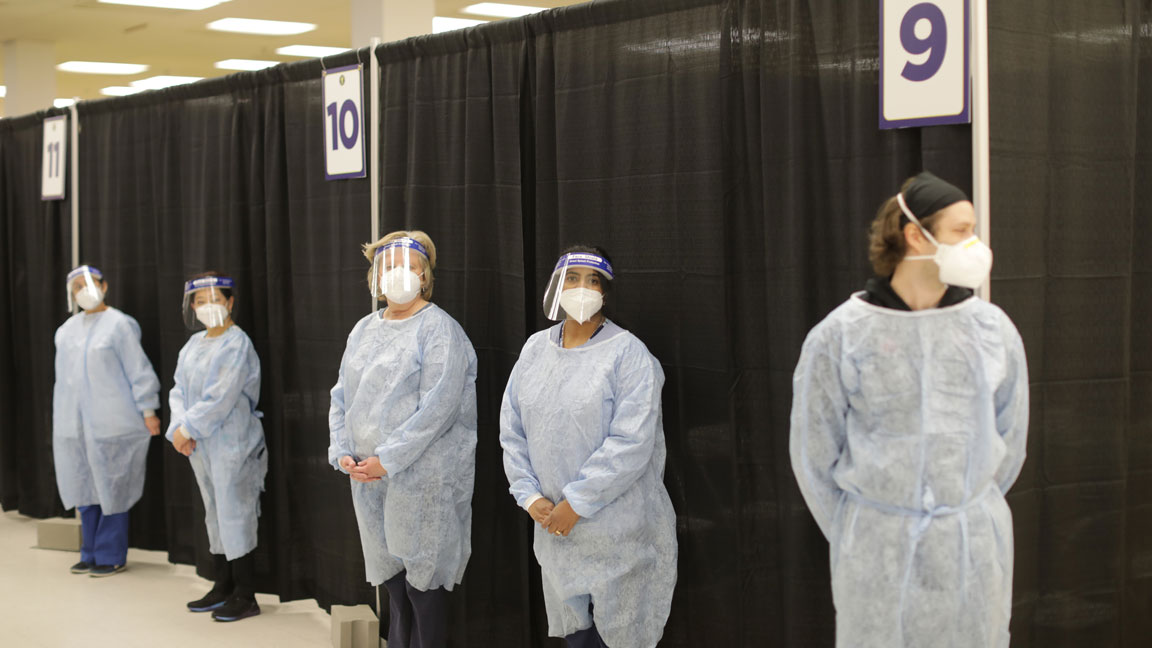
 Credit: (Edwin J. Torres/ NJ Governor's Office; CC BY-NC 2.0)
It happened with 9/11. Then in 2009 with the H1N1 outbreak, commonly known as swine flu, and again three years later, after Superstorm Sandy. In each emergency, local public health officials rushed in alongside — or soon after — other emergency responders. Then came a flood of federal money to fund the crisis response.
But like the tide, those federal dollars receded a few years later, leaving the local public health departments without the resources leaders say are needed to sustain the system over time and ensure it is ready for the next emergency. The problem is not unique to New Jersey, but experts say the situation here is complicated by the state’s heavy reliance on local taxpayers to support this work.
“We’re just repeating history again,” said Lynette Medeiros, the advocacy chair for the New Jersey Association of County and City Health Officers.
COVID-19 — the deadliest global pandemic in modern history — killed more than 1 million Americans, including 36,000-plus New Jersey residents and left public health workers exhausted and traumatized. Now Medeiros and her colleagues wonder, “How can we still be an afterthought? How can you not invest in us?”
Medeiros and other public health officers are urging New Jersey lawmakers to reinstate the Public Health Priority Fund, a program created in 1977 to support local public health operations and infrastructure. The fund provided a small but dependable annual revenue stream based on population and health needs but remained stagnant at $2.4 million for years until Gov. Chris Christie eliminated it in 2011.
A bipartisan bill sponsored by Sen. Vin Gopal (D-Monmouth) and others would resurrect the fund with at least $10 million annually. The measure (S-2413) was introduced last May and has yet to be heard by a committee in either house. “We did some research and found out they are dramatically underfunded,” Gopal said. “Some states spend a lot more money on public health.”
Raising awareness about public health
Gopal said the legislation — with a companion version sponsored by Assemblyman Herb Conaway Jr. (D-Burlington), a physician who leads his county health department — is also a vehicle to help educate his colleagues about the role public health officers play in New Jersey. It is a complex system with more than 100 regional, county and municipal offices, some of which oversee multiple communities, and a mix of public workers and contract staff, he said.
“I didn’t realize how many services they provide,” Gopal said. “We are continuing to move forward. We are continuing to raise awareness.”
 Credit: Wikimedia Commons
New Jersey received more than $48 billion in federal pandemic assistance in 2021 for its COVID-19 response, to fund unemployment benefits, support local governments and help small businesses offset their losses, according to data compiled by the state comptroller. Billions have gone to the Department of Health to fund operations, long-term care and testing and vaccination clinics.
But, according to the New Jersey Association of County and City Health Officers, relatively little of this money has flowed to New Jersey’s local health departments. These offices are responsible for inspecting retail food sellers, investigating communicable diseases and responding to public health emergencies, making them the frontline defense for COVID-19. Many offices also organize anti-smoking campaigns, cancer screenings and immunization clinics, among other duties.
“We are the invisible workforce,” Medeiros said, something she and her colleagues have made peace with, despite working 16- to 18-hour days during the pandemic. Even now, after some made public health workers the enemy for promoting what they saw as overzealous restrictions, Medeiros said, “people still don’t know who we are.”
The national scene
The funding situation is not unique to New Jersey. The nation spent $4.1 trillion on health care in 2020 but just 5.4% on public health or preventive measures — nearly double the 2019 percentage — according to a July 2022 report from the nonprofit Trust for America’s Health. Federal disease prevention programs have seen new funding since — including $200 million to improve public health capacity and infrastructure and $38 million for immunizations — but these are one-time infusions, the report notes.
“The COVID-19 pandemic has made that underfunding and its deadly consequences abundantly clear, but infectious disease outbreaks are not the only risk,” the Trust report said, noting wildfires, floods, suicide and other concerns are also having a growing impact on the nation’s public health system.
‘Some states spend a lot more money on public health.’ — Sen. Vin Gopal
“It’s like the game of Jenga,” Medeiros says. “You pull out that one block and it’s all going to tumble.”
While New Jersey is known for high-quality medical care, its investment in preventive public health measures lags other states. In 2021 New Jersey spent $32 per person on public health, according to an analysis by SHADAC, a health policy research program at the University of Minnesota funded by the Robert Wood Johnson Foundation, which also supports NJ Spotlight News. That is roughly one-third of the spending level in New York, Massachusetts and Maryland, the data shows, but twice the per-capita investment in Pennsylvania.
With less state and federal money to pay for this work, New Jersey public health offices are more dependent on local property-tax revenue than almost any other state, experts say. A 2007 study commissioned by the state health department found that public health offices here received 60% of their resources from local sources, twice the national average. Members of the county and city health officers’ association said that dynamic has changed little in the 16 years since.
By the numbers
In the current fiscal year, the state health department will spend $175 million through its Office of Local Public Health to shore up the workforce post-pandemic and continue efforts to address childhood lead, opioid addiction and other issues, according to a chart provided by deputy communications director Nancy Kearney. Seven of the 10 programs she identified are one-time funding opportunities, however, and many require grant applications that local officials said can become barriers to access.
“The Department works closely with local health departments to identify, address, and respond to public health threats and to support health equity,” Kearney said. “In addition to resources directed through local health departments, municipalities benefit from a mix of federal and state dollars and (it) goes to local health, health care facilities like federally qualified health centers and hospital systems, and community-based organizations.”
‘You can’t build a true public health foundation with state grants or short-term federal funds.’ — Chris Merkel, Monmouth County health officer
Association president Chris Merkel said $75 million of this funding is already being distributed by the organization, but the other funding will be used by the state to support public health initiatives of its own. “These funds are not every-year funds that can be counted on long term, and do not provide local health departments the sustainability to build a long-lasting infrastructure to combat future emergencies like a Superstorm Sandy or the next communicable disease pandemic.”
Gov. Phil Murphy’s budget proposal for fiscal year 2024, which lawmakers must approve before July, touts nearly $500 million in federal dollars for public health-related programs addressing everything from abstinence initiatives to West Nile virus. This money will go to support work done by the state, nonprofits and local health departments and comes with strict spending guidelines.
But Merkel, the Monmouth County health officer, said the new budget includes no flexible public health funding. “All these federal pass-through funds are grants that are unsustainable, not flexible, and they have an expiration date,” he said. “You can’t build a true public health foundation with state grants or short-term federal funds.”
While the proposed $10 million is not enough, Merkel and others said reinstating the priority fund is a critical step toward creating a lasting public health system. NJACCHO treasurer Margy Jahn said the true need is somewhat unknown, but the state health department is working with them to study the workforce, operations and other needs.
Workforce is a significant concern for local public health officers. Jahn, the health officer in Freehold Township, said while some states would support a team of 50 to 60 people for a population of 130,000, her office has a dozen employees.
Staffing issues
An October 2021 research paper funded by public health organizations found the workforce had shrunk by roughly 15% nationwide over the past decade and now needs to grow by 80% — adding 80,000 full-time jobs — to provide “a minimum set of public health services.”
The limited salaries, long hours and the possibility of public scorn make it hard to attract new talent, public health leaders said, and short-term funding complicates this challenge. “You may find the greatest employee, but you know you only have them for one or two years under the grant,” Medeiros said.
“Or you have to look for programs to cut,” added Stephanie Gorman, the association’s president-elect and assistant health officer in Morris County.
Without more staff, Gorman said she was forced to bring her 7-year-old daughter with her to work during the height of the pandemic; her family members are all first responders, she said, and there was no one to cover her shift.
Even when she contracted COVID-19 herself, Medeiros said she had to continue to work, making contact-tracing calls from her couch while she nursed a high fever and infections in both lungs. “There wasn’t an option,” she said, noting that many other health officers did the same thing.
Like Gorman, Medeiros has first responders in her family, professionals whom she noted serve in shifts that are designed to spread the weight of the job and give them time to recharge — something public health officers said is impossible in their work. “Even teachers have substitutes,” said Merkel, whose wife is a teacher. “But if we go down, there is nobody behind us.”
