 Credit: (AP Photo/Julio Cortez)
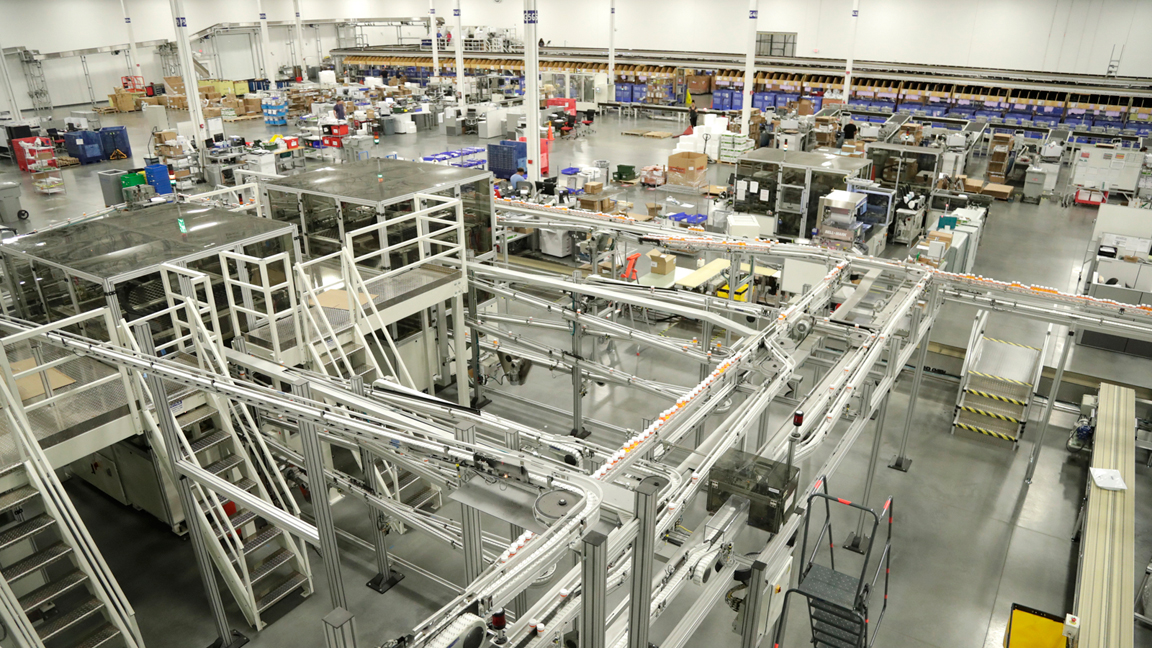
New Jersey’s warehouse industry faces a possible future restraint on its recent explosive growth because of legislative and municipal action to curb its expansion, according to the latest industry outlook.
A quarterly report on industrial real estate in north and central New Jersey found more evidence of strong demand for warehouse space in the final three months of 2022. It also signaled for the second consecutive quarter that the runaway growth seen in the last few years may slow at some point in response to state laws and local ordinances designed to curb so-called warehouse sprawl.
At least two bills, introduced in the Legislature in late 2022, are a response to public concern that the warehouse industry is consuming scarce open space, choking local roads with trucks and industrializing remaining rural corners of the state.
While those concerns are not having an immediate effect on warehouse growth, they are likely to in future, according to the report from Newmark, a commercial real estate firm.
“Even with these legislative changes and growing concern in New Jersey municipalities, warehouse inventory growth will continue in 2023 but faces mounting challenges in the mid- to long-term, which will have ramifications for occupiers and investors of industrial space,” the report said.
Public pressure curbing growth
The report said rents for industrial space — which is largely warehousing — in north and central New Jersey rose to an average of $13.25 per square foot in the fourth quarter, an increase of $2.27 from a year earlier. It said continued upward pressure on rents is likely because a growing number of municipalities are putting limits on the amount of new warehouse space that can be built in their towns. Vacancies rose slightly at the end of 2022 but are still above their level a year earlier, reflecting continuing strong demand for space, according to the Newmark document.
“Looking forward, more local municipalities imposing ordinances to slow industrial construction will keep vacancy lower for longer by constricting new supply,” it said.
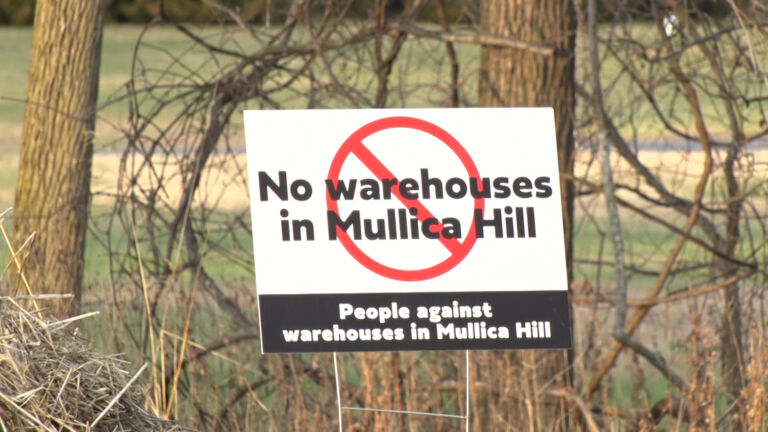
The report appears to recognize growing public pressure for curbs on warehouse growth in communities such as West Windsor, Mullica Hill and Robbinsville, where residents face plans for millions of square feet in new warehouses that are often approved by local officials who welcome the boost to tax revenues that the major developments offer, and fear lawsuits in response to any denial.

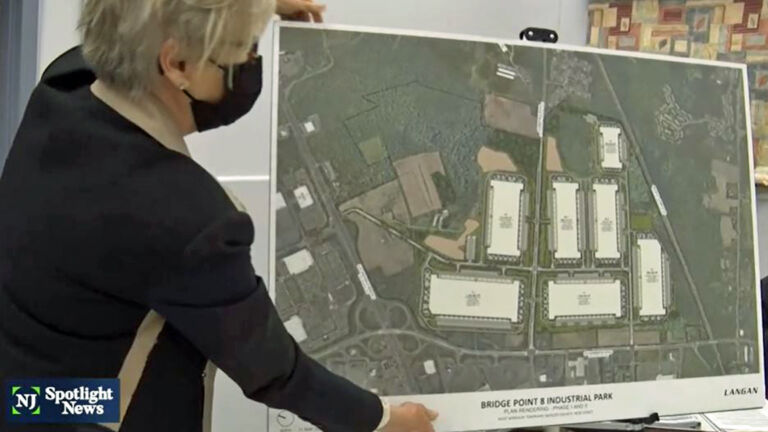
In West Windsor, Mercer County, where a developer wants to build seven warehouses covering a total of 5.5 million square feet, resident Kani Ilangovan added his voice to local opponents who argue that the project will violate new state rules on inland flooding, and should be canceled even if that means a loss for the developers.
“Their one-time loss of monies invested in insufficient stormwater management calculations is no real loss when lives can be lost, and when billions in emergency relief funds will be needed in the future with no end in sight,“ Ilangovan wrote in an open letter to officials at the Department of Environmental Protection, which has yet to issue all its permits for the project.
Shifting demand
Still, the Newmark report said demand for warehouse space remained high in the fourth quarter of 2022. Demand was fueled in the second half of the year by the Port of New York and New Jersey overtaking the ports of Los Angeles and Long Beach as the highest-volume U.S. port complex. Newmark attributed the shift to worries by the shipping community about labor disputes at the West Coast ports, and a consequent shift to the New York/New Jersey center.
For the industrial sector as a whole — which includes warehouses plus two smaller categories of commercial real estate — the vacancy rate in the fourth quarter of last year edged up to 2.8% from 2.6% in the previous quarter, but was below 3.1% a year earlier. The average asking rent also increased slightly to $13.25 a square foot, more than $2 higher than in the fourth quarter of 2021.
The total area under construction was some 9.4 million square feet, of which 9.1 million square footage was in the warehouse sector. Six of the 10 biggest leases were for warehouses, totaling about 3.1 million square feet.
In northern New Jersey, the most industrial construction took place in the Hudson Waterfront sub-market. In central Jersey, the busiest section was at Exit 12 on the New Jersey Turnpike — where some 2.4 million square feet were under construction, the report said.
Their one-time loss of monies invested in insufficient stormwater management calculations is no real loss when lives can be lost, and when billions in emergency relief funds will be needed in the future with no end in sight.’ — Mercer county resident Kani Ilangovan
Since before the pandemic, demand for warehousing has been fueled by online shopping, creating a need for more space to store and distribute a flood of consumer goods for delivery to private homes. Although e-commerce demand is trending downward, its growth in 2023 is projected to be 5% higher than before the pandemic, the report said.
Despite national concerns about inflation, the consumer price index for the northeast region stood at 5.9% in the fourth quarter, down from 6.7% in the second quarter and below the national rate of 7.1%.
In South Jersey, too, demand for industrial real estate remains strong, according to a separate Newmark report for the Philadelphia market.
The lowest vacancy rate among the four South Jersey counties was in Salem County, where there was no warehouse space available in the fourth quarter.
The South Jersey-Philadelphia industrial market is helped by its position at the heart of the populous northeast, said research analyst Trae Hoffner of Newmark.
“Demand is still very strong in our market despite macroeconomic headwinds. Proximity to the end user remains key for distributors, which makes this market highly desirable given that the entire northeast megalopolis is within a day’s drive,“ he said.
Jon Hurdle discusses warehouse development in New Jersey