Credit: (Health Professionals and Allied Employees)
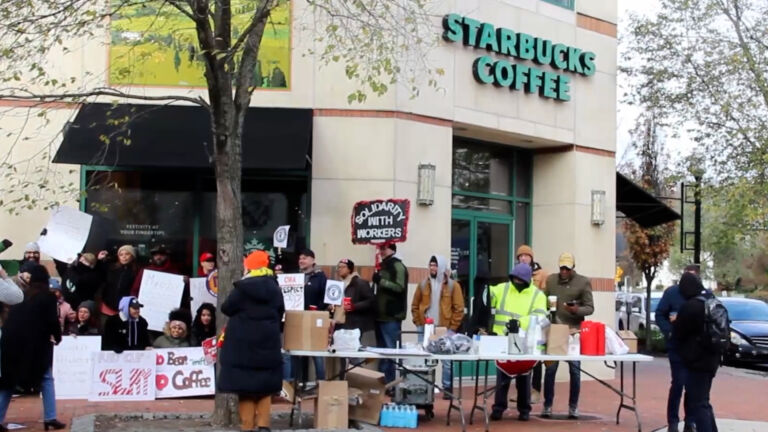
From Starbucks employees, to railroad workers, to the staff at The New York Times, workers everywhere are demanding their employers treat them humanely. In the case of nurses in New Jersey’s hospitals, workers said they felt like executives were putting profits over patient care and worker health.
During the height of COVID-19 exposure, New Jersey turned the “actual running of the pandemic” to hospitals, said Debbie White, president of the Health Professionals and Allied Employees (HPAE) union. Executives working from home dictated how hospitals should staff shifts, manage hospital beds and more. It was a hard pill for nurses, doctors and other hospital staff to swallow, White said, while they made critical decisions about who could be on a ventilator and who would be left to die — all as they were being exposed to the coronavirus.
‘And so it becomes this whole question about the relationship between the government and labor and capital.’ — Tamara Lee, assistant professor at the Rutgers School of Management and Labor Relations
“The employers didn’t even want to admit that [health care workers] were exposed [to COVID-19] in the workplace. So there’s a lot that has happened during the pandemic that exposed the conditions of the work environment,” White said. “What has happened as a result is that we have a very stressed-out, burned-out workforce.”
White said hospitals appear to only care about “maximizing profits.” Nurses and other health care workers have responded by striking or leaving the workforce — about a third of nurses have left in the last three years, according to a September HPAE survey.

The New Jersey Hospital Association declined to comment on the specifics raised by the nursing union. Each situation is unique to every hospital and its union contract, an association representative said Wednesday.
There’s a chasm, workers and labor experts say, between how employees want to be treated and how companies treat them. Workers across industries say executives treat them inhumanely with low wages, little to no benefits and little regard for their health and safety. And now they’re fighting for their employers to value them — not just the bottom line.
Imbalance of power
Patricia Campos-Medina, the executive director of the Worker Institute at ILR-Cornell University, explained that’s due to a shift “in this moment, in which workers realize their own power” and are asking to be treated humanely.
“Look at the railroad [workers]. The real strike is not just about wages, it’s about their ability to take a day off. And the ability to have paid sick leave … and the ability to know what your schedule is, so that … you can have time with your family. For basic things,” said Campos-Medina.
Workers across industries became fed up with working while sick, not being able to know if they would have a job the following day or not having basic benefits. And they have become increasingly frustrated with corporations making record profits while keeping the money to themselves.
‘There’s a lot of very strong rhetoric about commitment to the ‘beloved community,’ but the reality doesn’t match that.’ — Rutgers AAUP-AFT union president and Labor Studies Associate Professor Rebecca Givan
“[They are] demanding a little bit more investment back from the corporation, to also not just plan for the profits of the end of the year to be given to the shareholder, but to plan that your profits over the year to be invested back in the business, which means you invest back in your people,” Campos-Medina said.
Tamara Lee, assistant professor at the Rutgers School of Management and Labor Relations, says that the “worksite is becoming a place for political advocacy.” Injustices in the workplace are directly related to systemic and structural racial injustices experienced by Black, Indigenous and people of color for centuries, she said.
“If you have a Black worker who’s been feeling some kind of way in the years that have passed since the uprisings about George Floyd, they will be looking at their working subordination in the context of their broader subordination,” she said.

Lee said America is at a “convergence of critical junctures.” COVID-19 exposed the imbalance of power between workers and employers, as well as long-standing racial inequities society-wide. Lee saw this at her own school, Rutgers University. Faculty and staff are striking with their union, Rutgers AAUP-AFT, for living wages, better work benefits, safer working conditions and racial and gender equity.
In Lee’s case, she said she saw racial inequity in how the school decided to “freeze the tenure clock” for COVID-19 — that is, increase the time it would take for a professor to be considered for tenure.
“That made me think as a Black tenure-track faculty member, oh, you can pause it for COVID, but you can’t pause it for racial inequality?” she said.
Addressing how systemic racism impacts Rutgers’s workplace decisions is one part of the labor organizing picture. The union is also fighting for living wages for graduate school workers, who might not be able to make ends meet while studying and working for the school. They’re also asking for better benefits and job security.
Community care
Rutgers AAUP-AFT union president and Labor Studies Associate Professor Rebecca Givan said that companies across industries may brand themselves as “progressive” and caring about their employees. But not giving them basic benefits like parental leave or not paying them a living wage says otherwise, she said. She said she feels this way about her employer, Rutgers University.
“There’s a lot of very strong rhetoric about commitment to the ‘beloved community,’ but the reality doesn’t match that. So even on basic issues like parental leave, we have to fight tooth and nail to get people to have actual parental leave when they don’t have any,” Givan said.
Givan said the school has “not responded or has rejected all of our key proposals” but meets with her union weekly. She is concerned that the school is disciplining members of faculty who are involved in union organizing. NJ Spotlight News reached out to Rutgers University for comment but has not heard back.
In early December, the university told NJ Spotlight News in a statement, “We continue to negotiate in good faith and on a regular basis with Rutgers’ unions. All mandatorily negotiable issues related to those employee contracts will be discussed at the negotiating table with the appropriate bargaining team representatives from the administration and the unions.”
Ultimately, state and federal governments need to make it a policy priority to regulate corporations by strengthening labor rights and protections, Campos-Medina said.
Lee added it’s a critical moment for the state and federal governments to see “which side” they will help “increase bargaining power.”
“Why is it OK for Amazon or Starbucks to openly defy the National Labor Relations Board and still turn profits?” she said, referencing claims of employers union busting. “…And so it becomes this whole question about the relationship between the government and labor and capital.”